Influencer Campaign Timeline From Outreach to Live Post
Scheduling discipline matters more than strategy when influencer campaigns slip.
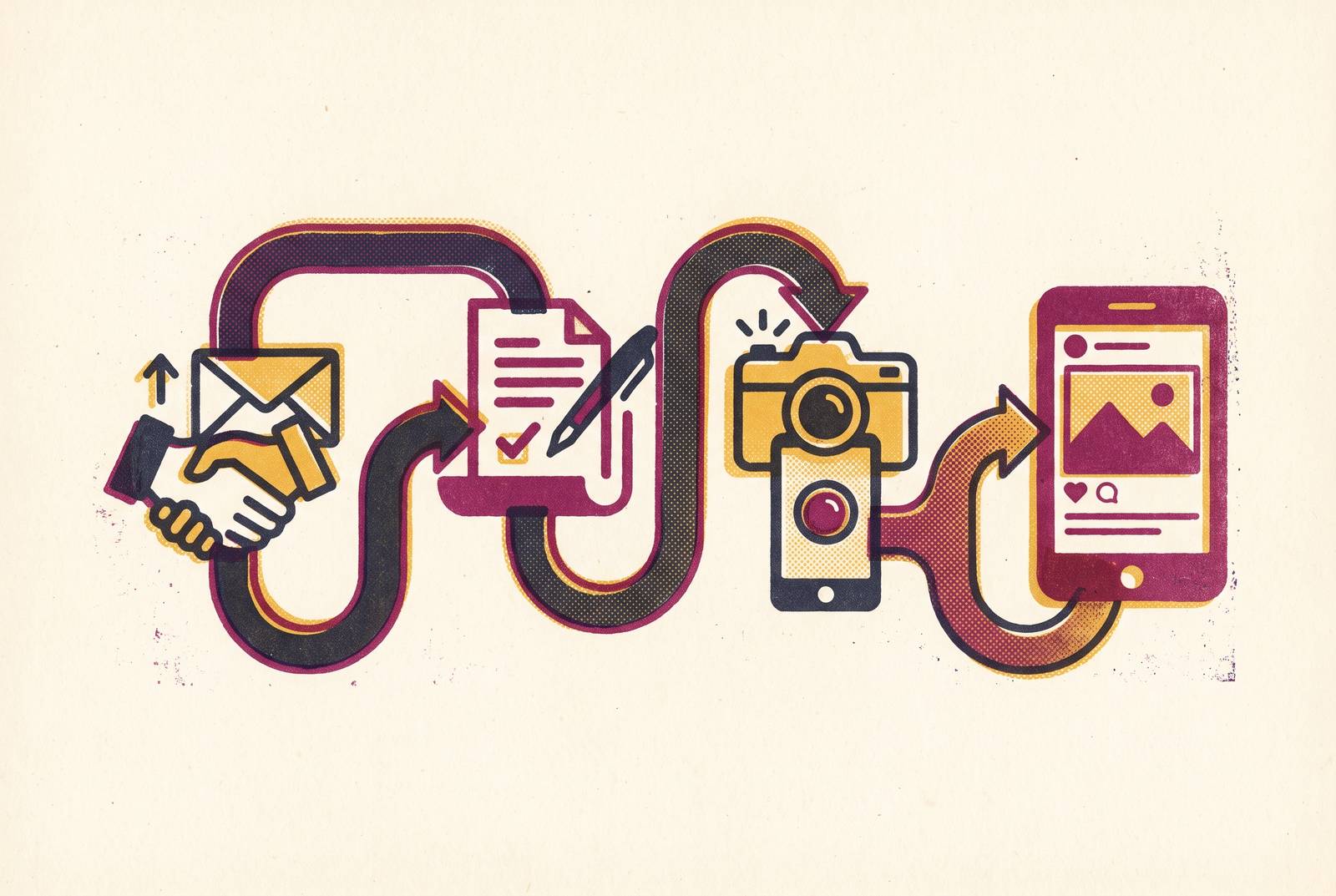
An influencer campaign fails or succeeds on its schedule, not its strategy. Most brands nail the concept and still ship late, because nobody maps the actual work behind a launch date. Content arrives at the last minute, approvals stack up unreviewed, and the whole thing either ships in a rush or slips a month past when it mattered.
A campaign runs as a chain of dependent phases. Each phase waits on the one before it: you can't brief a creator you haven't vetted, and you can't approve content that hasn't been made yet. That dependency structure is the reason timelines break down in predictable places, and why the fix is scheduling discipline, not a better pitch deck.
IQFluence ran 11 client timelines through a standard framework in the first quarter of 2026. The shortest hit live in four weeks. The longest took fourteen. That thirteen-week gap between best and worst case isn't random variance, it maps directly onto how well each phase got planned before work started. The data also pointed at something specific: timelines rarely slip during creator sourcing. They slip on unclear claim boundaries, missing approval owners, late review cycles, and briefs that leave too much open to interpretation.
The stakes are getting bigger, not smaller. The influencer marketing industry is projected to grow from $32.55 billion to $40.51 billion between 2025 and 2026. At that scale, an operational failure isn't a minor scheduling headache, it's a real cost line.
How long a campaign takes: realistic ranges before the phase breakdown begins
Flinque's guide puts a structured, end-to-end campaign at roughly six to twelve weeks. A simple, single-creator push compresses toward the shorter end. A multi-creator program with heavy production work stretches toward the longer one. Influee's 2026 strategy guide puts a typical paid partnership at four to six weeks from first outreach to a published post, and influencer.vip's 2026 roadmap notes that most high-performing brands settle on an eight-week framework as the sweet spot between creative quality and operational speed.
Length also depends heavily on campaign type. A short-term push, a product launch, a seasonal promo, a limited-time offer, runs two to six weeks. Long-term work, thought leadership or positioning in a crowded market, needs three to six months at minimum. Ambassador programs don't really have a "timeline" in the traditional sense; they run in quarterly cycles instead. IQFluence's data adds useful context here too: 75% of B2B buyers take up to four months to reach a final purchasing decision, so a long sales cycle isn't the brand being slow, it's the buyer.
Mifu's guide notes that many teams still run all of this fragmented: the brief lives in one document, creator research sits in a spreadsheet, outreach happens over email, contracts get buried in folders, and posting dates get chased down in Slack. That fragmentation is a timeline risk on its own, separate from anything that happens inside any individual phase. Four weeks is achievable under close-to-ideal conditions. Fourteen weeks is a documented, real outcome when the upstream phases weren't prepared properly.
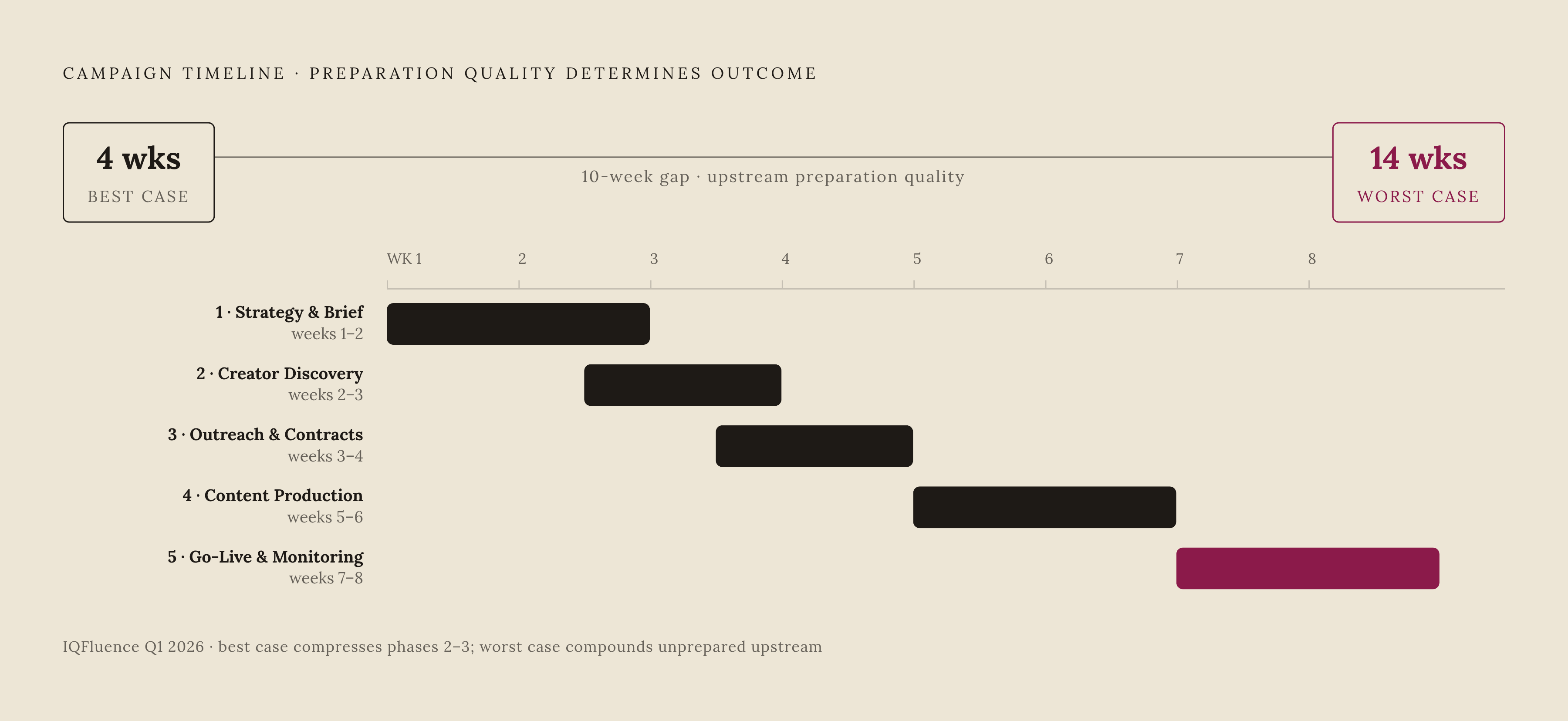
Phase 1: Strategy and brief (weeks 1 to 2, or 4 to 6 weeks pre-launch)
Pre-launch prep starts four to six weeks before the date content actually needs to publish. Influenceflow's complete guide describes that window as covering defining objectives and budget, writing a detailed brief, and starting to identify and vet influencer candidates.
A brief that actually holds up needs a campaign goal tied to a real business outcome, whether that's awareness, consideration, or conversion, plus a clear definition of the target audience and the platform and content format required. FTC disclosure language must be spelled out explicitly in the brief, the exact wording, placement, and format required on each platform. It needs a defined approval workflow with timelines and revision caps built in, and KPIs set before any clock starts running.
Platform choice changes the math here too. Influencer.vip's roadmap notes that YouTube integrations demand heavy research and editing time upfront, while TikTok content runs on speed and trend timing. Campaign type shapes the production model on top of that: a product launch usually wants a synchronized hard launch, where every creator posts inside the same tight window, while a brand awareness push benefits more from a staggered rollout that builds over several weeks.
The most common failure point in this phase is a brief that leaves too much room for interpretation. IQFluence's Q1 2026 data showed that when ambiguity in the brief got resolved before outreach even started, timelines stayed tight. When that same ambiguity appeared after a creator had already drafted content, every small edit turned into another full review loop. influencer.vip's guide calls this the Golden Rule: add a 20% buffer to every phase. If a production window is ten days, the internal deadline should be twelve.
Phase 2: Creator discovery and vetting (weeks 2 to 3)
Discovery is where a lot of timelines fail first, quietly. Influencer.vip's roadmap puts manual sourcing at typically eating about 14 days of schedule time, while a marketplace with data-backed creator profiles can compress that same work down to roughly 48 hours.
Vetting itself isn't one task, it's several. Audience authenticity checks come first, since fake or bot followers remain the top concern for marketers, flagged by around 57% of them in Influencer Marketing Hub's 2026 benchmark. Content quality and relevance get assessed next, followed by how much the creator's audience actually overlaps with the brand's real customer base, and engagement rate relative to follower count. Kuli's agency guide notes that a creator with 50,000 followers can genuinely outperform one with 500,000, depending entirely on content quality and niche fit, particularly given how algorithmic distribution works across platforms.
Skipping real vetting has a cost that shows up later. Kuli's guide finds agencies burn 15 to 20 hours per campaign on manual creator research, and 40% of selected influencers still underperform anyway. That's the argument for automated creator matching, which one industry benchmark survey (cited via a marketing platform) found is the single biggest 2026 priority for marketers, at 26.89%, ahead of every other use case named.
Flinque's guide notes that manual, one-profile-at-a-time vetting can eat a full two weeks before a single post exists, but it's also a phase where investing in better tooling and data can meaningfully compress the timeline. It should never be the phase teams cut to save time: the downstream risk, fraud, brand safety incidents, plain underperformance, costs far more schedule than the shortcut ever saves. For regulated categories like healthcare or financial services, clinical claim checks and compliance pre-screening belong here too, not after a draft already exists. For regulated categories, this pre-screening step is where schedule slippage most often originates.
Phase 3: Outreach, negotiation, and contracts (weeks 3 to 4, but start 6 to 8 weeks before the needed publish date)
ScaleGrowth's outreach guide says outreach needs to start six to eight weeks before the actual publish date, because the full chain, initial contact, negotiation, briefing, creation, review, and publishing, simply takes that long to run end to end.
Response mechanics affect how many replies a brand gets and when. ScaleGrowth's guide finds between 40% and 60% of positive responses come from the follow-up email, not the first one sent. Timing plays a role too: outreach sent Tuesday through Thursday, between 2 and 4 PM in the creator's own timezone, performs best, while Mondays (inbox overload from the weekend) and Fridays (creators already checked out) underperform. Influencer Marketing Hub's 2025 research, cited in Influenceflow's 2026 guide, finds personalized outreach gets a response 3 to 5 times more often than generic outreach, and a 2026 Statista survey cited in the same guide finds 72% of creators say they've turned down a partnership purely because the outreach itself was poorly done.
influencer.vip's roadmap suggests a simple rule: if a creator hasn't responded within 72 hours, move on to the next candidate. Momentum is a scheduling asset, not just a nice-to-have.
Contracts have gotten more complicated. Payment terms need to be explicit, since Influenceflow's compliance guide reports that 38% of creators have experienced late payments. Contracts in 2026 increasingly need to address emerging content formats and evolving disclosure expectations. Usage rights, revision limits, and exclusivity windows all need to be spelled out, and FTC disclosure requirements belong in the contract itself, not left dangling in the brief where nobody's legally bound to follow it.
The compliance risk here is not abstract. A 2026 report cited in LegalLens's guide finds 43% of influencer campaigns face compliance issues, and in 2025, major brands paid over $100 million combined in penalties tied to influencer violations. The 2026 enforcement environment is described as more aggressive than any prior year. influencer.vip's roadmap puts FTC fines at $53,088 per violation, which makes contract compliance language a scheduling requirement, not a legal afterthought squeezed in at the end. Mifu's guide finds teams working with UK or EU creators face an added wrinkle: 60% of execution time gets lost to logistics bottlenecks in vetting and performance tracking following the post-2025 GDPR updates. And on negotiation generally: A short window doesn't just stress the schedule, it can also affect the quality of creators willing to participate.
Phase 4: Content production and brand approval (weeks 5 to 6, with approval deadlines set 2 to 3 weeks before launch)
Content production and approval is widely regarded as the longest phase in a campaign and the one most likely to run over. Approval deadlines should be set two to three weeks ahead of a product launch to absorb revision cycles without threatening the publish date.
influencer.vip's roadmap recommends a two-stage approval protocol. Stage one checks raw footage: confirming brand safety requirements and key messages are present before full editing even begins. Stage two reviews the finished edit for overall brand alignment and platform fit. Catching a problem at stage one avoids a full reshoot after the brand's already sunk real production investment into a finished piece.
Influenceflow's guide finds that optimized approval workflows cut content approval time by 30% to 50%, letting brands react faster to trends instead of publishing something already stale. What slows approvals down, consistently: no named approval owner, so review turns into ping-pong between departments with nobody actually empowered to say yes; revision rounds that weren't capped in the brief, where every surprise round adds meaningful delay; and briefs that left too much room for creative interpretation, so the creator's draft is technically compliant but the brand doesn't recognize its own message in it.
influencer.vip's 20% buffer rule applies most heavily right here, since this phase is where that buffer usually gets fully consumed. Revision limits need to be locked into the contract back in Phase 3, not introduced for the first time during approval, since retroactive limits just create friction with the creator and slow everything down further. And platform matters again: YouTube integrations need meaningfully more editing time than TikTok or Instagram Reels, so per-creator deadlines should reflect that rather than running off one blanket production window for everyone.
Phase 5: Go-live, monitoring, and the post-launch window (weeks 7 to 8)
Every creator engagement moves through the same sequence toward completion: discovery, vetting, outreach, negotiation, contracting, briefing, product shipment, deadline setting, content submission, approval, live posting, metric collection, ROI calculation, and client reporting.
Launch format follows straight from the goal set back in Phase 1. A product launch wants a synchronized hard launch, all creators posting inside a defined window to dominate the feed at once. Brand awareness work wants a staggered posting schedule that builds momentum gradually over several weeks instead.
Fulfillment tracking software gets used by 67% of marketers, and it improves campaign results by roughly three times on average, per a HubSpot study cited in Influenceflow's 2026 fulfillment guide. During the live period itself, three things need active monitoring: disclosure compliance (confirming each post carries the right FTC language, in the right placement, in the right format), posting confirmation (verifying each creator actually published within the contracted window), and early engagement signals, so an underperforming post can get flagged fast enough to still act on it, whether that's paid amplification or a reshare push.
Reporting happens one to two weeks after the live window closes, per Flinque's guide: pulling results, attributing outcomes, documenting what worked and what didn't. Skipping this step means walking into the next campaign with the same scheduling mistakes intact. A common error is treating the live post as the finish line, stopping monitoring right there, and losing the very data that would've made the next timeline tighter. Reporting is a scheduling commitment in its own right, carrying the same weight as the work that precedes it.
The three bottlenecks that silently eat the most schedule time across every phase
Flinque's 2026 guide identifies three things that quietly consume timeline across every single phase, often without anyone noticing until the launch date is already at risk.
The first is ambiguity that survives past the brief. A goal, a claim, or a creative direction that sounds clear in a strategy meeting but reads three different ways to three different people, an approver, a legal reviewer, a creator, doesn't cost time when it's written. It costs time later, in every review cycle it touches.
The second is the missing named decision-maker. Approval workflows fail less often because of taste disagreements and more often because nobody was ever formally handed the authority to say "this is approved, ship it." Without that person, review becomes a forwarding chain instead of a decision.
The third is treating buffer time as optional rather than structural. The 20% rule from influencer.vip isn't padding for comfort, it's an acknowledgment that creative work, legal review, and creator schedules don't run on exact math. Campaigns that build the buffer in from Phase 1 tend to land inside their original window. Campaigns that treat the ideal-case timeline as the real one are the ones that show up in a dataset like IQFluence's, sitting out at week fourteen instead of week four.
Sources
- What’s the ideal timeline for influencer marketing campaigns?
- Influencer Marketing: The Complete Strategy Guide for Brands in 2026
- Influencer Marketing Campaigns: The Ultimate 2026 Guide
- Timeline for Influencer Marketing Campaigns | Flinque
- Influencer Campaign Timeline Example: The 2026 Strategic Roadmap for Brands
- Automated Influencer Outreach Tools + Best Practices 2026
- How to Do Influencer Outreach (2026 Guide) - Scale Growth Digital
- influenceflow.io