Managing Multiple Creator Deliverables Across a Single Campaign
A tracker and workflow system stop multi-creator campaigns from collapsing under coordination chaos.

Most brands don't fail at multi-creator campaigns because they picked the wrong influencer. They fail because a deliverable slipped through email, an exclusivity window quietly overlapped with a second campaign, or a usage-rights clause expired while someone was still running the ad. Multi-creator campaigns are now the norm: 78% of successful campaigns rely on multiple creators sharing the brief. That shift changes what a campaign actually requires to run well. Once a brand moves past its first campaign, the hard part becomes coordination rather than creator selection, because coordination at scale is a systems problem, not a scheduling inconvenience. A single source of truth, a defined approval workflow, usage-rights tracking, and exclusivity mapping are the four systems that separate the teams that scale cleanly from the ones that scramble.
What a single source of truth contains, and why it has to cover more than deadlines
One tracker, one row per deliverable. That's the whole principle, and it holds because information sitting in someone's inbox is information that gets missed. A reply buried under forty other emails doesn't stop a campaign from being live, it just means nobody catches the problem until a post goes out without the right disclosure or a payment gets triggered twice.
The fields that matter aren't complicated, but they're the ones teams skip when they're moving fast, and they're exactly the ones that cause the damage when they drift. Start with the basics: creator, campaign, platform, and deliverable, so everyone knows what was booked, from whom, and where it's running. Then three dates, not one: draft due, approval due, and publish date. Campaigns don't usually slip on the publish date itself, they slip in the gap between draft and approval, where a piece of content sits waiting for someone to look at it.
Approval status needs a visible stage label instead of a vague "in progress."" Draft received, in review, revisions requested, approved: four words that tell anyone glancing at the tracker exactly where things stand. Adding the usage-rights window (organic repost, paid ads, or both, with a start and end date) and the exclusivity term (category, window start, window end) completes the record. Round it out with fee, payment status, and a disclosure check, confirming whether the post carried the correct ad label.
A spreadsheet handles this fine for a first campaign. Filling every field, every time, for every creator is what keeps the deliverable, the approval stage, and the payment status tied to a single record as the roster grows. But once the roster grows past a handful of names, a spreadsheet starts to strain, and a platform that ties the deliverable, the approval stage, and the payment status to a single record keeps those fields from drifting apart. The tracker is a live document the whole team reads from. It's a live document the whole team reads from, and it stops working the moment one person routes an approval through email instead of updating the row.
The approval workflow: how to stop a slow reviewer from breaking a creator's publish date
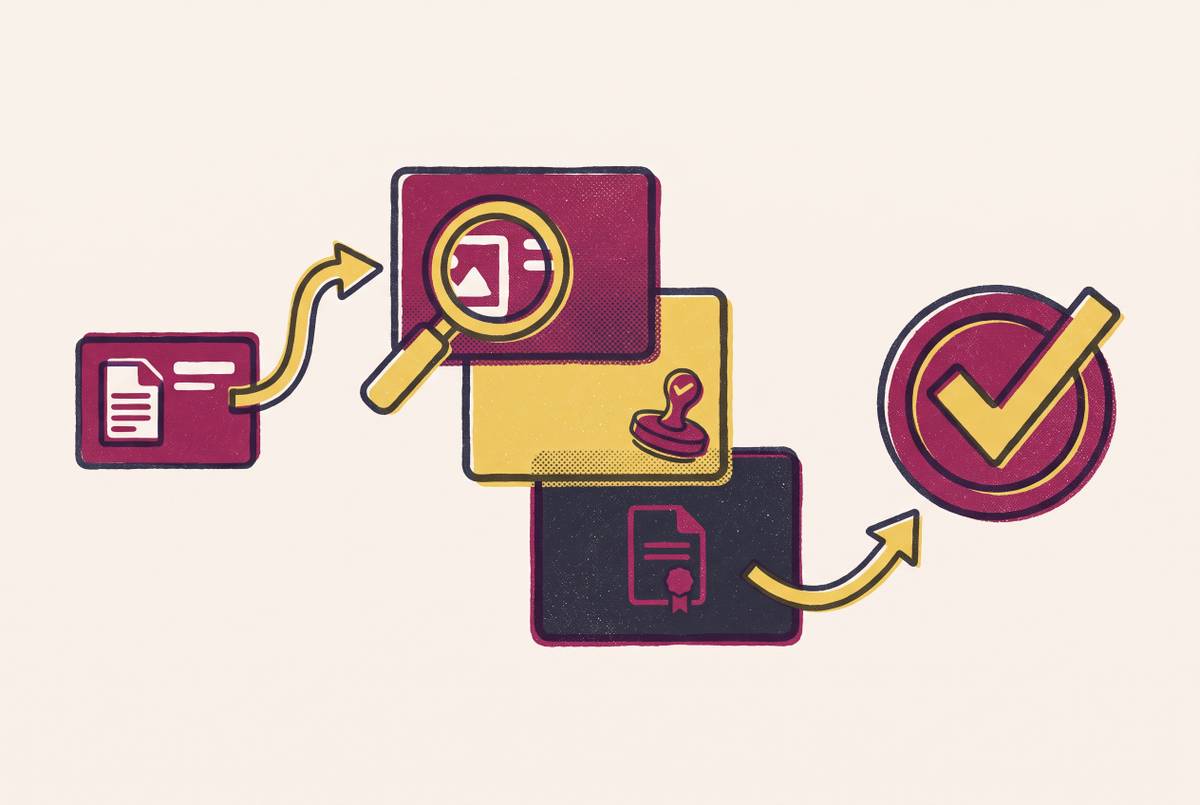
A deliverable moves through a defined sequence: Pending, Submitted, Under Review, Revision Requested, Approved, Published, Archived. Each step is a handoff between people, and handoffs without clear ownership are where campaigns stall, not at the creative stage, not at the shoot, but in the silence after a draft lands in someone's inbox and nobody says anything for four days.
Check progress at fixed points rather than waiting for problems to surface on their own: divide the campaign timeline into regular intervals and review at each one. For anything running longer than four weeks, weekly check-ins are the floor, not the ceiling.
The risk compounds at scale in a specific way. A creative strategist managing approvals across several client accounts at once ends up buried in ad-hoc review requests, each one arriving without warning, each one competing for the same hour of attention. Pre-approved brief templates that route content automatically to the correct brand approver cut that volume down substantially, because the routing decision gets made once, at setup, instead of every single time a draft comes in.
The real fix for a slow reviewer is a default-approve clock. Define upfront how many rounds of revision are included in the contract and what happens if a reviewer doesn't respond inside the agreed window. Silence should not be a possible outcome. A creator who delivered on time and met the brief should never be the one absorbing the cost of someone else's inbox backlog.
Usage rights and exclusivity: the two terms that quietly expire and collide at scale
These are the two terms brands lose track of most often once a roster grows past a few creators, and they're also the two with the largest financial consequences when they lapse or collide.
Usage rights and exclusivity aren't the same thing, even though contracts sometimes blur them together. Usage rights govern the brand's right to reuse a creator's content, priced by duration and scope, and they determine what a brand can legally do with the file itself: repost it organically, run it as a paid ad, or both. Exclusivity governs the creator's side of the relationship: a window during which that creator agrees not to promote a competing brand, priced by length and by category.
Both expire. Both overlap across parallel campaigns running at the same time. And both need to live in the tracker that gets checked weekly, not in the contract PDF that gets signed once and never opened again. A campaign that keeps running a paid ad past the usage-rights end date, or books a creator into a competing category before an exclusivity window closes, is committing a predictable, common mistake. It's the predictable outcome of tracking these terms nowhere except a static document.
The pricing stakes are real enough to justify the tracking effort. Thirty-day category exclusivity typically runs 15 to 30% of total deal value; a 90-day window runs 25 to 50%. These structural costs shape whether a campaign's economics work.
Creator tier selection and the coordination burden before a campaign begins
Tier choice isn't just a budget decision, it's a decision about how much coordination the campaign is signing up for before a single brief goes out. Micro-influencers, generally in the 10,000 to 100,000 follower range, tend to land 3 to 5% engagement. Macro-influencers above 500,000 followers average closer to 1 to 2%. Micro-influencers generate engagement rates roughly 60% higher than mega-influencers, but mega-influencers still win on raw brand awareness. The strongest rosters use both tiers for different jobs rather than picking one.
Micro and nano-influencers mean higher volume, simpler contracts, faster approval turnarounds, and lower exclusivity premiums, but also more rows in the tracker to manage. Micro and nano-influencers mean higher volume, simpler contracts, faster approval turnarounds, and lower exclusivity premiums, but also more rows in the tracker to manage. Macro and mega-influencers mean fewer names on the roster, but each one carries a heavier contract, a longer approval cycle, and a bigger exclusivity stake if something goes wrong.
For campaigns built around conversion, the structural logic follows the funnel: macro-influencers drive top-of-funnel awareness, micro-influencers handle mid-funnel engagement and the push toward conversion. That mix isn't just a creative decision, it determines the approval routing and the payment cadence, and both of those need to be built into the workflow before the first brief goes out, not retrofitted once the campaign is already live.
Where agency portfolio operations diverge from single-brand campaign management
Before building a shared workflow across a portfolio, one question decides everything else: are these brands designed to work together, or independently? The answer changes the editorial calendar, the voice guidelines, the approval routing logic, and even how success gets measured across the portfolio.
Most agency workflows are built for a single brand with a single voice. That's fine until a portfolio of five brands lands on the same desk, at which point those single-brand workflows either collapse under the weight or get duplicated five separate times, inefficiently, with five separate trackers that don't talk to each other.
Centralizing the operation pays off in a way that compounds. When one brand in a portfolio finds a hook format or a creator that clearly outperforms, that intelligence becomes available immediately for briefing creators on other brands in the same portfolio. Each brand stops re-learning the same lessons independently through its own testing spend, which is money and time that a shared system gets back.
SPH Media runs campaigns across more than 40 media brands inside a single platform, using work management software from monday.com. That's not a case study offered as inspiration, it's evidence that managing dozens of brands through one operational system is a solved infrastructure problem, not a theoretical one.
AI visibility as part of the creator campaign brief
AI chatbot referral traffic grew 357% year over year, reaching 1.1 billion referral visits in June 2025. Creator content that surfaces inside an AI-generated answer is now a real distribution channel, and campaign briefs need to start treating it that way.
The gap between ranking well on Google and getting cited by an AI system is wider than most brands assume. Ahrefs' Brand Radar study, run across 15,000 prompts, found only 12% overlap between AI citations and Google's top 10 results, with the overall average across engines including Bing landing at 11%. ChatGPT showed just 8% overlap with Google's and Bing's top results, according to Ahrefs Brand Radar. Ranking on page one of search no longer means a brand shows up when someone asks an AI system the same question.
For multi-creator campaigns, the practical implication is straightforward: content that earns mentions across a wide spread of publications and platforms, beyond a brand's own channels, is more likely to get picked up in an AI-generated response. Distributing creator content broadly used to be a reach strategy. Now it's also an AI visibility strategy, and the two goals point in the same direction. That matters more each quarter: 25% of traditional search volume is projected to shift to AI-native discovery by the end of 2026. The audience finding brands through AI answers is heading toward a large share of total discovery, not a fringe case.
Building the operational system: what to put in place before the first creator brief goes out
Four systems need to be running before the first brief leaves the building, not bolted on after the first missed deadline. The tracker comes first: every field in place, creator, campaign, platform, deliverable, all three dates, approval status, usage-rights window, exclusivity term, fee, payment status, and the disclosure check. Second, the approval workflow needs stages defined, revision rounds capped, a default-approve clock set, and routing logic confirmed, especially in a multi-brand environment where ad-hoc requests pile up fast. Third, the usage-rights tracker, living in the same active document as everything else, not buried in a contract PDF nobody reopens. Fourth, the exclusivity map, cross-referenced across every active campaign so a conflict gets caught before it happens, not after a creator has already posted for two brands in the same category.
The contract itself needs the same rigor before anyone signs it: deliverables, timeline, revision rounds, payment terms with a holdback, rights scope and duration, exclusivity category and window, disclosure requirements under FTC, ASA, or EU rules depending on jurisdiction, and a dispute resolution clause. None of these are optional line items to fill in later.
Schedule the milestone cadence at kickoff, not after the first delay: regular interval check-ins across the campaign timeline, with a weekly sync built in for anything running longer than four weeks.
For agencies specifically, three questions need answers before the campaign starts: which clients have platform access, what billing structure applies, and what the reporting cadence looks like. Getting clarity on those points upfront is what separates the agencies that keep their accounts at renewal time from the ones scrambling to prove value in a review meeting they weren't ready for.