Influencer Payment Terms and Late Fee Structures
Understanding three payment schedules protects both brands and creators.
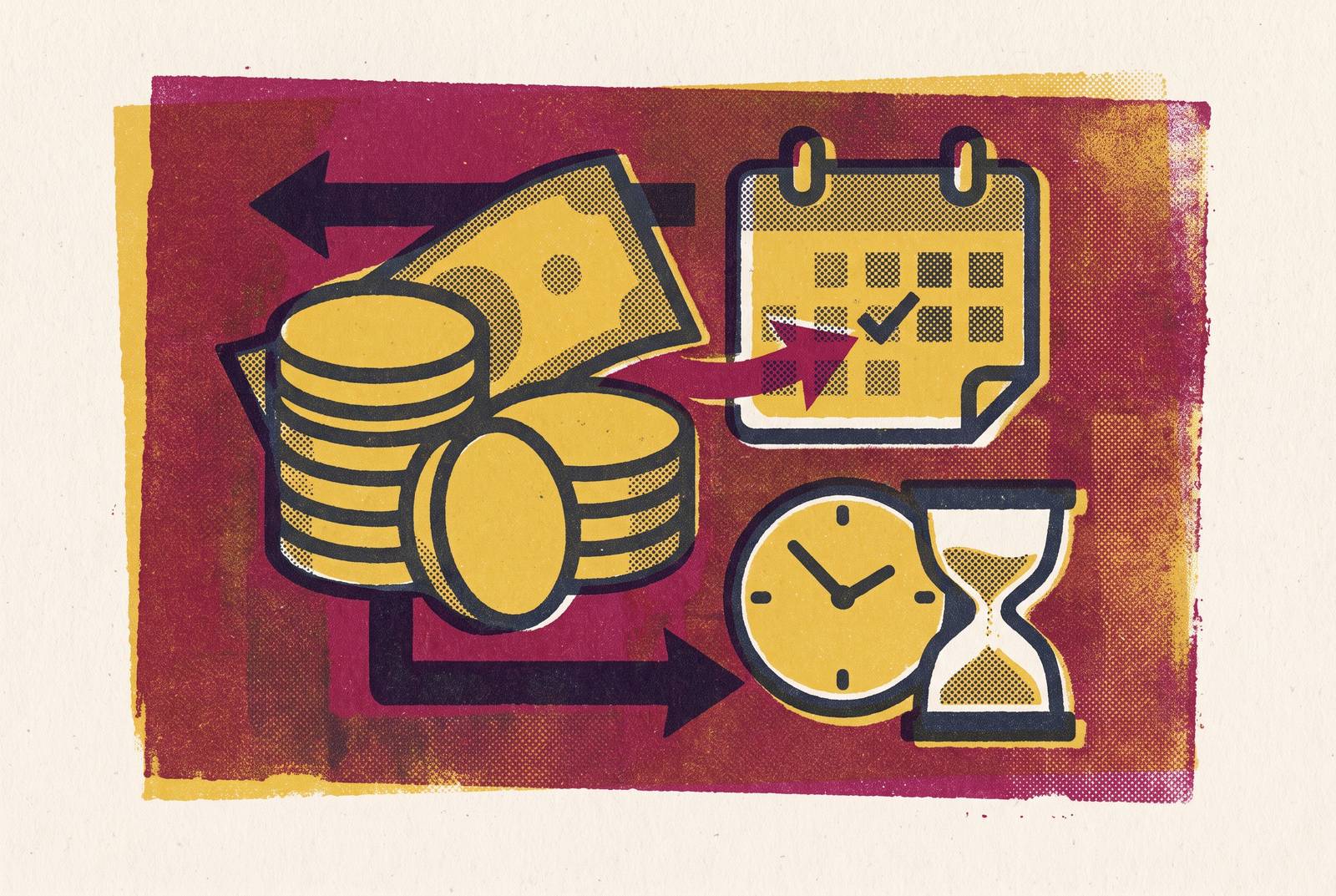
How the three core payment schedules work
Payment terms decide whether an influencer campaign runs clean or collapses into invoice disputes. The schedule, the deposit split, the late fee clause are the operational core of the deal. They're the operational core of the deal, and brands that treat them as an afterthought end up losing creators mid-campaign or paying legal fees to settle what a clearer contract would've prevented.
Three schedules dominate creator contracts right now: the 50/50 split, Net-30, and milestone-based payments. Pick one for internal convenience without explaining the logic to the creator, and you've already set up the dispute that follows. Each schedule signals something different about who's carrying the risk, and that signal shapes whether the creator agrees to the terms or disputes them later.
The 50/50 split pays half at signing and half when the post goes live. It's the working default for most direct brand-to-creator deals, especially with macro creators who set their own terms. The upfront half covers real production costs: editors, props, a location fee, sometimes a small crew. It tells the creator the brand understands they're fronting money before a single frame gets shot. Where it breaks down is cancellation. If a brand kills the deal after seeing a first draft, the creator's already been paid for content that will never see daylight, and that money doesn't usually come back.
Net-30 pays the full invoice 30 days after receipt, or 30 days after the content goes live, depending on how the contract defines the trigger. That single line of wording decides whether the clock starts at receipt or at publish, and vague contracts leave it ambiguous on purpose. Net-30 is common in agency-mediated deals because it matches standard vendor cycles inside accounts payable systems. It signals that the brand's finance calendar takes priority over the creator's calendar, which isn't automatically wrong, but it should be named out loud rather than pretended otherwise. It works fine for creators with steady cash flow. It fails badly for nano and micro creators who can't absorb a multi-month wait on a single invoice. And Net-30 on paper often isn't Net-30 in practice: invoices bounce for missing tax paperwork, wrong purchase order numbers, or currency conversion snags, and every bounce resets the clock. Thirty days can quietly become 90 or 180.
Milestone-based schedules tie payment to specific deliverables, with each payment triggered by a defined stage such as brief approval, draft delivery, and final publication. Some contracts structure this as Net-15/30/45 after invoice approval at each stage. These appear most in higher-value contracts, and they signal that the brand cares about specific outputs rather than one big delivery moment. Both sides need to agree, in writing, what counts as acceptable delivery at each stage. Skip that step and the milestone no longer triggers payment. It triggers a dispute instead.
What flat fees cover
A flat fee usually covers content creation, one round of light revisions, and organic posting to the creator's own channel. Nothing more. Everything past that point lives on a separate line item, and those line items add up fast, faster than most first-time brand negotiators expect.
Paid usage rights are the biggest one: the term and territory for which the brand can run the creator's content in paid ads. Whitelisting arrangements are another, letting the brand run paid media through the creator's own handle rather than its own account. Exclusivity windows, the stretch of time a creator agrees not to work with a competing brand, cost extra too. So do multi-cut edits and bilingual versions of the same asset.
Stack a few of these together, cross-platform bundling, paid-usage rights, an exclusivity clause, and the final quote can shift 20 to 60 percent off the base rate. That's wide enough to blow a campaign budget open if these terms are raised mid-negotiation instead of in the original brief, which is exactly when they tend to occur if nobody forced the conversation earlier.
The payment schedule and the scope of work need to get written together. A Net-30 schedule attached to a flat fee is a completely different agreement than Net-30 attached to a flat fee plus 90 days of usage rights plus an exclusivity window. Treating those as interchangeable is how budgets go sideways.
For agencies juggling a roster of creators, this matters even more. Scope creep on one deal is annoying. Scope creep across twenty deals compounds into a campaign-level budget overrun that's hard to explain to a client. Standardizing what the base rate includes, before negotiations start, makes spend predictable and cuts out the monthly scramble to explain variance.
Why late payment persists
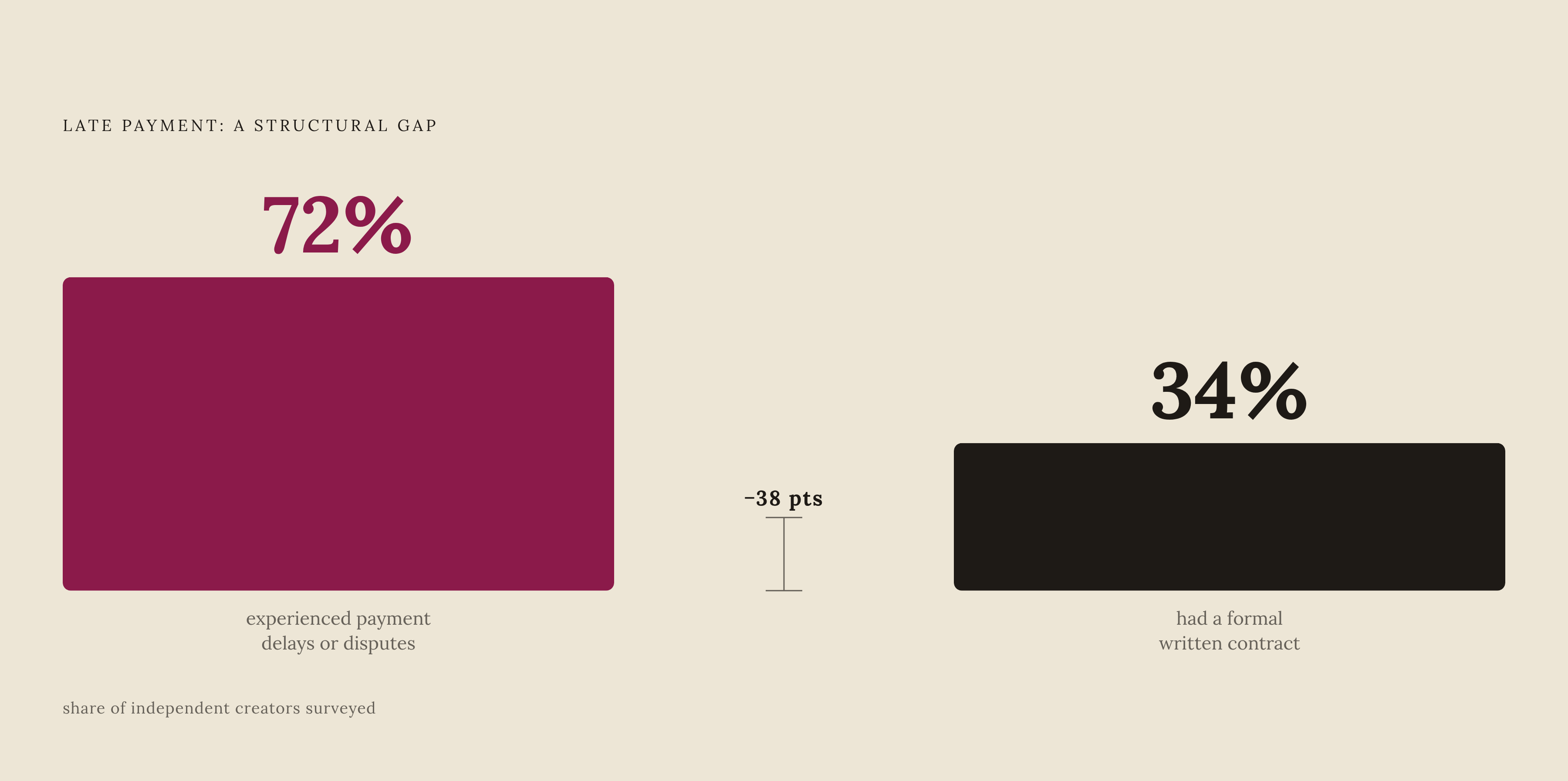
Late payment is close to the median experience. It's close to the median experience, and the data backs that up without much room for debate. The Creator Economy Report found that 43% of influencers experienced payment delays exceeding 30 days, and 41% named payment delays as the single biggest pain point in working with brands. The Influencer Marketing Hub puts the number even higher: 72% of creators reported payment delays or disputes, while only 34% had a formal written contract in place.
That gap between the disputes and the contracts is the actual root cause. Without a written contract defining the trigger, the due date, and the penalty, late payment is the structurally expected outcome. It's the structurally expected outcome. Gigapay's Creator Pay Report documents delays routinely stretching to 120 days across the creator economy, and the mechanism behind that number is mundane and bureaucratic rather than malicious: brands with large accounts payable departments run creator invoices through the same queue as every other vendor invoice, and creators, lacking the leverage of a big supplier, get deprioritized. Invoices bounce for missing tax documentation, wrong purchase order numbers, currency conversion mismatches, and every bounce restarts the clock from zero.
Creator Jazmin Griffith, who has more than 300,000 followers across TikTok and Instagram, described a campaign booked through an influencer marketing platform that took over six months to pay out. Her words: "They expect you to give them their content within a specific time frame. But when it comes to getting paid, I have to wait the net 60 or the net 90. And after that, you really wait another net 30 because you're still having to chase them for your money."
Creator Jayde Powell, with over 10,000 followers on TikTok and Instagram and 17,000 on X, reported that three separate brands missing agreed payment dates caused her to fall behind on a mortgage payment. Late payment is a financial emergency with real downstream consequences for creators running lean. It's a financial emergency with real downstream consequences, and treating it as a minor operational hiccup misreads what's actually at stake for the person on the other end of the invoice.
Gigapay's State of Influencer Payments research, conducted with input from leaders at Billion Dollar Boy, Meltwater, The Influencer Marketing Factory, and Wild, identified payment terms stretching to 120 days as one of the main barriers keeping enterprise brands from working with the nano and micro creators they most wanted to activate. For agencies, the math multiplies. One brand's AP backlog doesn't just hurt one relationship. It becomes a crisis with a creator who's simultaneously running two other agency campaigns and watching all three payments slip at once.
What a well-constructed late fee clause contains
A standard late fee clause charges 1.5% monthly interest on overdue balances, usually written as something like "late payments accrue interest at 1.5 percent per month after the agreed due date," capped around 18% annually. That's the baseline, and it works fine for lower-stakes deals. It is not enough for anyone with real leverage or real money on the table.
For creators with real leverage, or contracts with serious dollar amounts attached, a more aggressive structure makes sense: 5% per 30-day period overdue, the right to pause any ongoing work if payment doesn't arrive within a grace period, and the right to disclose non-payment publicly once a balance passes 90 days late. That last clause sounds harsh until you consider that public disclosure is often the only leverage a creator has against a brand that's simply ignoring invoices.
A lighter version, 1.5% per week after a five-day grace period, gives a brand's finance team a genuine reason to close the loop fast, without demanding the brand rebuild its entire accounts payable process around one creator's contract.
Jayde Powell built her own version: a 10% non-compounding late fee that increases every additional month payment is late. Her assessment, in her own words, is that putting the fee on both the invoice and the contract "almost acts as an incentive to brands to be mindful about paying on time." Creator Joy Ofodu, who has over 375,000 followers across TikTok and Instagram, takes the opposite approach: she skips late fee language entirely and instead requires the brand to start the payment process immediately once content publishes. That's a structural fix rather than a punitive one, and it avoids the fee ever needing to trigger in the first place. Both approaches work. What doesn't work is having no mechanism at all and hoping the brand pays on time out of good faith.
Every production-heavy contract also needs a kill fee: a clause naming the percentage of compensation a creator keeps if the brand cancels after production has already started. Without it, a creator who's booked a studio and paid an editor has no recourse if a brand simply changes its mind.
According to Influencer Advisory's deal log, contracts that specify payment schedules and milestone triggers up front cut post-deal disputes by 60 to 75 percent. The clause itself rarely gets enforced through actual collection. Its real value is deterrence: brands pay on time more often simply because the penalty is written down where everyone can see it.
Invoicing practices that shorten payment cycles before a late fee is ever triggered
Sending an invoice the moment deliverables are complete, instead of batching it into a month-end cycle, cuts payment time by 5 to 10 days. On a Net-30 schedule, that's a meaningful compression, and it costs nothing to implement.
Building in a short correction window before a payment actually processes also prevents expensive reversals. Catching an error before money moves is a lot cheaper than unwinding it after.
The current industry benchmark is processing payment within 5 business days of deliverable approval, with faster turnaround especially important for micro-influencer payments, where cash-flow sensitivity runs highest. Creators have adapted to the uncertainty by asking upfront: is this deal milestone-based, Net-30, Net-15, or partial prepayment? Brands and agencies that can answer that question clearly, without hedging, close contracts faster.
For agencies handling many creator relationships at once, a consistent invoicing workflow is what separates a campaign that closes cleanly from one that drags open invoices for months after the content's already live. That workflow needs standard templates, clearly defined milestone triggers, and a built-in correction window, nothing more exotic than that.
Processor choice matters too, and the differences aren't trivial. Stripe and Bill.com work well for creators operating in the country where they're based. Wise handles international payments better. PayPal is functional, but creator-side fees often run 2 to 3 percent, and every contract should state whether that fee comes out of the creator's rate or gets added on top of the budget. Passing processor fees to the creator silently, without disclosure, is the kind of small thing that erodes trust fast.
The tax and compliance layer that sits on top of every payment term
The One Big Beautiful Bill Act, signed into law in July 2025, raised the reporting threshold for Form 1099-NEC and 1099-MISC from $600 to $2,000, effective for payments made on or after January 1, 2026. That's a real shift for brands running high-volume micro-influencer programs, where a lot of individual payments used to sit right at or above that old $600 line.
Any contract template still referencing the $600 threshold needs a review, now, not at the next renewal cycle. It's a small detail, but tax paperwork errors are one of the most common reasons invoices bounce and reset the payment clock in the first place.
International payments add their own friction: currency conversion, local tax withholding, and banking delays that stretch effective payment timelines well past whatever the contract states on paper. That matters more for agencies running campaigns across multiple markets simultaneously, where a delay in one country doesn't stay contained to that one country's creators.
A proposed EU Digital Fairness Act, expected in late 2026, is likely to tighten rules around influencer labeling and advertiser liability, including for AI and virtual creators. Agencies with European clients should watch this closely, since it's still moving through process and isn't finalized.
Sprout Social announced native integration with Lumanu's payment infrastructure in June 2026, offering segregated accounts with FDIC insurance coverage up to $3 million. It's one example of compliance infrastructure getting built directly into campaign tooling instead of being left for brands to manage by hand, invoice by invoice.
The underlying principle doesn't change: the cleaner the compliance setup on the brand or agency side, W-9s collected before signing, thresholds understood correctly, processor fees accounted for in the budget, the fewer reasons an invoice has to bounce back and restart the clock.
Payment term design for agencies running multiple creator programs, compared with individual brands
An agency managing a portfolio of creator relationships runs into every problem above, except multiplied. Different clients run different AP cycles. Creators overlap across campaigns. Reporting obligations span multiple accounts at once, and a schedule that works fine for one brand's finance team can be a disaster for another's.
Standardizing on a preferred schedule type, most commonly 50/50 for direct deals and Net-30 for agency-mediated ones, and a standard late fee clause, cuts negotiation time on every deal. It also makes it far easier to brief a junior account manager on what terms to offer without escalating every question up the chain.
Whalar's internal experiment with charging interest on late invoices, reported by Digiday, reflects a broader shift: talent organizations formalizing decisions that used to get made case-by-case, because the sheer number of deals no longer allows for ad hoc judgment calls. Victoria Bachan, president of Whalar Talent, has noted the problem cuts both ways. Brands juggling many campaigns let payment become an afterthought, and creators new to the industry often don't yet understand bank holidays, W-9 forms, or how an invoice actually moves through a payment system. Account managers who can navigate both sides of that gap are a genuine competitive advantage, not a nice-to-have.
The same discipline that makes payment terms work, clear structures, defined triggers, systematic tracking, evidence that a milestone was actually met, applies just as directly to how agencies scope and bill other service lines for clients. Agencies that have already built that kind of operational rigor into their creator payment process are better positioned to bring the same rigor elsewhere.
What ties it together is infrastructure: a single workspace where an agency can manage multiple client programs, with per-client controls, billing that runs centralized or split by account, and reporting that exports cleanly. That's what cuts out the operational chaos that makes payment term management fall apart at scale. The discipline doesn't change based on whether the deliverable is a sponsored post or a performance report. It's the same either way, and agencies that treat it as the same from day one spend a lot less time explaining budget variance to clients who were promised something clearer.
Sources
- Influencer Payment Terms Decoded: Net-30, 50% Upfront, and Milestone Payments | Gigapay Blog
- In a booming influencer economy, creators seek standardization for payment terms
- What Are Standard Influencer Payment Terms in 2026
- Influencer Payment Terms: Net 30, Deposits, and Creator Payment Best Practices
- archive.com
- Influencer Marketing Guides & Resources - InfluenceFlow
- influenceradvisory.com
- gigapay.com