Influencer Campaign Project Management Without an Agency
How to manage influencer campaigns in-house without an agency's infrastructure.
Global influencer marketing spend reached $32.55 billion by the end of 2025, with the domestic market hitting $10.52 billion after a 23.7% jump in 2024, according to eMarketer. Most of that money moves in-house now: 60.4% of brands run these campaigns themselves rather than through an agency. Going in-house isn't the risky part of that decision. What comes after is: someone on a marketing team has to rebuild, usually with no playbook, the machinery an agency would have brought by default. This piece breaks down that machinery, stage by stage, from goal-setting through delivery, and argues for a specific order of operations most teams get backwards: build the charter and the contract infrastructure before touching a discovery platform, not after.
What the agency does that you now have to replace
When the pitch decks and the relationship talk are stripped away, an agency is a project management layer. It plans the campaign, sources the creators, writes the briefs, negotiates the contracts, runs approvals, handles payment, and reports the results, all on one invoice. That's three systems stacked on top of each other: a production pipeline, a measurement system, and a relationship flywheel built up over years of repeat deals. Most in-house teams try to stand up all three at once, in month one, and end up with none of them actually working.
The failures repeat in the same order almost every time. Content comes back late, or in the wrong format, or saying something legal never approved. Usage rights turn into a fight because nobody put them in writing before the content existed. Finance asks whether the campaign moved a real number and gets handed impressions instead of revenue. The whole operation collapses into a shared spreadsheet nobody trusts once the roster passes a dozen creators, and every new campaign starts from zero because nothing from the last one got documented well enough to reuse.
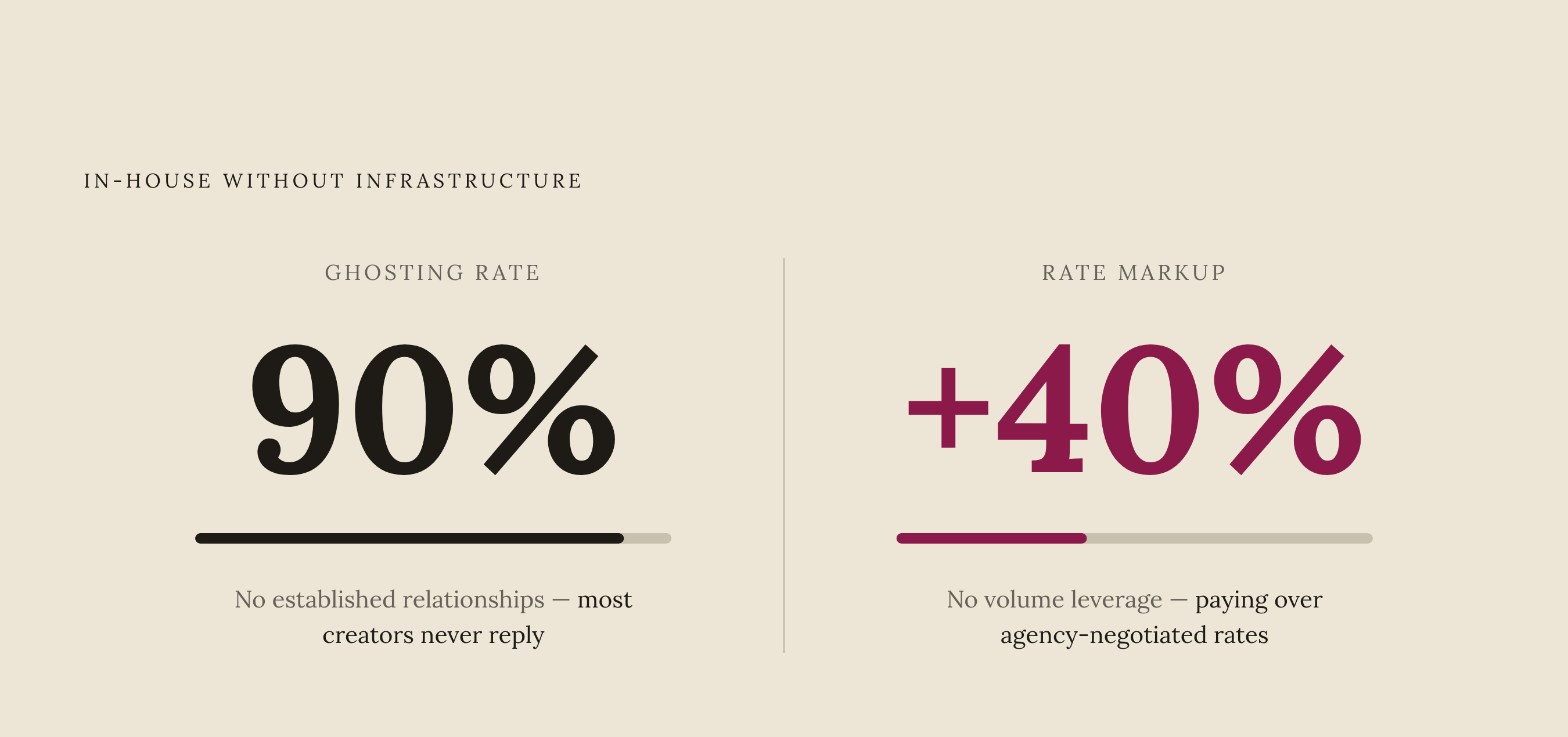
Skipping this infrastructure raises costs directly. Brands with no established name and no track record of repeat business face a 90% creator ghosting rate, and they pay what amounts to a 40% markup over what an agency with existing relationships would negotiate for the same creator. Those two numbers are the real price of skipping the boring work: the reach, credibility, and negotiating leverage an agency spends years accumulating doesn't transfer just because a brand hired a coordinator and bought a productivity app template. Replacing an agency means building a version of that infrastructure on purpose, one stage at a time, starting with the stage almost everyone skips.
Setting goals and writing a campaign charter before anything else
Most execution failures trace back to a decision nobody actually made. Which creator fits, what the brief should say, whether a piece of content clears the bar for approval: all of it turns into a live debate when no document settled the question in advance. A campaign charter is that document, and skipping it is the most common, most expensive mistake in this whole process. It has to lock down seven things before a single creator gets a message.
The objective should be singular: awareness, acquisition, revenue, a library of usable content, or app installs. Pick one. Name a single primary KPI that decides success, and demote every other metric to supporting evidence rather than a tiebreaker. The charter also needs the offer and call to action spelled out in plain terms (what the viewer does the second they see this), a target persona defined by what that person already believes rather than just an age bracket, and a creative hypothesis specific enough to be proven wrong. "If we say X, Y audience does Z because of this reason" holds up under scrutiny. "Make it go viral" is not a hypothesis, but a wish. Close it out with hard constraints (claims that can't be made, disclosures that are mandatory, topics that are off-limits) and a distribution plan stating whether this runs organic-only, whitelisted, or backed by paid amplification.
Campaign structure has to match the funnel it serves, and this is where most teams pick wrong by default, defaulting to the burst launch because it feels like the safer, smaller bet. A burst launch, two to three weeks, suits a product drop or a seasonal push. It generates fast signal but builds nothing lasting unless the winning creators get renewed afterward, and most teams never renew them, so the same discovery cost gets paid over and over on every campaign. An always-on creator program trades that speed for a steady flow of usable content and compounding learnings, at the cost of needing tighter operations and real scorecards to manage it week over week. An ambassador or affiliate hybrid suits repeat-purchase products and community-driven brands, but demands strict fraud guardrails, since the incentive structure invites gaming almost by design.
Once written, the charter becomes the one document everyone downstream checks their work against. The person writing briefs, the person reviewing content for legal risk, the person approving the final cut: all three measure their decisions against the same page, instead of relitigating the campaign's purpose every time a question comes up.
Finding and vetting creators without an agency's rolodex
Follower count is the wrong first filter, and treating it as the main one is how most in-house budgets get wasted in month one. Results follow from audience overlap with the target persona, on-camera style that matches the brand's tone, and recent, consistent performance on the format that actually matters, TikTok, Reels, Shorts, more than from reach. A creator with a smaller number and real alignment on those three points beats a bigger account with none of them, every time.
A tier structure makes budgeting concrete: nano under 10,000 followers, micro from 10,000 to 100,000, mid-tier from 75,000 to 250,000, macro from 250,000 up to around a million, mega above that. The economics favor the small end more than brands expect going in. Nano-influencers held the highest engagement rate on TikTok in 2024, at 10.3%, so the attention bought per dollar often beats what the bigger names deliver. Smaller creators are also easier to brief, easier to correct mid-campaign, and far less likely to treat a revision request as an insult.
Vetting has to go past the follower count and the bio, every time. Pull the last 10 to 20 videos and check whether views hold steady against that creator's own baseline, rather than getting propped up by one lucky hit. Read the comments: real back-and-forth beats a wall of "nice!" and heart emojis. Check who else they've promoted recently, especially direct competitors, and be honest about whether the product would sit naturally inside their usual content or stick out like a paid insert. Reliability counts as much as any performance metric, since a creator who hits deadlines on schedule is worth more than one with marginally better numbers and a habit of going quiet mid-campaign.
Fraud isn't a fringe risk here, it's a line item. Over 36% of influencer accounts show some form of fraud, and fake follower pods paired with synthetic engagement can burn through as much as 35% of a campaign's budget before anyone notices the pattern. None of the warning signs require special software to catch: a sudden follower spike with no clear cause, engagement numbers that don't line up with view counts, an audience concentrated in the wrong country, or comment sections full of repetitive, templated praise.
The legal ground shifted under this too. The FTC finalized a rule banning fake reviews and testimonials in 2024, effective October 21 of that year, so fraud and disclosure failures now carry legal exposure on top of reputational risk. Platforms that score audience authenticity and flag fraud patterns cut this risk down structurally. This is where the tooling layer earns its cost.
The platforms that give in-house teams agency-grade infrastructure
The tooling market splits into two layers, and confusing them is how teams end up paying for software that doesn't do what they need. Some tools help a team find creators. Others run the whole program: discovery, relationship management, outreach, approvals, contracts, payment, measurement, and brand-safety monitoring. No single platform fits every team; the right one depends on workflow, headcount, which channels carry the campaign, and how reporting needs to roll up to finance.
Upfluence has a database of more than 12 million creators, with AI-driven discovery, affiliate management, and a Shopify integration that ties content directly to sales, at entry pricing around $478 a month, though typical costs run between $1,276 and $3,500-plus. Grin leans toward DTC and e-commerce brands, built for long-term creator relationships with automated contracts and payments, starting at $999 a month. Aspire positions itself as the enterprise option for compliance-heavy, long-term partnerships, starting near $2,000 a month. Creator.co offers a hybrid model, letting a brand run campaigns itself or hand pieces of the work to a managed service team.
HypeAuditor leads with analytics and fraud detection, used by over 8,000 brands, and fits teams that weight audience quality above everything else. Modash covers the full loop in one place: finding creators, managing the relationship, tracking performance, paying out, with a lean toward e-commerce. Influee focuses on micro and nano creators across more than 23 countries, structured so a brand briefs, content gets made, and full usage rights come back automatically; its MCP agent lets a team manage campaigns from tools they already use, with no separate dashboard login required. CreatorIQ introduced an AI agent called Maya in 2026 that fields routine creator questions about authentication and campaign details, escalating to a human when it hits something it can't resolve. Brandwatch pairs influencer management with social listening, useful when a brand needs to track the surrounding conversation as closely as the content itself.
Building this same set of capabilities independently, fraud detection, contract management, payment processing, reporting dashboards, runs $15,000 to $50,000 or more a year, which makes even the pricier platforms look cheap next to what an agency marks up for the same functions. AI adoption in the category is moving fast: 63% of brands already use AI somewhere in their influencer marketing as of 2026, and 55% use it specifically for discovery and campaign management. But AI tools fail in specific, predictable ways. They hallucinate vetting criteria, miss sarcasm in a creator's content, and undercount brand-safety risk buried in old posts. Human review at the key approval gates isn't optional, no matter how good the discovery layer gets, and any team that treats an AI recommendation as a final answer will eventually pay for it.
For budgeting purposes, discovery and campaign management platforms generally run $200 to $1,000 a month. A full in-house build, salaries, legal templates, and all, runs $180,000 to $250,000-plus a year in fixed overhead, and that math only pencils out at real campaign volume. A brand running one or two campaigns a year has no business building this from scratch; the platform subscription is the correct call there, full stop.
Writing briefs that get the content you planned for
The brief is the charter translated into instructions a creator can act on. Every piece of the charter, objective, hypothesis, constraints, CTA, has to show up here as a specific line item; it must be a concrete instruction, not a mood board.
A brief that works specifies the number of deliverables, the platform, the format, and the duration. It states the draft-due date, the revision window, and the post date. It spells out the exact disclosure language required for FTC compliance and where it needs to sit on screen or in the caption. It lists which claims the creator can make and which ones are off-limits, gives tone and style references, and states upfront, not after delivery, whether the brand expects whitelisting or extended usage rights.
Three failure modes occur constantly, and they pull in opposite directions. Over-scripting kills the exact thing that made the creator worth hiring in the first place: 88% of consumers trust influencer recommendations as much as personal ones when they feel authentic, and a creator reading brand copy word-for-word reads as an ad rather than a recommendation. Under-specifying does the opposite kind of damage, leaving compliance, format, and timing open to guesswork that turns into a fight during approval. Treating the brief as separate from the contract creates a third failure entirely, since a creator who never signed anything treats brief requirements as suggestions rather than commitments, and finds that out too late.
Brief quality predicts approval speed better than anything else in the pipeline. A creator handed a tight, specific brief rarely needs more than one round of revisions. One handed a vague brief needs three, and by round three the relationship is already strained enough to affect the next campaign.
Outreach sets the tone before any of this even starts. A pitch that opens with why the content will work on that specific creator's channel, rather than what the brand wants from them, reads as a partnership offer instead of a job posting. Creators notice that difference, and they respond to it.
Contracts, usage rights, and the compliance infrastructure most in-house teams skip
Industry bodies like ISBA publish influencer marketing codes of conduct covering deliverables, transparency, payment, and responsibilities. In-house teams with no legal resources on tap do better adopting one of these frameworks wholesale than drafting contract language from scratch and hoping it holds up.
Every contract needs deliverables locked down (count, platform, format, duration, post date), usage rights defined (organic repost versus paid amplification, license length, which territories it covers), exclusivity terms (which product categories are locked out, for how long, what counts as a competitor), and whitelisting permissions in writing before content gets made, if paid amplification is even a possibility down the line. It needs a defined revision and approval process, spelling out how many rounds are included and what triggers a kill clause, plus payment terms covering the amount, the currency, the trigger event (post going live versus draft approval), and what happens if payment runs late. FTC disclosure language and enforcement responsibility belong in the contract as well as the brief, not one or the other.
Usage rights disputes cause more post-campaign damage than anything else on this list, and it's almost always avoidable. A creator who never agreed to whitelisting in writing can demand extra payment the moment a paid ad team wants to boost their post, or refuse outright, and by then the content has already proven itself worth amplifying, so the brand has no leverage left. Negotiating the full bundle, usage rights, exclusivity, whitelisting, before any content exists is consistently cheaper than negotiating for it after a piece starts performing.
Some platforms already covered, Aspire among them, build contract management and payment processing directly into the product, which cuts the legal lift for teams without in-house counsel. The FTC's 2024 rule against fake reviews, effective October 21 of that year, raised the floor further: disclosure compliance is something regulators now enforce actively, not a courtesy brands extend voluntarily.
Running the approval and content delivery pipeline without losing time or quality
The approval pipeline is where the brief either holds together or falls apart in front of everyone. Without a defined process, revisions pile up, deadlines slide past the post date, and creators start to doubt the brand actually knows what it wants. That doubt causes slower turnaround and less goodwill on the next campaign.
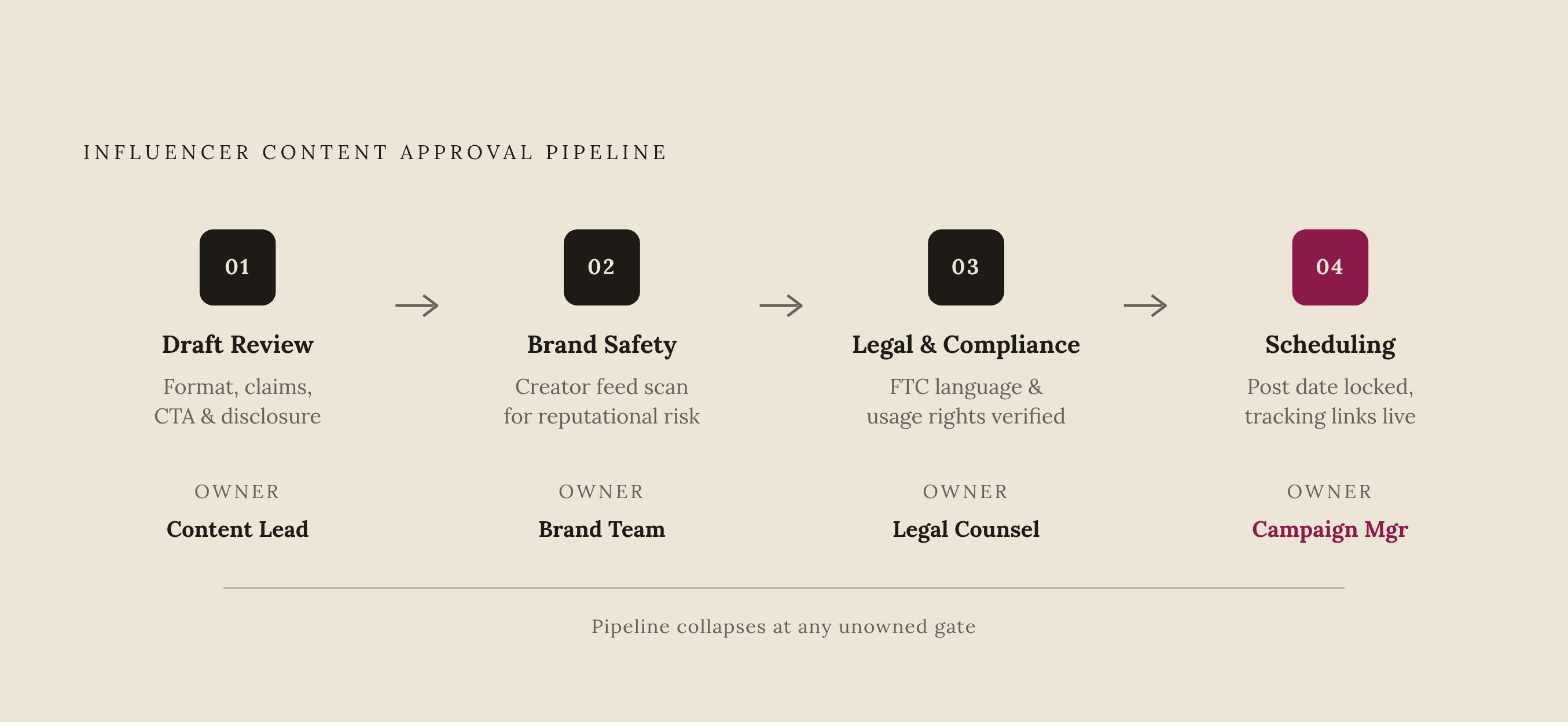
A working approval process runs through four checkpoints, and each one catches a different failure. Draft review checks the content against the brief itself: right format, permitted claims, the CTA in place, disclosures sitting where they need to sit. A brand safety check looks past the content to the creator's surrounding feed, checking for anything nearby that could reflect badly on the brand. Legal and compliance sign-off confirms the FTC disclosure language is correct and that usage rights in the final content match what the contract actually says, not what someone assumed it said. Scheduling confirmation locks the post date and activates whatever tracking links or promo codes the campaign depends on for measurement.
Each checkpoint needs a named owner, so responsibility doesn't quietly become nobody's job. When brand safety has no owner, it gets skipped under deadline pressure, every time. When legal sign-off has no owner, disclosure language turns into a last-minute scramble instead of a line item confirmed days in advance. The charter, the brief, and the contract exist to make these four gates fast to clear rather than fights to relitigate on every campaign. Built well, this pipeline turns an in-house influencer program from a string of one-off scrambles into something that runs the same way every cycle, improves each time it runs, and delivers the predictability a brand used to pay an agency for.