Content Usage Rights Clauses for Influencer Contracts
Paying for content doesn't mean owning it—here's what usage rights clauses actually control.

Content usage rights clauses determine what a brand can actually do with influencer content after it's delivered. They are also the section of the contract most likely to get skipped, rushed, or copy-pasted from a template that no longer matches how content actually gets used. The influencer marketing industry grew from roughly $24 billion in 2024 to about $32.55 billion in 2025, and at that scale, ambiguity about who owns what, and for how long, stops being a technicality. It becomes the thing lawyers get paid to argue about.
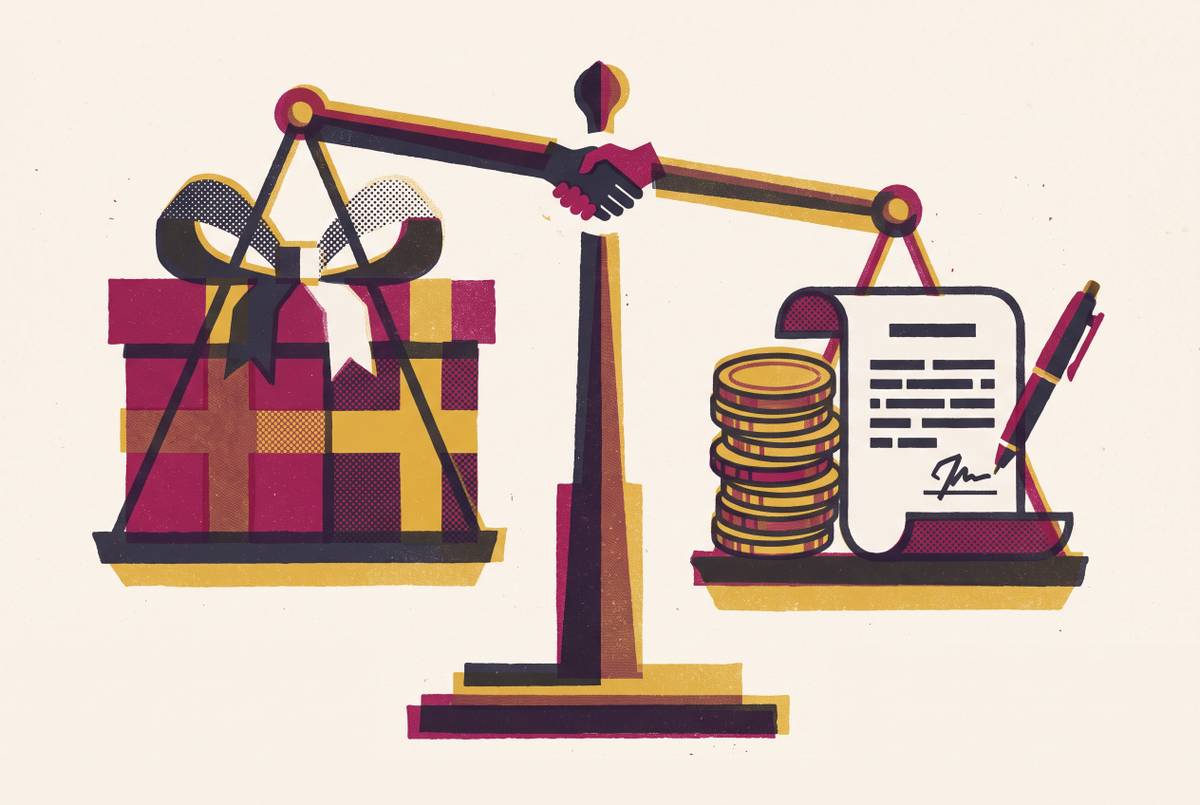
The most persistent misconception in this space is simple, and it's wrong: brands assume that paying for content means owning it. U.S. copyright law disagrees. A creator owns the work the moment it's made, full stop, unless a signed agreement transfers or licenses specific rights away, or the piece qualifies as work made for hire under a narrow legal definition that does not broadly cover independent creator relationships. Absent that paperwork, the brand has purchased a service, not a property, and treating the two as the same thing is where most disputes start.
What follows is a clause-by-clause account of how usage rights actually function in influencer contracts, where the language typically breaks down, and what it costs when it does.
The ownership vs. licensing distinction every contract must resolve first
Copyright attaches the moment content is created. No registration, no notice, no filing required. That's the starting point for every negotiation that follows, and it means the default position favors the creator, not the brand writing the check.
From there, a contract goes one of two directions. Full transfer, sometimes structured as work-for-hire, makes the brand the actual copyright owner; the creator walks away with a paycheck and no further claim on the work. Licensing is the model that actually dominates influencer marketing: the creator keeps ownership and grants the brand a defined set of permissions, scoped to specific uses. Brands should stop reaching for transfer language by default. It's the wrong instinct for a relationship that's usually campaign-scoped, not a buyout.
Brands lean toward transfer language for obvious reasons: they've paid for the content, they want to control it indefinitely, and they'd rather not come back to the table every time a campaign extends or a new channel opens up. Creators resist that same language for reasons that are just as practical. A content catalogue is a professional asset, arguably the core one, and signing away ownership can quietly undercut a creator's ability to build a personal brand or pitch future partnerships using their own portfolio. Legal + Creative's analysis of influencer negotiations flags work-for-hire language as one of the most commonly contested terms, either rejected outright or accepted only at a price high enough to offset what's being given up.
A license scoped tightly to what the brand will actually use serves both sides better than a transfer ever will. The creator keeps ownership and reputational control, the brand gets exactly the permissions the campaign requires, priced to match, and nobody pays for rights that sit unused in a drawer.
A few phrases deserve extra scrutiny during contract review. "All rights granted" often functions as an ownership transfer dressed up as a usage grant. "Perpetual rights" without any accompanying scope limits does the same thing by omission. Vague references to "derivative works," left undefined, tend to surface as disputes only once circumstances change and someone discovers the language covers more, or less, than either side assumed.
One point gets overlooked constantly: brand IP embedded in the content, trademarks, packaging, logos, stays the brand's property regardless of who owns the surrounding footage. Usage rights clauses need to address both directions, not just the creator's contribution.
The four dimensions every usage rights clause must define
Four variables determine what a usage rights clause actually permits. Miss any one, and the gap defaults to no: the brand cannot do the thing it assumed it could, and finding that out mid-campaign is the expensive way to learn it.
Platform and channel scope comes first. Which surfaces can the brand actually use the content on? The creator's own page, the brand's owned social feeds, a website, an email blast, paid digital ads, print, television, out-of-home, retail media, connected TV: each of these needs to be named specifically. "Social media" is not a scope, it's a category, and categories leave room for exactly the kind of argument that ends up in a demand letter. Paid media rights are a separate negotiation from organic posting rights entirely, a distinction significant enough to earn its own section further down.
Territory comes next. Is the license limited to a single country, extended across a broader region, scoped to a handful of named countries, or granted worldwide? Geography moves price. Worldwide rights cost more than regional ones, which matters most for brands running localized campaigns through agency partners across multiple markets at once.
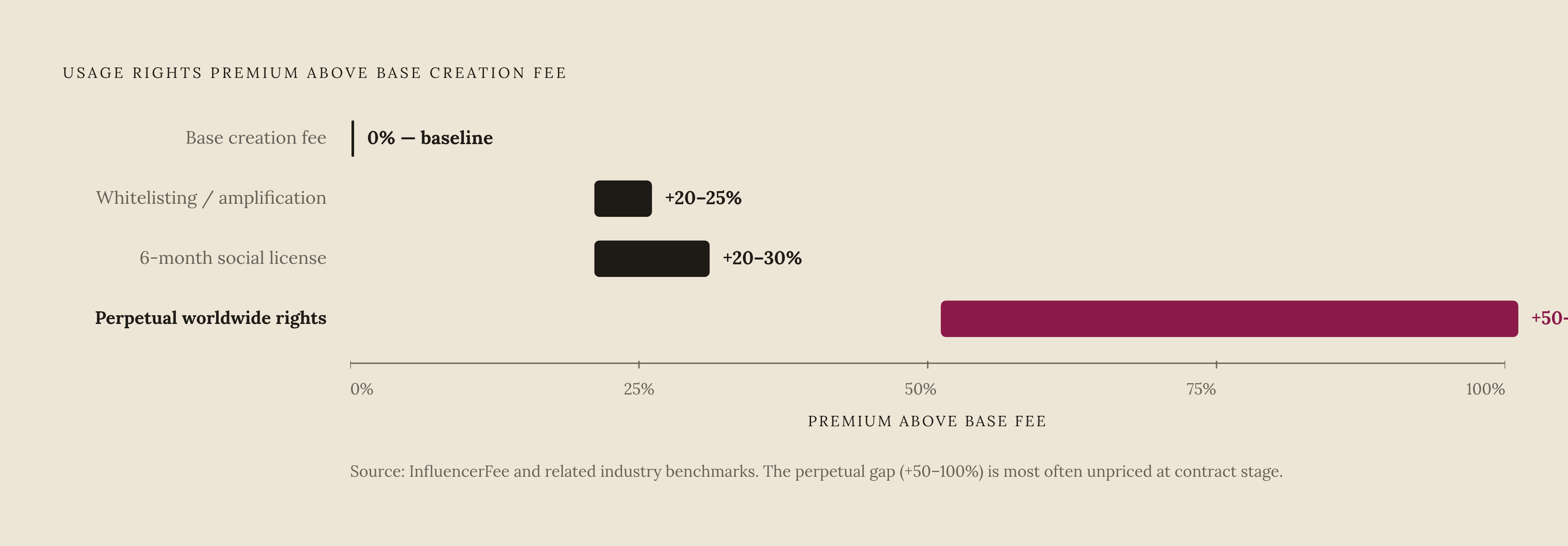
Duration is where a surprising number of disputes actually start, and usually not because the term length is wrong, but because the start date is ambiguous. Terms vary widely, but the clock needs a defined starting point: content delivery, campaign go-live, or some other trigger. A standard six-month social usage license typically adds 20 to 30% to the base creation fee, while perpetual worldwide rights add 50 to 100%, according to InfluencerFee benchmarks. Leave the trigger date vague and both numbers become meaningless, because nobody can agree on when the clock actually started running.
Exclusivity is the fourth dimension. Non-exclusive terms let a creator license similar content to other brands at the same time. Exclusive terms lock the brand in as the sole licensee for the period specified, and category exclusivity, barring direct competitors while leaving unrelated verticals open, sits as a common middle ground. Exclusivity always costs more, and it should be scoped to match actual need: a seasonal campaign with a six-week shelf life rarely justifies paying for perpetual exclusivity.
Brands should map out which permissions they'll realistically exercise before they start negotiating, not after. Rights that sound useful but never get used just inflate the fee and complicate the contract for no benefit to either side.
Derivative works rights and what "editing" actually means in contract language
Derivative rights govern whether a brand can touch the content after delivery: trim it, remix it, reformat it. This is a separate grant from basic usage rights, and treating it as bundled in is the mistake. Trimming a video down for a fifteen-second cutdown, laying a new voiceover over existing footage, swapping the background music, building a highlight montage, reformatting a horizontal video into a vertical crop: every one of these counts as a derivative act. Without explicit derivative rights in the contract, doing any of it is legally impermissible, even on content the brand paid to produce.
Negotiation on this point clusters around a few recurring questions. Does the creator retain approval rights over any edited version before it goes live? Many do, and many brands will negotiate that requirement down, or waive it entirely, but only if the contract says so explicitly; silence doesn't default in the brand's favor here. Attribution comes up too: does a remixed or reformatted version still need to credit the creator by name or handle? Moral rights considerations linger even when derivative rights are formally granted, since creators can still object to edits that misrepresent their views or put their reputation at risk.
The term "derivative works" itself was written for a simpler era of editing: trims, cuts, format changes. It's now being asked to cover AI-generated outputs, digital doubles, voice clones, and synthetic composites built from a creator's original footage, and that's a much bigger ask than the phrase was ever designed to carry.
That gap is where things go wrong. A lifestyle influencer who'd granted rights to "derivative promotional materials" discovered months later that a brand had built an AI-generated ad campaign around a digital double of her, endorsing products she'd never seen, according to reporting from Rodriques Law. The result was a cease-and-desist and a drawn-out legal negotiation that neither side wanted to be having.
The lesson generalizes past that one case. Derivative works language now needs to state, in plain terms, whether AI-generated outputs built from the source content are included or excluded. A generic derivative clause, the kind that was standard boilerplate five years ago, no longer carries enough precision to answer that question either way.
Perpetuity clauses: what brands gain, what creators give up, and how to price the difference
Perpetual rights appeal to brands for a straightforward reason: assets get reused. More than 65% of large brands recycle digital assets across multiple campaigns, according to a 2024 Statista report, and a one-time licensing fee that covers years of reuse looks like a bargain from the brand's side of the table.
It looks like the opposite from the creator's side, and it should. Perpetual rights mean giving up control over where and how one's own image circulates, indefinitely, with no further say. They also foreclose the option to repurpose or relicense that same content to a different partner down the line. There's a slower, less obvious cost too: as brands expand into new platforms and formats over time, the practical reach of a "perpetual" grant expands right along with them. Content licensed in 2025 for social media use can end up running in connected TV placements or retail media environments years later, under the exact same clause, with no additional payment triggered, because none was written in.
Pricing has to reflect that asymmetry. A six-month social usage license runs 20 to 30% over the base fee; perpetual worldwide rights run 50 to 100% over base, per InfluencerFee data. Usage rights and amplification together make up an estimated 20 to 30% of total influencer spend under budget frameworks used by platforms like Later. That's a real line item, not a rounding error tacked onto the invoice.
One term deserves a flat warning: perpetual usage rights granted without additional compensation attached. LegalGPS classifies this as a major deal-breaker, the kind of clause a creator shouldn't sign without either renegotiating the scope or securing meaningful upfront payment to match it.
A few alternatives split the difference reasonably well: a fixed term with renewal options locked in at pre-agreed rates, perpetual rights limited to specific platforms or formats named explicitly at signing rather than left open-ended, or perpetual organic rights paired with a separate, time-limited agreement covering paid amplification. That last option keeps the two use cases from blurring into one uncapped grant.
Kill fees function as the contingency plan sitting underneath the duration clause. Industry standard scales run 25% if the project is cancelled before production starts, 50% if cancelled mid-production, and 100% if cancelled after delivery and approval, according to contract template research from SuperDeal.
Whitelisting and paid amplification rights as a separate, explicitly priced agreement
Usage rights and whitelisting get confused constantly, and the confusion is expensive. Usage rights let a brand repost or repurpose content it already has. Whitelisting is a different animal: it grants the brand access to the creator's ad account so it can run paid spend directly through the creator's own profile. Legally and commercially, these are two separate permissions, and a contract that grants one without addressing the other has left a hole in the middle of the agreement.
The commercial stakes are rising fast. Paid amplification of creator content is the fastest-growing segment of creator spend, projected to climb 56% to $11.1 billion, according to a 2026 industry analysis citing IAB creator economy figures. Brands are pulling creator content into display advertising, connected TV, and retail media, channels where a standard organic usage grant provides zero coverage. The performance case isn't theoretical either: TikTok Spark Ads, which require explicit whitelisting permission, deliver a 25% lift in click-through rate and a 24% lift in conversion rate over standard in-feed ads, according to LaunchPoint HQ data. That gap alone makes the amplification clause a commercial priority, not an afterthought tacked onto the end of negotiation.
The market has already priced this in. Research from Lumanu found 51% of influencers now charge a separate fee for whitelisting, boosting, or amplification on top of standard creation fees. Micro-influencers typically charge $150 to $500 monthly for the access; mid-tier creators run $500 to $2,000 monthly. Applied to a flat $10,000 content fee, a 20 to 25% whitelisting fee pushes the monthly total to roughly $12,500, according to Influencer Marketing Hub.
Timing matters more here than almost anywhere else in the contract. Lock in paid amplification rights before the content exists, not after it starts converting and the creator can see exactly what the asset is worth on the open market. Negotiating after the fact means negotiating against data the creator now has and the brand doesn't want to pay for.
A properly built whitelisting clause specifies whether ad account access is granted at all and to which platforms, what spend caps or category restrictions apply to ads run through the creator's handle, how long the access lasts and how it gets revoked when the term ends, and who retains creative control over the boosted posts themselves. Agencies juggling multiple brands and creator rosters should keep a centralized record of who holds which amplification rights across which roster, since whitelisting terms vary by platform and by creator tier, and the mid-campaign surprise is hard to unwind once ad spend is already committed.
The likeness rights clause and where it ends, or used to
Likeness rights sit next to content usage rights but aren't the same clause, and treating them as interchangeable is a common source of scope disputes. A brand might have full permission to repost a specific video, that's content usage, without having any permission to use the creator's name or face in a separate piece of brand material entirely. That's likeness, and it needs its own line in the contract, not a shared one.
A properly scoped likeness clause answers a few direct questions. Can the brand use the creator's name, face, and general persona beyond the specific deliverables named in the campaign? Which channels does that cover: paid ads, press materials, product packaging, in-store displays, third-party retail environments? Does likeness usage expire on the same timeline as content usage rights, or does it run separately? Is attribution required every time the likeness appears, or only in certain contexts?
The 2022 case documented in Viral Nation's research illustrates exactly what happens when this isn't spelled out. A beauty brand's agreement with an influencer covered one photo and one video post. The brand went on to use her image in physical in-store retail displays, a use the original contract never contemplated, and the gap between what was agreed and what was used became the basis for legal action. It's the predictable outcome of treating likeness and usage as one clause instead of two.
Historically, a phrase like "use of likeness in derivative promotional materials" was considered sufficient to cover traditional advertising formats: print ads, in-store banners, the usual channels. That language is no longer adequate, and the reason is technological rather than legal. A creator's likeness today extends far beyond a photograph or a name on a release form. It's voice samples, facial geometry, gesture patterns, speech cadence, each one extractable on its own and reusable independently of the original footage it came from.
That's precisely where the standard likeness clause runs out of road, and where a newer, more specific kind of clause has to begin.
AI training data and synthetic derivative clauses: what contracts drafted before 2024 missed entirely
Contracts signed between 2019 and 2023 were built for a world without generative AI in the picture, and the gap that leaves behind isn't small. Those agreements typically say nothing about whether a creator's footage, voice, or likeness can be fed into a training dataset, used to generate synthetic composites, or repurposed to build an AI model of the creator that keeps operating long after the original campaign ends. The silence carries its own weight. It's the same hole that produced the digital-double dispute described earlier: a derivative works clause written for trims and voiceovers, stretched to cover a use case its drafters never anticipated.
A usage rights clause that doesn't explicitly name AI training data and synthetic derivatives as either included or excluded is incomplete, in the same way a contract without a duration clause is incomplete. It leaves the most consequential question, whether a creator's face and voice can be cloned and redeployed without further consent, unanswered. And unanswered questions in a content contract have a habit of getting resolved in the most expensive venue available: after the fact, in front of a lawyer, once someone has already found out the hard way what the old language didn't cover.
Sources
- Usage Rights in Influencer Marketing: What Keeps Marketers Up at Night
- Marketing with Influence - Be Ready to Negotiate These Points in Your Next Influencer Deal - Legal + Creative
- Do Influencers Need a Contract for Brand Deals?
- Perpetuity Clauses in Content Usage Rights 2025 | Protect Ownership
- Influencer Contract Template 2026: Free Download + 10 Must-Have Clauses
- 9 Essential AI Clauses for Entertainment Contracts | Rodriques Law
- superdeal.io
- influencermarketinghub.com