International Creator Contracts and Cross-Border Tax Obligations
Brands must map tax obligations and contract terms separately or risk surprise withholding bills.
Cross-border creator payments have quietly become one of the messiest compliance problems in marketing. A brand books a creator in one country, another in a second country, a third in a yet another country, all for the same campaign, and pays each one through whatever payout tool the platform happens to offer. That's the whole problem in one sentence: the contract terms and the tax obligations behind these payments haven't caught up to how global the work already is.
Influencer programs used to be a domestic affair by default. A domestic brand. brand worked with domestic. creators, an accounts payable team cut a check or ran an electronic transfer, and nobody thought much about withholding because nobody had to. That era is over. Brands now source talent through global marketplaces, TikTok Shop's affiliate program, and agency networks that span a dozen or more countries inside a single campaign. Brands are increasingly chasing audiences in Southeast Asia, Latin America, and the Gulf region, and budget is following that shift across borders. Budget is moving faster than the paperwork behind it.
The paperwork is catching up on its own timeline, though, and it's not a friendly one. Influencers-time.com reports that 92 countries now require platforms to report gig and creator earnings to tax authorities, and the list continues to grow. Treating a creator payment like petty cash, something too small to bother documenting, made sense when nobody was watching. Governments are building the digital infrastructure to watch now, and it's already live in most of the markets brands care about.
Two compliance tracks run in parallel here, and brands need to manage both. One is contractual: what the agreement actually says about payment terms, IP, AI likeness, and governing law. The other is tax: withholding, reporting forms, indirect tax, and the risk of accidentally creating a taxable presence abroad. This piece walks through both, aimed at marketing teams and agency account managers, and the finance and legal people they need to loop in early rather than after a payment has already gone out the door. None of it replaces actual tax counsel licensed in the relevant jurisdictions.
What a modern international creator contract needs to cover
A standard brand deal in 2026 looks structurally similar to one from 2022. Same sections, same dense boilerplate language, same confidentiality agreements and usage-rights riders. But the substance inside several of those clauses has shifted in ways that matter a lot more than the formatting suggests. The Creator Economy Report 2026 (via influenceflow.io) found that 73% of creators now negotiate at least some terms in their brand agreements, up from 42% in 2023. The take-it-or-leave-it contract, where a creator signs whatever the brand's template says, is fading fast.
Five clauses need to be explicit, not implied, in any deal crossing a border. Governing law and jurisdiction come first: which country's law applies and where disputes get resolved determines almost everything else downstream, including how a tax dispute would even get litigated. Currency and payment method need to be spelled out in the contract itself, not left to whatever a platform defaults to. Tax withholding responsibility has to state whether the brand withholds at source or the creator handles their own reporting; leaving that ambiguous creates disputes and compliance gaps, especially across jurisdictions that assign default rules differently (influencers-time.com). Indemnification needs to say who eats the cost if a tax authority later disputes how a payment was treated. And VAT or GST treatment needs to state whether the creator's fee includes indirect tax or sits on top of it, and who's on the hook for any reverse-charge obligation.
Influenceflow.io's 2025 guide for creators and brands makes the same point from the creator's side: international collaborations demand extra documentation around currency, payment method, tax withholding, and governing law, precisely because none of that can be assumed to default sensibly across borders.
A contract can only do so much, though. It records what the parties agreed the tax treatment should be. It doesn't collect the actual forms, verify treaty eligibility, or apply the correct withholding rate before the payment clears. That work happens outside the four corners of the document, and skipping it is how brands end up owing money they didn't know they owed.
How AI likeness clauses have rewritten the IP terms inside creator contracts
The word "likeness" hasn't changed. What it covers has. Viralsliceco.com, citing a Forbes investigation from May 2026, reports that a likeness clause in a 2026 contract may now cover a creator's face, voice, and mannerisms for AI generation, potentially forever, for one flat upfront fee. Boilerplate that used to mean "you can use my photo in an ad" has, in many templates, quietly expanded into perpetual AI training rights: a brand can use a creator's existing content to build and run models that generate synthetic versions of that creator, indefinitely, with no additional payment and no further approval required.
Three developments between 2023 and 2025 permanently changed how contracts in entertainment and media get drafted, and creator agreements are inheriting the same language (rodriqueslaw.com). One entertainment industry union's 2023 base labor agreement introduced disclosure rules for AI-generated writing and revisions. SAG-AFTRA's AI and Digital Replica Guidelines defined when a "synthetic performer" needs consent and compensation, not just a signature on a generic release. And the FTC updated its Endorsement Guides and subsequently issued its 2024 Rule on Consumer Reviews and Testimonials, both of which bear on how creators must handle AI-generated content in their work.
Viralsliceco.com reports that creators negotiating from a position of strength in 2026 are pushing back on four fronts: time-limited licenses instead of perpetual grants, approval rights over every AI-generated output that uses their likeness, revenue participation tied to how much the output actually gets used, and a "kill switch," a contractual right to revoke AI usage mid-deal if the relationship sours.
This mirrors a fight already playing out in commercial AI contracts more broadly. IP allocation has emerged as one of the most actively negotiated areas in AI agreements generally: who owns the outputs, what rights the customer keeps over training data, and whether the vendor can use that data to improve its own model. The practical guidance is consistent: contracts need explicit ownership clauses covering derivative works, not language lifted wholesale from a generic SaaS terms-of-service template. A creator's face is not a software feature, and treating the IP clause like one carries real financial consequences.
The gap in tax terms appears almost immediately once payment structure is set. How a payment gets structured, a flat service fee, a royalty for content licensing, or a fee for AI remix rights, changes how the IRS treats withholding on that payment. The next section unpacks how.
Why most brands trigger the 30% default withholding rule without knowing
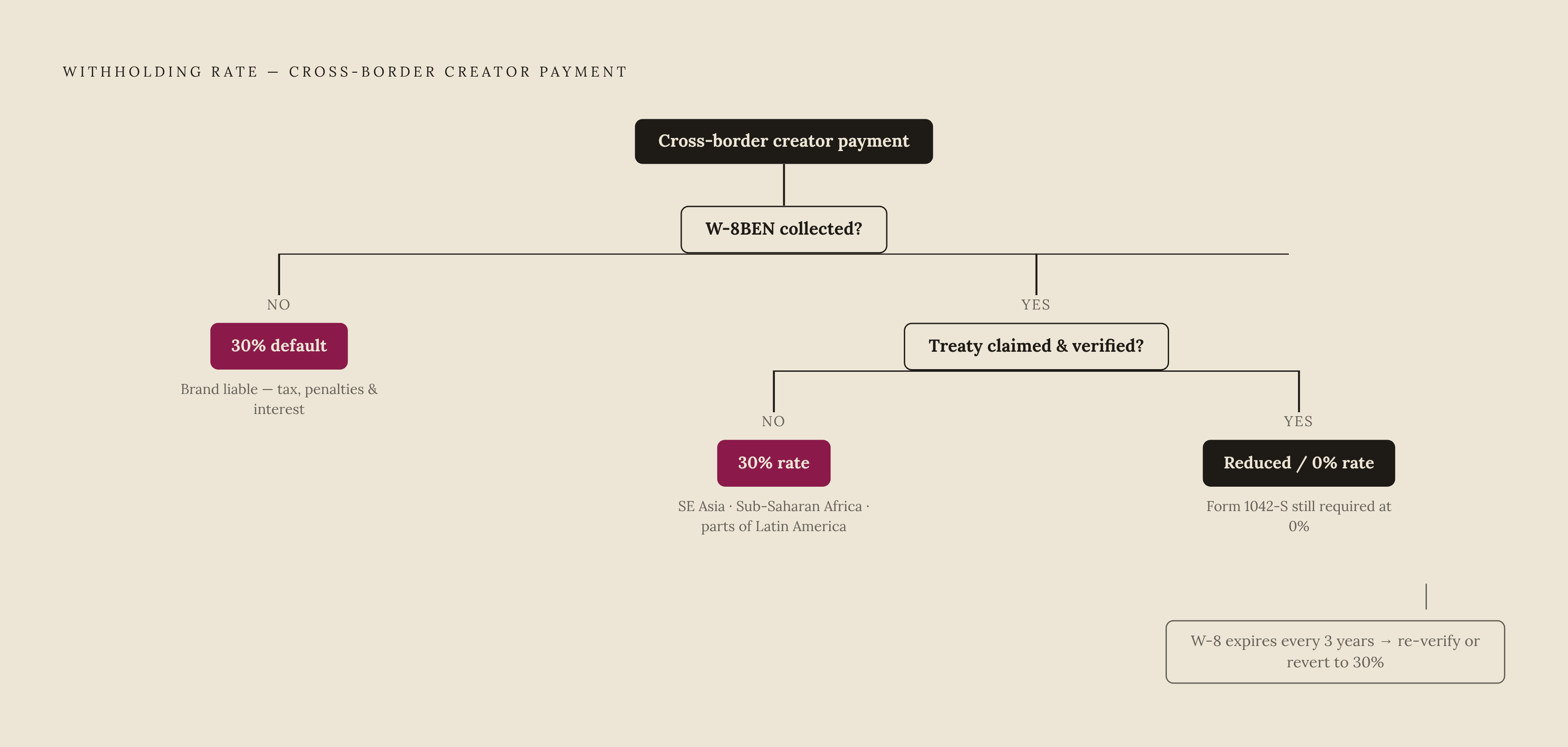
Here's the rule: if a domestic. brand pays a non-U.S. creator for services sourced to the country in question, the tax authority's default withholding rate is 30%, unless a tax treaty reduces or eliminates it, or the creator certifies the income is foreign-sourced through a properly completed withholding certificate for individuals or the equivalent entity certificate (influencers-time.com, September 6, 2026).
The obligation to withhold sits with the payer, not the payee. If a brand fails to withhold, the IRS comes after the company for the tax owed plus penalties and interest. That liability doesn't evaporate because the creator lives in another country and never files a domestic. return. Grassi Advisors confirms the mechanics: the default rate is 30% unless a lower treaty rate applies, and only then if the payor holds documentation proving the recipient qualifies for it. The payor is the withholding agent, and the payor is jointly liable for getting it wrong.
The way brands trigger this liability is almost always the same, and almost always accidental. Marketing teams issue payments through PayPal, Payoneer, or whatever payout system the platform bundles in, and none of those tools flag a tax documentation requirement before the money moves. Nobody asks the creator for a W-8. Nobody checks whether a treaty applies to that creator's country. The payment just goes out. Influencers-time.com puts it starkly: if a brand cannot produce a valid W-8BEN or W-8BEN-E for every foreign creator it paid last year, finance is sitting on undisclosed withholding liability right now, today, whether anyone in the building knows it or not.
Classification of the payment matters too. Whether a fee counts as a service payment, a royalty for content licensing, or an endorsement fee changes the withholding treatment, and royalty payments for usage rights often get treated differently than a flat service fee (influencers-time.com). The AI remix and licensing language covered in the previous section is a withholding classification question, not merely a rights question. It's a withholding classification question, and getting the IP framing wrong on paper can mean applying the wrong tax treatment in practice.
Even when a treaty reduces withholding to zero, the reporting obligation doesn't disappear. Brands still generally owe an information return via Form 1042-S, and skipping that filing because "no tax actually got withheld" is one of the most common, and most costly, mistakes brands make (influencers-time.com, September 6, 2026). The reporting obligation remains even when a treaty reduces the rate, and skipping the Form 1042-S filing on the assumption that no tax was owed is one of the most common mistakes brands make.
Why a creator's address is not enough to claim a tax treaty benefit
The country in question. holds tax treaties with more than 60 countries, and many of those treaties reduce or eliminate withholding on certain royalty and services payments (influencers-time.com, July 22, 2026). Creators based in the UK, France, Australia, or Germany, for instance, may qualify for a reduced rate. But the benefit only kicks in if the creator actively claims it on the W-8BEN, citing the specific treaty article that applies. A mailing address abroad doesn't automatically trigger anything.
Two failure modes appear constantly in these arrangements, and they pull in opposite directions. A brand pays a creator gross, assuming the treaty covers it without anyone actually confirming the claim, and the brand ends up carrying the liability if that assumption is wrong. Or a brand applies the full 30% out of caution when a treaty would have reduced it, which damages the relationship with the creator and may mean overpaying the IRS unnecessarily. Neither outcome is acceptable, and both come from skipping the same verification step.
Creators based in non-treaty countries face the standard 30% rate unless some other exemption applies, and that group includes some of the largest and fastest-growing creator markets in the world: large parts of Southeast Asia, sub-Saharan Africa, and parts of Latin America. These are precisely the regions eMarketer data shows brands chasing hardest right now, which means the exposure and the growth are pointed in the same direction.
Influencers-time.com recommends verifying every treaty claim against the current IRS treaty table rather than trusting a creator's self-reported claim on the form. Forms also expire: a W-8 needs refreshing every three years, or sooner if the creator's circumstances change, so a form collected for a campaign launch in early 2026 may already be stale by the time a follow-on campaign runs later that year. One advisory firm extends this to the whole vendor relationship, not just creators: any vendor, shareholder, or creditor with a foreign address should have a foreign-status withholding certificate on file, or the domestic equivalent if based in that country, and reviewing that documentation annually should be standard practice, not a one-time box checked at onboarding.
Scale makes manual tracking untenable fast. A mid-size DTC brand can easily work with creators across dozens of countries in a single quarter. Verifying treaty status by hand for 200 creators, across dozens of countries, with three-year form expirations staggered unpredictably, is not a spreadsheet problem. It's a systems problem, and brands that treat it like the former usually find out the hard way.
DAC7, VAT, GST, and the indirect tax layer that compounds the compliance burden
Income tax withholding is only half the picture. Brands paying creators in the EU, the UK, Australia, or any country running a GST regime also carry indirect tax obligations that operate on entirely separate rules and thresholds.
DAC7 is the EU's version of the reporting push: a directive requiring digital platforms to report seller and creator income to tax authorities across member states. Brands outside the EU aren't automatically exempt, either. A domestic. A brand paying creators based in EU countries, or using an EU-based platform to manage payments, can still get pulled into DAC7's reporting obligations through the platform itself or through documentation requirements imposed on the creator (influencers-time.com, July 22, 2026). Some DAC7 thresholds trigger at roughly €2,000 or 30 transactions in a year, thresholds low enough that a handful of small nano-creator payments can cross the line without anyone noticing (influencers-time.com, July 22, 2026).
The UK's HMRC runs a parallel framework, and similar rules are moving through Canada, Australia, and several Latin American tax authorities. The common driver behind all of it is the OECD's Model Reporting Rules for digital platforms, which is steadily pushing dozens of jurisdictions toward mandatory reporting of gig and creator income on a similar timeline.
VAT and GST mechanics add another layer specific to cross-border B2B payments. A creator registered for VAT who provides services to a business client outside their home country typically issues an invoice without VAT on it, and the brand self-assesses the tax through what's called a reverse charge. Getting this wrong cuts both ways: either the brand underpays tax owed to a foreign authority, or it overpays a creator who was never entitled to charge VAT on that cross-border service in the first place (influencers-time.com, September 6, 2026). Grassi Advisors notes that indirect tax thresholds abroad tend to sit much lower than income tax thresholds, and assuming no obligation exists just because a company has no physical office overseas is a common, costly mistake.
Platform reporting adds a layer of false comfort here. Marketplace facilitators may issue reporting forms for domestic. persons, but foreign creator withholding is a separate obligation entirely, and it often lands back on the brand or agency whenever payments run through direct contracts, invoicing tools, or a brand-managed affiliate program rather than the platform's own payout rails (influencers-time.com, September 6, 2026). AI-matched creator campaigns make this murkier still: a platform that algorithmically pairs a brand with global talent pools abstracts the entire payment flow behind a dashboard. If legal hasn't reviewed how that platform contractually handles tax responsibility, that's a gap to close before the next campaign launches, not something to discover in an audit letter.
Permanent establishment risk and the 2026 remittance excise tax, two exposure points brands rarely anticipate
Operating abroad, even for a marketing campaign, can create what's called a Permanent Establishment, a taxable presence that lets the host country tax profits tied to that activity (Grassi Advisors, April 7, 2026). A taxable presence is defined inside income tax treaties and typically requires a fixed place of business, but it doesn't stop there: it can also arise from domestic. employees working inside a country, from dependent agents who conclude contracts on the company's behalf, or from a business project that runs long enough, long enough to cross a treaty's duration threshold.
The relevance to creator programs isn't abstract. An agency or brand that embeds staff in a foreign market to manage a sustained, long-running creator campaign, or that leans on a locally based agent to sign contracts with creators on the brand's behalf, can trigger a PE without ever intending to open an office there. Remote and hybrid work has only blurred this further. Eversheds Sutherland notes that even home offices have started raising PE questions in tax authority reviews, a scenario nobody was writing contracts around five years ago.
Every jurisdiction runs its own domestic PE concept, and those concepts don't always line up neatly with the internationally understood treaty definition, nor do they line up consistently treaty to treaty. Eversheds Sutherland is direct about the implication: assessing PE risk requires looking at the specific rules of each relevant jurisdiction individually. There's no shortcut, and no single global standard a brand can apply once and reuse everywhere.
Both PE exposure and the sourcing of creator payments make one thing unavoidable: how a brand structures a global creator program, where staff sit, who signs contracts with whom, and how long a campaign runs, is no longer just an operational decision. It's a tax decision, made whether or not anyone at the brand realizes they're making it.
Sources
- Cross-Border Creator Payments: Close the Tax Compliance Gap
- Cross-Border Tax Withholding Checklist for Creators
- International Tax Insights: Key Takeaways from the 2025 Filing Season and What to Focus on Next
- Tax Considerations in International Corporate Reorganizations: Navigating Cross-Border Risks
- Digital Creator Contracts Guide 2026 | InfluenceFlow
- rodriqueslaw.com
- viralsliceco.com
- irs.gov