Creator Outreach Email Templates That Get Responses
Personalization and specificity drive response rates far higher than generic bulk outreach.
Creator outreach isn't a copywriting problem, it's an operational one. The global influencer market saw substantial spend in 2026, returning $5.78 for every dollar put in, and over 74% of brands say they're increasing budgets. Yet 73% of influencer partnership emails go unanswered. The gap between those two facts is where this piece lives, because the same three or four craft decisions explain almost all of the variance between the brands getting replies and the brands getting silence.
What the response rate data shows across creator tiers
Cold email as a category converts poorly. Instantly's benchmark data puts the platform-wide reply rate at 3.43%. Influencer outreach specifically does better, but the split inside that category is the whole story: the Influencer Marketing Hub's benchmark report shows personalized influencer emails landing a 38% response rate against just 6% for generic blasts. That's a 32-point gap, and it is the return on a small set of decisions made before hitting send. It's the return on a small set of decisions made before hitting send.
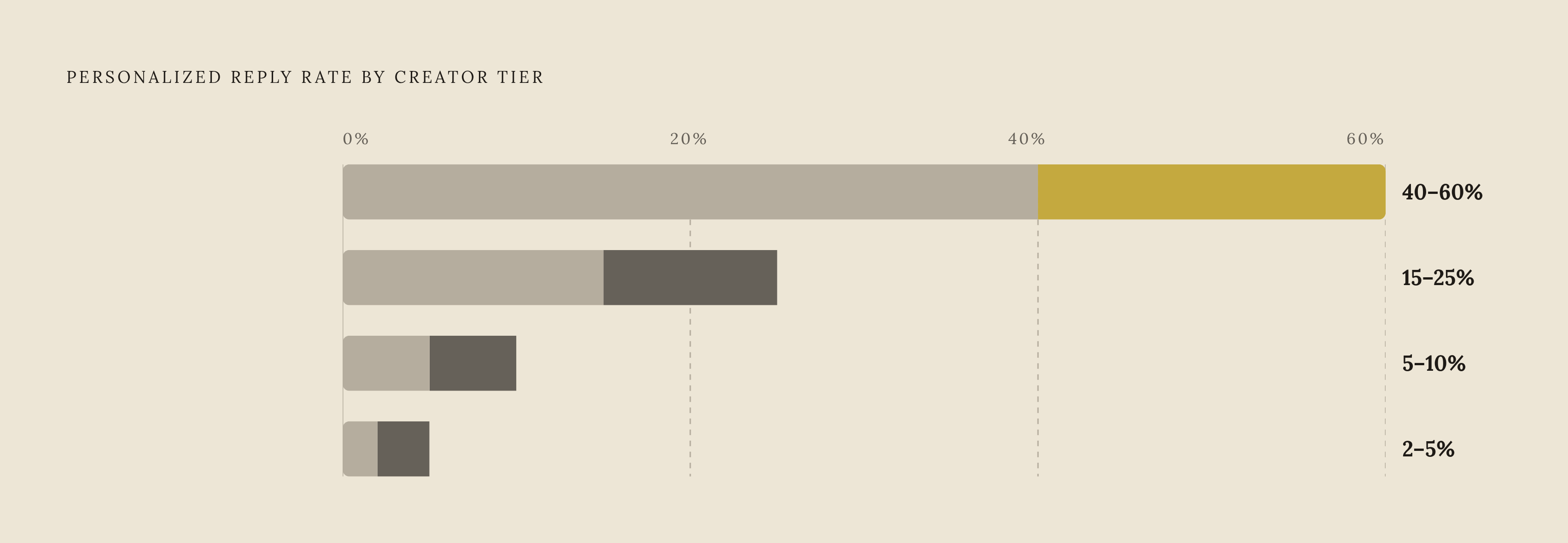
The gap widens further once you break it down by creator tier. Nano influencers, the 1,000 to 10,000 follower range, respond to personalized outreach 40 to 60% of the time. Micro influencers (10,000 to 50,000) land 15 to 25%. Macro influencers, spanning a follower range an order of magnitude wide, drop to 5 to 10%, and mega influencers above the top end of that range respond at just 2 to 5%, usually because an agency is filtering the inbox before a human ever sees the pitch.
Read that ladder the right way and it argues against the instinct that bigger is better. Nano and micro creators aren't just easier to reach, they're proportionally more valuable per unit of outreach effort, because the personalization ceiling for a nano creator is dramatically higher than for a mega creator whose replies are gated by a management layer.
Campaign size compounds the effect. Cold email benchmark data show sends to 50 recipients or fewer average a 5.8% response rate, while larger list sends average 2.1%. That's the volume trap: more names in the spreadsheet doesn't mean more replies, it usually means less attention per email and a worse outcome overall.
Channel choice matters too. Instagram DMs pull 20 to 30% response rates, ahead of email's 8 to 15%. But a Later survey found 68% of mid-tier creators prefer that brands make first contact by email rather than DM. DMs may convert better once a relationship exists, but email remains the front door for anything that looks like a serious, paid partnership rather than a casual ask.
The three craft decisions that separate replied-to emails from deleted ones
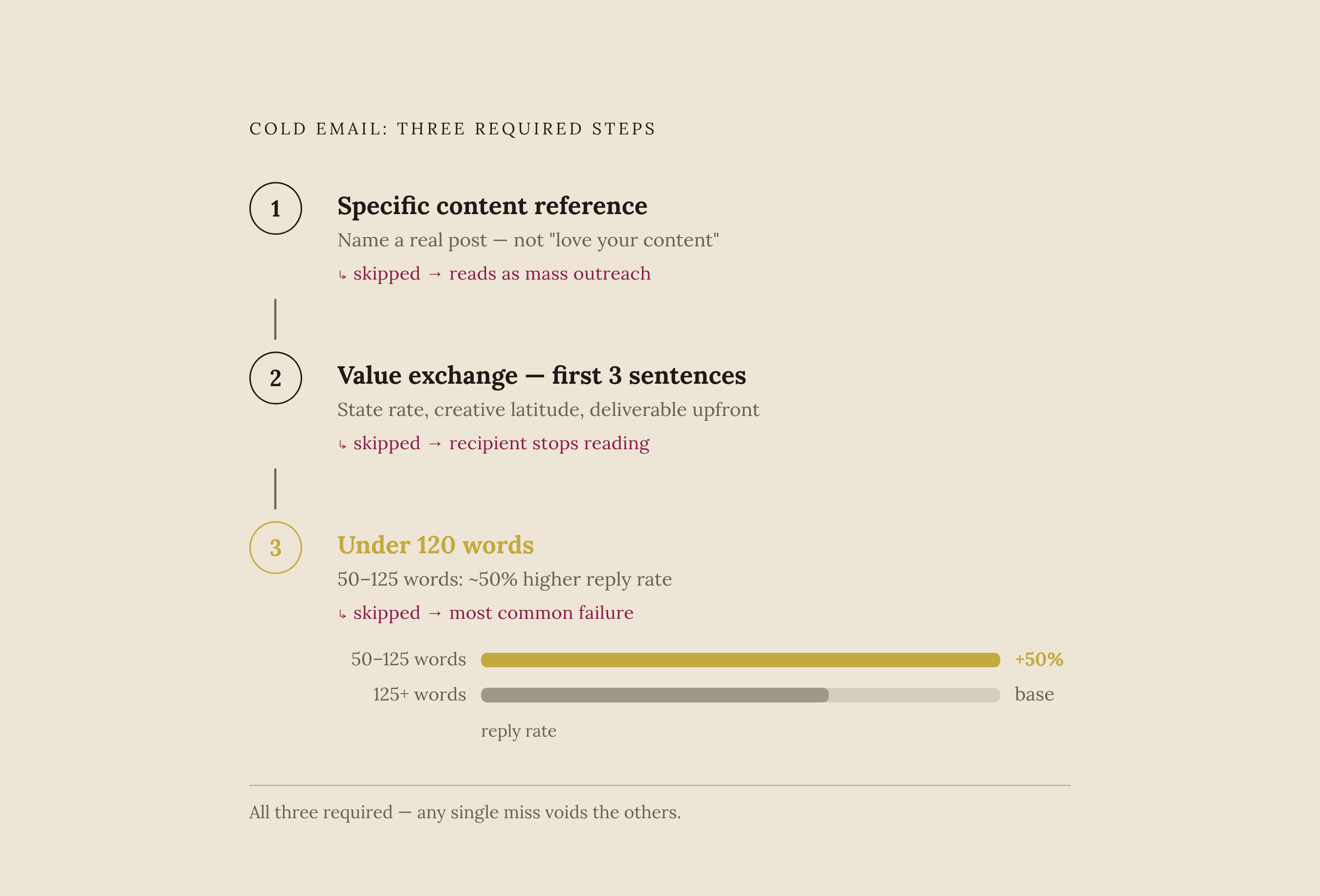
Research from Smartlead and the Influencer Marketing Hub converges on the same three traits in every email that gets a reply. It names a specific reference to the creator's actual content, states a value exchange within the first three sentences, and keeps the first pitch under 120 words. Miss any one of the three and the other two don't save the email.
Start with specificity. "I love your content" reads, to a creator who gets 15 to 30 pitches a week according to Aspire's Creator Economy Report, as the exact mail-merge signal it is. A real compliment names a specific post, a specific joke, a format choice the creator made on purpose, something that could only have been written by a person who actually watched the video. Statista's survey found 72% of creators reject partnerships on outreach quality alone, before compensation or brand fit even enter the conversation. Fifteen to twenty minutes of research per creator, checking their last five posts, noting what they've said about their audience, is the entire cost of clearing that bar.
Value exchange comes next: sequencing affects how the creator judges their importance to the sender, before the content of the message is even read. An email that spends four paragraphs describing the brand's mission before mentioning what the creator gets has already told the creator where they rank. Leading with deliverable requirements, like a shot list, before establishing why the creator should care, reads as a demand rather than an offer. Aspire's 2025 data backs this up directly: over 71% of creators prefer brands that state compensation upfront rather than burying it at the bottom of the email or, worse, saving it for a call. State the number, the product, the creative latitude, whatever the actual offer is, in the first three sentences.
Then there's length. Emails in the 50 to 125 word range post the highest reply rates in 2025-2026 data from Mailforge and Instantly, roughly 50% above longer formats. First-touch emails specifically do best under 80 words with one clear call to action. Creators are scanning pitches between shoots, on a phone, often with a thumb. An email that requires scrolling has already lost, regardless of how good the offer inside it is.
A few secondary details compound all three. Send from a named person's real address, never a no-reply alias, and write a subject line that references the creator or their content by name rather than "Partnership Opportunity," a phrase that landed in the same inbox from a dozen other brands that same week.
Ten templates organized by outreach scenario
Each of these ten covers a distinct outreach scenario, drawn from template frameworks built by Smartlead, Elev8or, and InfluenceFlow. The bracketed personalization slot in each is not decorative; it is the entire mechanism that separates the template from the generic version everyone else is sending.
1. The Warm Introduction (Smartlead). For a first pitch with no prior relationship. Leads with one specific content reference, frames the ask around relationship-building rather than transaction, and closes with a soft CTA, a quick chat rather than a signed contract. Ruined by a generic opener, or by a content reference vague enough to apply to any creator in the niche.
2. The Direct Value Lead (Smartlead). For creators who respond better to transparency than to rapport-building. States the compensation range and creative control terms in the opening lines, names the deliverable count and campaign type immediately. Ruined by burying the number, which defeats the entire premise of the template.
3. The Gentle Nudge follow-up (Smartlead). Sent four to five days after a first pitch draws no response. Recaps the value proposition in a single sentence and explicitly removes pressure, language like "no worries at all" does real work here. Ruined by repeating the full original pitch, which reads as if the sender forgot they already sent it.
4. The New Angle Follow-Up. Uses something the creator posted since the first email as fresh context, reframing the collaboration rather than restating it. Ruined by referencing stale content, or skipping the new angle and just resending the same ask.
5. No-Strings Gifting (Smartlead). States that there's no posting requirement and no contract, signaling product confidence rather than a hidden obligation. Ends with a low-friction shipping ask. Ruined by any hint of a hidden expectation buried in the fine print.
6. Gifting With Soft Ask. Builds on the no-obligation baseline but adds a light, optional request if the creator happens to enjoy the product. Ruined by making the "soft" ask feel mandatory, which undermines the entire low-pressure premise.
7. Cold Outreach for Nano or Micro Influencer (Elev8or). Subject line references a specific post. Body states the compensation figure by the second paragraph, names an exact deliverable (one Reel, two Stories, for example), and specifies "no script." Closes with a reply-to-confirm CTA, kept under 150 words. Ruined by vague deliverables or missing compensation.
8. Product Gifting, No Post Requirement. Removes the posting obligation explicitly to kill hesitation before it starts, and ends with a link to pick a variant and enter a shipping address, framed as a 30-second task. Ruined by any ambiguity about whether posting is actually required.
9. Paid Campaign Outreach for a Mid-Tier Creator. Names specific deliverables and a timeline upfront, and acknowledges that a manager may need to be copied if one is listed in the creator's bio. Ruined by ignoring a listed manager and going straight to the creator, which reads as a research failure.
10. Platform-specific DM variant. A compressed format built for Instagram's 20 to 30% DM response rate. Mirrors the email principles, specificity, value, brevity, but fits them into two or three sentences with one clear ask. Ruined by pasting an email-length pitch into a DM box, where it reads as spam regardless of content quality.
Follow-up discipline: when to send a second email
A single follow-up raises reply rates by as much as 49% in high-performing campaigns, according to data cited by Superhuman drawing on Instantly figures. And yet roughly half of all senders never send that second email, which means half of the reachable replies in any outreach campaign simply go uncollected because nobody asked twice.
Two touches, total. Send the follow-up two to three days after the initial pitch, and if there's still no answer after that second email, the silence is the answer. A third email crosses the line from persistent to pushy, and creators talk to each other about which brands do that.
The follow-up's only job is to introduce something the first email didn't say, not to repeat the ask in slightly different words. Reference a post the creator published since the first email went out. Add a detail about the offer that wasn't in the original pitch. Keep the same length discipline as the first touch, under 80 words, one call to action, no exceptions just because it's the second attempt.
Timing carries measurable weight too. Available benchmark data shows Thursday sends post the highest reply rate at 6.87%, and the 8 to 11 PM window shows the strongest engagement at 6.52%. SalesHandy's research points to 9:30 to 11:30 AM local time as the better send window for daytime outreach. None of these numbers are dramatic on their own, but stacked against a campaign running hundreds of sends, they add up to a meaningfully different reply count.
Knowing when to stop matters as much as knowing what to write. Sender reputation is a finite resource, and burning it on a third or fourth follow-up to an unresponsive creator makes every future email, to that creator and to others on the same sending domain, less likely to land.
Deliverability infrastructure that determines whether outreach reaches an inbox at all
None of the craft work above matters if the email never reaches an inbox. Global inbox placement averages 83 to 84%, meaning 6 to 7% of email traffic lands in spam before a creator ever sees it. Gmail placement runs close to 87%, while Microsoft's inboxes are a significant consideration given how much outreach volume runs through business addresses hosted on a major webmail provider.
Microsoft tightened the requirements in 2025: starting May 5, Outlook began mandatory enforcement of SPF, DKIM, and DMARC authentication for high-volume senders. Gmail's bulk sender policy requires spam complaint rates to stay under 0.1%, with 0.3% treated as a hard ceiling that triggers filtering. These aren't suggestions, they're the mechanics that decide whether a well-written email ever gets read.
Getting the authentication stack right isn't a marginal fix. Mailforge's data puts the improvement from proper authentication at up to 30.5% in response rate; proper authentication produces this gain because it determines deliverability before any other craft decision can take effect, making it a multiplier on every other decision covered so far, not a technical afterthought.
Compliance carries real teeth, too. The FTC raised its maximum civil penalty under CAN-SPAM effective January 17, 2025, and any outreach program running at volume needs to treat that as infrastructure risk, not legal boilerplate buried in a footer.
The practical minimum is short: run cold outreach from a domain separate from the primary business domain, authenticate SPF, DKIM, and DMARC on it, and watch spam complaint rates per campaign rather than per email. Skip this layer and every craft decision made earlier in the funnel gets undone before a creator's eyes ever reach the subject line.
How AI-personalized outreach changes the response rate math at scale
Janney.ai's data shows AI-personalized outreach, sent from a real sender inbox rather than a bulk-send platform, achieving 25 to 40% response rates against 5 to 10% for template email. The same data shows AI-assisted negotiation compressing deal cycles from a manual 14 to 30 days down to 5 to 10 days.
The distinction that matters here is between AI personalization and mail-merge with a smarter interface. Feeding a model a creator's name and follower count and asking it to "personalize" the email produces the same generic tell that "I love your content" produces manually. Real AI personalization requires feeding the model actual context: specific posts, audience composition, campaign fit, the same fifteen to twenty minutes of research a human would otherwise do, just compressed and scaled. The test doesn't change: would a human who actually watched this creator's work have written this sentence.
Smartlead's Q1 2026 campaign data shows what that looks like at scale. Sequences using personalized subject lines and sub-120-word first emails hit 58% open rates and 34% reply rates. Generic sequences run in parallel averaged 22% open and 6% reply, roughly the same gap that appears in the tier-level data above, just measured at the sequence level instead of the individual email level.
Agencies running multiple client portfolios face a specific version of this problem: maintaining that level of per-creator specificity across dozens of concurrent campaigns for different brands. The tool matters less here than the workflow around it: real research must actually feed each send, or the system quietly reverts to template behavior under volume pressure.
AI tools speed up the mechanics of personalization. They don't replace the judgment call about which creators are worth prioritizing in the first place, and no amount of automation fixes a list built around the wrong creators.
Creator outreach's connection to brand visibility in AI-driven discovery
Creator outreach has started to matter for a reason that has nothing to do with campaign reach directly. HireInfluence's data shows that among the 18 to 34 age group, 41% now use a generative AI tool to search for a product instead of a traditional search engine, with 24% of all consumers doing the same and 75% of that younger cohort saying they trust GenAI for at least some of its recommendations.
AI systems making those recommendations aren't just indexing brand pages. They're weighing authentic third-party signal, customer reviews and creator content specifically, to figure out how a product actually performs in the real world. That makes creator-generated content an input into how AI surfaces describe and recommend a brand, with long-tail visibility that outlasts the campaign it came from.
The scale of that surface is large and still growing. ChatGPT reported 900 million weekly active users as of February 2026, and BrightEdge's year-long analysis found AI Overviews now triggering on roughly 48% of tracked search queries, a 58% jump year over year. Every one of those surfaces is a place where creator content can show up as the evidence an AI system cites when it makes a recommendation.
The strategic implication follows directly: a creator partnership isn't only buying reach on a platform, it's producing an asset with long-tail visibility inside AI-driven conversations that outlast the original post. Agencies advising clients on influencer programs need to be able to explain that connection credibly and report campaign metrics after the fact.
Every creator email that actually converts into a partnership is doing two jobs at once. It's a campaign asset in the conventional sense, and it's also a signal that compounds, quietly, into how AI systems describe the brand months after the post itself has stopped generating impressions.
Sources
- 11 outreach email sample templates that actually get responses in 2026
- 10 Influencer Outreach Email Templates That Actually Get Replies (Copy-Paste Ready)
- Influencer Outreach Email Templates That Actually Get Replies
- Sample Influencer Outreach Templates & Guides 2026 -...
- Instagram Influencer Outreach Template 2026 - InfluenceFlow