Creator Campaign Kickoff Call Agenda and Preparation
The kickoff call determines campaign success or failure before production even starts.
Influencer marketing crossed $32.55 billion in 2025, up from $24 billion the year before, and industry figures put the average return on a working campaign at $5.78 for every dollar spent. Research from The Cirqle found that 53% of influencer campaigns miss their performance goals anyway, which makes the whole category look less like a growth channel and more like a coin flip with better production values. The failure does not trace back to creative talent or platform reach. It traces back to a single meeting, run badly or skipped outright: the kickoff call.
The research names two recurring failure modes: brands chasing follower counts instead of audience fit, and campaigns that never pin down what return on investment actually means before content goes into production. Both come from the same root cause. A brand either forces itself to answer the hard questions before a creator starts filming, or it doesn't, and the remaining share of successes starts looking a lot more like luck than strategy.
What a creator campaign kickoff call is
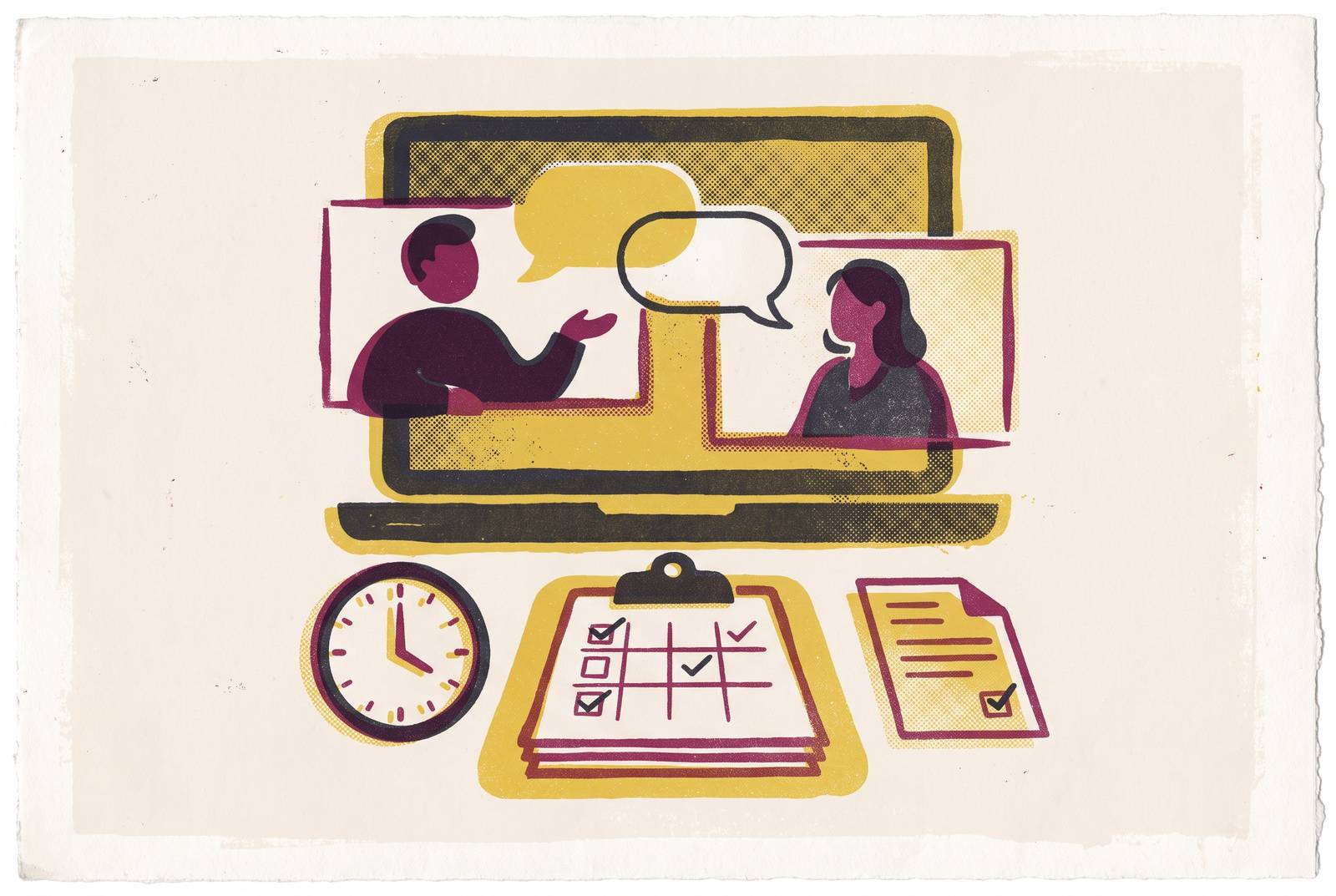
A kickoff call is the first working session, usually virtual, where brand and creator map objectives, timelines, and responsibilities before anyone produces a frame of content. It sounds simple enough to skip, and that's exactly the trap. Skipping it means production starts without agreement on what "done" even looks like.
The call does three things at once, and it needs all three to justify the time on the calendar. It aligns both sides on goals, audience, key messages, and deliverables, so nobody discovers a disagreement three weeks into editing. It heads off the slow bleed of back-and-forth emails that fill the gap left by ambiguity. And it sets the tone of the working relationship, since the rapport built in that first conversation shapes how seriously a creator treats the brief that follows.
Three misconceptions keep the call from getting the structure it needs. Treating it as just an intro chat misses that it's a planning session with specific decisions attached. Assuming it only matters for large campaigns misses that even a single sponsored post benefits from fifteen focused minutes of alignment. Treating it as optional is the costliest mistake of the three, because that is exactly where mismatched expectations and blown timelines get their start. Projects that skip the call tend to surface their problems late, when a reshoot costs real money instead of a quick message on a team chat app.
Choosing the right kickoff call format for the campaign at hand
Three formats cover nearly every situation. Picking the wrong one for the job is a quiet failure mode of its own, and the mismatch becomes visible weeks later as confusion nobody can trace back to its source.
An internal kickoff happens before any creator joins, with brand-side team members aligning on their own goals first. It matters most when a campaign spans multiple markets or needs legal sign-off before talent enters the conversation. A group kickoff brings several creators onto one call to cover shared goals, useful when messaging has to stay consistent across a wave of posts. A one-on-one kickoff is a personalized session with a single creator, and it's the only format built to engage that creator's specific voice and audience rather than hand them a generic brief.
Format should match the size and structure of the program, not how much effort a team feels like spending that week. A group call that skips individual creative context for each creator recreates the same misalignment that skipping the call entirely would cause. Even a micro-influencer project with one deliverable earns something from a short sync. The discipline scales down with the project, but it always remains present in some form.
Whichever format gets chosen, the quality of the call depends almost entirely on what happens before it starts, not during it.
Internal brand prep: what must be decided before the creator is in the room
A kickoff call converts an approved campaign concept into a shared operating plan. It is the wrong venue for research, for a first creative review, or for waiting on specialist sign-off. Those things have to happen earlier, or the call turns into a stalling exercise dressed up as alignment.
Before any creator joins, the brand needs one primary campaign goal and two or three KPIs mapped directly to it. Scope needs to be locked too, covering which markets, which languages, which products, which audience segments, which channels, the launch window, and anything explicitly excluded. A phrase like "drive awareness" is a wish. It gives nobody on the call anything concrete to plan against, and a creator handed a wish instead of a target will fill the gap with a guess.
Measurement decisions can't wait either. Whether success gets defined by click-throughs, incremental sales tied to a discount code, or raw impressions changes what kind of content gets requested, so that decision has to happen before the meeting, not during it. Roles need assigning too: someone chairs, someone owns final creative decisions, someone takes notes, someone watches the clock. A draft project plan should already exist going in, not to hand the creator a fixed script, but to give the conversation a concrete starting point instead of a blank page.
What to send creators before the call
What a brand shares in advance determines how much of the call gets spent explaining things instead of deciding them. A solid pre-read package includes the approved business objective, whatever audience data exists on the target consumer, prior campaign performance where relevant, the offer and its constraints, brand guidelines, the measurement definitions and KPIs, known risks or sensitivities, and a draft timeline.
Brand guidelines, mood boards, and reference links belong in that pre-read, not on a shared screen during the call. Reading a style guide out loud live burns the exact minutes that should go toward creative discussion. Asking the creator to send comps or early content ideas ahead of time means whoever reviews on the brand side walks in having already seen a direction, rather than reacting cold in real time.
Most creative briefs in 2026 still live in a standard document rather than a dedicated tool. Miro boards tend to handle the earlier, messier stage, the moodboards and brainstorming and loose visual concepts, before that material gets distilled into something structured. Neither tool matters as much as the discipline of sending material early enough that the call can start from alignment instead of introduction.
Opening the call: introductions and setting the right working tone
The first few minutes are not small talk. They set the register for everything that follows, and a call that opens as one-way brief delivery tends to stay one-way straight through production.
Framing the call as a dialogue changes what a creator brings to the table. Creators carry direct knowledge of how their specific community behaves: what tone lands, what format their audience actually watches to the end instead of scrolling past. An opening built around brainstorming, rather than instruction, invites that knowledge into the room. A brand that only reads its brief aloud gets a creator who executes on command. A brand that asks questions gets a creator who improves the plan, and that difference compounds across every deliverable that follows.
In practice, that means the brand introduces its core team and each person's role, the creator explains their platform and their audience's particular habits, and both sides say out loud what success looks like from where they're sitting. Getting disagreements into the open at this stage, while they're still cheap to resolve, is the entire point of doing it here rather than three weeks later.
Aligning on campaign goals, scope, and the specific metric that defines success
Two things need to be said out loud on this call, never assumed as understood. Scope is the first: markets, languages, products, audience segments, channels, launch window, and exclusions. The second is the single metric that will decide the campaign's success.
Naming that metric out loud changes what gets filmed and how results get read afterward. "We're measuring this on click-throughs to the product page" produces a different piece of content than "we're measuring this on incremental sales attributed to the discount code." If that conversation is skipped, a creator will optimize for whatever's visible on their own dashboard, usually likes and views. A campaign can rack up 800,000 impressions that convert to nothing and still look like a win from where the creator sits.
The metric shapes the content down to the shot list. A campaign measured on conversion needs the call-to-action on screen and repeated in the caption. A campaign measured on awareness doesn't need that at all, and forcing a hard CTA into an awareness piece usually just makes it worse at the one job it has. The metric decided at this point in the call is what tells the creator which one to build.
With scope and the success metric settled, the conversation can move into creative direction, where the working relationship gets tested most directly.
Giving creative direction without scripting the creator into stiffness
The operating principle here is guardrails: enough direction to protect the brand's message, enough freedom that the finished content still sounds like the person who made it.
At this stage the brief should cover the key message and the points that must get said, topics or language to avoid, competitor references, whatever disclosure language is legally required, and the brand's voice and tone, ideally by pointing back to the mood board already sent ahead of the call. Value propositions and talking points belong here too, framed as points to hit rather than lines to read verbatim.
What the brief should never include is a word-for-word script or a shot-by-shot storyboard. Audiences follow a creator for that creator's voice, and content that's been over-controlled reads as an advertisement instead of a recommendation, which defeats the reason a brand hired a creator instead of buying a media placement. Platform matters here too, and treating platforms as interchangeable is a mistake: Each platform has its own norms and audience expectations. Applying one set of content rules across all of them makes the result mediocre on every single one.
The deliverables walkthrough: format, platform, length, and posting window spelled out precisely
"An Instagram post" is not a deliverable. A deliverable is one Instagram Reel, vertical, thirty to forty-five seconds, posted October 14th between 7 and 9pm CET. The gap between those two descriptions is where most production timelines quietly fall apart, and most brands operate on the wrong side of that gap.
The call should confirm format (single post, carousel, video, Stories, Reel, Short), platform, length or dimensions, number of pieces, required hashtags, any tracking link or discount code that has to appear on screen, the exact posting date and time window, usage rights (can the brand repurpose the content elsewhere, and for how long), and payment terms.
Video specifically, TikToks, Reels, YouTube Shorts, carries its own layer of technical detail that has to get addressed here: audio quality standards, caption requirements, platform-specific compliance rules, metadata. If these are skipped on the call, they do not disappear. They just resurface in a revision round later, after the creator has already produced something that fails to meet a standard nobody mentioned during the call.
Once everyone agrees on what's actually getting made, the conversation turns to how that content gets reviewed before it goes live.
Setting up the content approval process so it does not become a bottleneck
Approval is where otherwise solid kickoff calls still fall apart, mostly because the process gets gestured at instead of specified. Brands typically run two to three rounds of approval before signing off on final content, though fast-track processes can bring that down significantly for creators with an established track record and straightforward deliverables. Batch approvals, reviewing several pieces of content together instead of one at a time, cut publication timelines by roughly 40% compared to reviewing post by post.
The call needs to name the specific person who reviews content, not "the team" in the abstract. It needs to establish whether the creator submits a concept or script before producing the full piece, how many days sit between submission and feedback, and the maximum number of revision rounds allowed, stated as an actual number rather than an open-ended "as needed." It helps too to agree on what counts as a minor fix versus what triggers a full escalation, so a small wording change doesn't get routed through the same process as a genuine creative disagreement.
Asking creators to share comps before the call means the review team isn't seeing a direction for the first time mid-approval, which is the single fastest way to blow past a deadline. A written recap sent to everyone after the call, covering what got agreed, becomes the record both sides point back to once memory of a verbal conversation gets fuzzy two weeks later.
Closing the call: roles, timeline, and the follow-up that keeps both sides accountable
The last few minutes need to nail down who does what: who handles scripting or creative development, who handles editing and post-production, who owns final approvals (named specifically, never just a department), who tracks performance once the content is live, and who serves as the creator's actual point of contact when a question comes up mid-production.
Timeline gets locked here too. A firm deadline for the first draft or concept, and an agreed window for how long revisions are allowed to run. Vague deadlines let a two-week production schedule quietly turn into a five-week one, with neither side quite able to say when it slipped or why it slipped.
None of this replaces the written recap that follows the call. If that recap is skipped, the campaign is relying on memory to hold together a plan with a dozen moving parts, across two organizations, working from two different sets of notes taken by two different people. Given that 53% of these campaigns already miss their goals without that added risk, memory was never going to be equal to the task.