Influencer Contract Exclusivity Clauses and Competitor Lockouts
Exclusivity clauses protect brand value but are widely misdrafted on both sides.

Influencer marketing hit $33 billion globally in 2025, and exclusivity clauses are the single most consequential term in the contracts that move that money. They're also the term most often misdrafted, on both sides of the table, and the mistake stays invisible right up until a deal turns into a dispute. Most people default to the broadest possible restriction because it feels safer to draft. That instinct is the single most expensive habit in this entire practice.
A brand pays for a creator's audience trust, not just a post, and that trust dilutes fast if the same voice is endorsing a direct competitor a week later. Exclusivity protects the thing the brand actually bought. Strip it down and the clause does three jobs at once: it makes the endorsement read as singular rather than one entry in a roster of paid partners, it keeps a competitor out of that audience during and after the campaign, and it holds the content's value in place for a defined stretch of time. It sits alongside scope, compensation, deliverables, IP and usage, disclosure, kill fee, and dispute resolution as a standard clause in a modern influencer contract, not a footnote bolted onto the deal. Priced and scoped correctly, it's a commercial protection that benefits whoever's on either side of the signature line, not a discipline creators grudgingly accept.
The four structural forms exclusivity takes in practice
Category exclusivity is the version most people picture: no other fitness or activewear brands for three months, say, while the current deal runs. It's the default because it maps cleanly onto how brands think about competition, industry by industry. It's also the version most often drafted too broadly, and that's where the real cost hides.
Brand-specific exclusivity is narrower, the more disciplined choice when a brand has one real rival in mind. Instead of locking out an entire category, it names one competitor, or a short list of them, and leaves everything else open. Platform exclusivity narrows things a different way: a creator might be locked out of promoting rival brands on Instagram specifically, while staying free to run competing deals on YouTube or TikTok. Geographic exclusivity slices by territory instead, so a creator under exclusivity with a company in one country can still take on that same brand's competitors in Europe without breaching anything.
Full exclusivity, meaning no brand deals of any kind, is rare. It mostly shows up in celebrity ambassador arrangements, where the compensation reflects just how much ground is being given up.
None of these forms are mutually exclusive. A single contract might stack category exclusivity with a platform limit and a geographic carve-out all at once. The form chosen should match what the brand is actually trying to protect. Defaulting to the broadest version available, just because it's available, is how deals get more expensive than they need to be and how creators end up boxed out of income they never should have lost.
How the scope of a competitor lockout is defined, and why vague language is a liability
A clause built around a brand list ("no deals with Notion, Asana, or ClickUp") looks precise on paper and fails in practice, because it stops covering anything the moment a new competitor launches. Naming a category instead ("no competing project-management software") holds up regardless of who enters the market mid-contract. That preference is not stylistic. It's the difference between a clause that still functions in month eleven and one that quietly expired in month three.
The recurring failure points are consistent across bad drafts. Categories get defined too broadly, blocking an entire industry instead of the specific segment the brand actually competes in. Key terms get left undefined: "competitor," "similar products," and "same industry" show up in the clause with no contractual meaning attached, and that gap is exactly what turns into a dispute later. List-only drafting, as noted, expires the moment a new entrant shows up.
The fix is to define the restricted category by product type and consumer function, then attach a non-exhaustive list of named brands purely as illustration. That gives the brand a definition that survives market changes and gives the creator a scope they can actually plan around. Talent agreements are widely understood to be negotiated rather than accepted as-is, per Ironclad, so vague scope language doesn't sit quietly in a signed contract. It gets tested at the table before anyone signs, and weak definitions are usually where those conversations stall out. When "competitor" is left undefined, the creator is the one absorbing the uncertainty, unsure whether a brand in an adjacent category triggers the restriction. That uncertainty resolves either as missed income or as a breach dispute nobody wanted.
Duration standards, blackout periods, and where the negotiation actually happens
The during-campaign restriction is the one nobody argues about. That's the window where the brand's investment is most exposed, and both sides generally treat it as non-negotiable. Standard duration benchmarks typically place the during-campaign window at several weeks, with premium deals extending longer.
The real friction shows up in the post-term blackout period: the stretch of weeks or months after the final deliverable goes live during which the creator still can't work with a competitor. It's the part of the clause creators skip past most often, and the part brands lean on hardest. Once the content is published, though, the brand has already captured most of its value, so a long post-term extension adds little additional protection while cutting directly into the creator's future income. Brands that push for six-month blackouts on a single Instagram carousel are asking for protection the content itself can't justify. That's the wrong instinct, and creators should treat it as a red flag rather than a standard ask.
The regulatory ground under this shifted recently. The FTC's 2024 Non-Compete Clause Rule was vacated as of September 5, 2025, so enforceability of non-compete-style restrictions now turns on applicable law outside the vacated rule, so enforceability of non-compete-style restrictions now turns on applicable law outside the vacated rule. That puts real weight on how a contract defines its own end date, particularly where creation and usage terms are split apart, because a dispute over when the contract formally ends is a dispute over when post-term exclusivity even starts running. Creators negotiating short campaigns should push to cap the post-term window tightly. Brands, for their part, should size that window to actual exposure risk instead of defaulting to the longest term they can get away with.
Pricing exclusivity correctly, the premium model and the most common error creators make
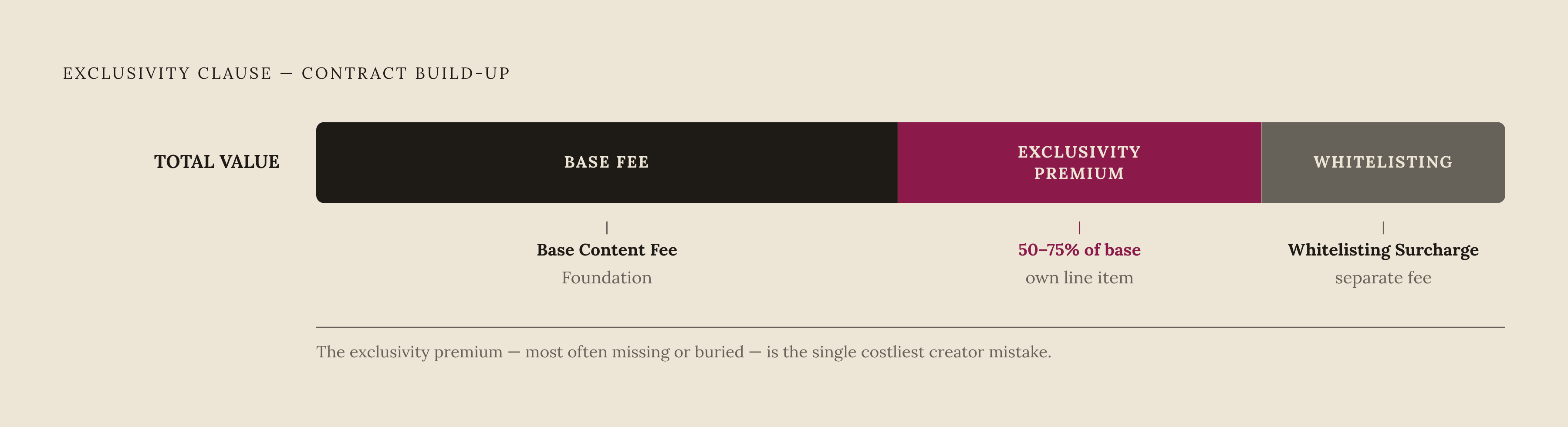
Exclusivity is a restriction on future earning capacity, not a creative deliverable, and it needs its own line item rather than getting folded into the base content fee. The market benchmark for that premium runs in the range of 50 to 75 percent of the base fee, paid on top of content costs, not instead of them.
That math only holds if the base rate itself is sound. If the base fee was set off follower count instead of engagement quality, the exclusivity premium inherits the same error and just makes it bigger.
Whitelisting, meaning paid amplification of the creator's content through the brand's own ad accounts, is a separate right entirely and carries its own surcharge, unrelated to whatever exclusivity is priced at. Ambassador programs handle this differently again: exclusivity there is usually baked into the monthly retainer rather than itemized, which is why ambassador rates run structurally higher than a straight per-post fee. A discount without volume behind it doesn't hold up as one. It's compensation for an ongoing restriction, and treating it as anything less is how ambassador deals end up underpriced across the board.
The costliest mistake, by a wide margin, is a creator accepting exclusivity for free, or finding it buried inside usage-rights language with no dedicated fee attached at all. A creator who misses that is effectively subsidizing the brand's competitor lockout out of their own pocket. Keep the 60-to-75-percent range on hand as a gut check against any offer that comes across the table. Any contract that mentions exclusivity without a corresponding number next to it deserves to be sent back before signing.
How exclusivity terms scale with influencer tier and contract complexity
Micro-influencer deals tend to carry lighter exclusivity, both in scope and duration, and the contracts around them are often shorter and less formally built out, though the clause is rarely absent entirely.
Macro-influencer contracts, meaning creators with large followings who haven't reached celebrity status, typically carry detailed competitor-lockout language as a matter of course. Agreements at this level often run several pages and warrant legal review before signing. Mega-influencer and celebrity deals sit at the far end: exclusivity can approach the full-exclusivity model for the length of the contract, compensation scales up to match that restriction, and negotiations at this tier tend to run long.
Ambassador programs are close to a fixed feature regardless of tier. Category exclusivity for the full contract term is almost always embedded rather than something either side negotiates around. One-off sponsored posts sit at the other extreme, where category exclusivity for a defined window gets requested constantly and accepted just as often, so long as it's priced fairly.
Tier sets the baseline expectation. It doesn't change the underlying obligation: exclusivity still has to be defined precisely and priced honestly, whether the deal is worth a few hundred dollars or seven figures.
The FTC regulatory layer and how it intersects with post-term restrictions
The FTC's disclosure requirements for 2026 remain untouched by any of this: paid or incentivized endorsements still need clear, visible disclosure, and an exclusivity clause has no bearing on that obligation whatsoever.
Where things get more complicated is the overlap with non-compete rulemaking. FTC action on non-competes in employment contracts raised a real question about whether influencer exclusivity clauses would get swept in. The distinction that's held up is that restrictions active during the contract term remain valid; the contested ground is what happens after the term ends, per EPGD Business Law. Complicating that further is how influencers are classified. They're independent contractors, not employees, and FTC guidelines treat them as workers subject to FTC rules within their contractor agreements, so exclusivity clauses sit at the intersection of ordinary contract law and FTC compliance at the same time.
The specific risk here is a contract with separate creation and usage terms. That structure creates genuine ambiguity about when the relationship is actually over, and therefore when a post-term exclusivity clock starts ticking, which is exactly where enforcement disputes tend to concentrate. Brands have responded by leaning harder on confidentiality clauses to make up ground where post-term exclusivity itself has gotten harder to enforce, layering protections rather than betting everything on one clause. This backdrop matters for how these clauses get drafted now, though it isn't a substitute for legal review on high-value contracts or for legal advice generally.
What brands and creators each risk when exclusivity clauses are poorly structured
On the brand side, an overly broad category definition tends to alienate creators, either driving up the premium they demand or killing the deal outright before it closes. Undefined terms like "competitor" turn the clause into something unenforceable the moment there's an actual dispute. Post-term extensions priced as though they carry the same value as the live campaign ignore the fact that returns diminish sharply once the content's already been seen, and a brand that skipped negotiating post-term coverage at all can watch a competitor step into that same audience the day after the campaign ends.
On the creator side, the costliest error by far is agreeing to exclusivity that's unpaid or underpriced, especially across a multi-month ambassador term where the lost income compounds. Unclear contract-duration language leaves a creator unsure whether post-term restrictions have even started running. Broad category definitions can quietly block adjacent deals nobody saw coming when the contract was signed, and exclusivity terms buried inside usage-rights language are easy to miss without a careful read.
The risk both sides share is the same one. A clause neither party fully understood at signing is a clause that fails at the exact moment it's tested, and exclusivity disputes tend to cost far more, relative to the size of the original deal, than either side expected going in. Given that exclusivity is a central term in these agreements and is widely understood to be negotiated rather than accepted as-is, both sides are better served knowing precisely what they're trading before they ever sit down.
Practical standards for structuring an exclusivity clause that holds up
Define the restricted category by product function and consumer segment first, then attach a non-exhaustive list of named brands as illustration only, never as the operative definition. Set duration to match actual exposure: the during-campaign restriction isn't up for debate, but the post-term extension should reflect the real shelf-life of the content and the brand's genuine competitive risk, not whatever the longest standard term happens to be.
Price exclusivity as its own line item, at a benchmark in the range of 50 to 75 percent of the base content fee, kept separate from content fees, usage rights, and any whitelisting surcharge. Where creation and usage terms are split into separate provisions, spell out explicitly when the exclusivity clock starts and when it stops, since ambiguity on that single point is exactly where enforcement disputes tend to concentrate. For ambassador programs, put in writing that exclusivity is part of the retainer structure, so both sides work from the same understanding rather than treating it as an unstated discount.
Both sides should read the exclusivity clause next to the usage-rights clause every time, since these are the two provisions most often bundled together in ways that hide an unpaid restriction. For macro-tier deals and above, legal review isn't optional: the financial exposure from a badly drafted exclusivity clause is routinely larger than the cost of the counsel that would have caught it.
The eight-clause architecture, scope, compensation, deliverables, exclusivity, IP and usage, disclosure, kill fee, and dispute resolution, gives both sides a checklist to work from. Exclusivity belongs on that list as its own named, standalone clause. Folded into something else, it's the kind of term that gets missed right up until the moment it matters most.