Whitelisting and Dark Post Rights in Creator Agreements
Splitting whitelisting and dark post rights prevents mid-campaign renegotiations.
Whitelisting and dark posting are not the same right, and creator agreements that treat them as one clause are the reason paid media teams end up renegotiating mid-flight. One grants a brand access to a creator's account. The other lets a brand run content in a paid unit that never touches the creator's profile at all. Confuse the two at the drafting stage, and the gap surfaces on launch day, when the campaign clock is running and the creator holds all the leverage.
What the paid amplification market looks like and why contract precision is now a commercial necessity
The content creator economy hit $160.3 billion in 2025 and is on track for $205.81 billion in 2026, a 28.4% compound annual growth rate according to the Business Research Company's Content Creator Economy Global Market Report, published March 2026. Inside that growth, paid amplification has emerged as a fast-moving piece: brands are pulling creator content out of organic social and pushing it into display, connected TV, and retail media, none of which were part of the original creator deal.
At that scale, a contract written for one Instagram post and a 30-day boost clause stops working. Run a program across six platforms and four regions with a paid media calendar that shifts weekly, and the standard agreement cracks under its own vagueness. Legal ends up re-papering usage rights creator by creator, campaign by campaign, which is slow and costly in exactly the moments speed matters most.
Difficulty securing usage rights is widely cited among paid media managers and marketing executives as a top barrier to scaling creator content. That bottleneck sits in the contract, not the creative, and most teams still get this backwards: they treat the negotiation as a legal afterthought instead of the thing that actually determines whether the campaign can scale at all. Brands that wait to negotiate rights until content already exists face narrower permissions and a creator who knows the campaign now depends on their signature. The clause architecture has to exist before a single asset gets shot, not after, and that's the argument the rest of this piece works through.
The five contract clauses that actually govern whether a paid media team can do its job
Platform scope and inventory access. Name every platform outright: Meta (Facebook, Instagram, Audience Network), TikTok Spark Ads, YouTube, Pinterest, programmatic display, connected TV. A catch-all line like "digital advertising" sounds broad on paper and gets disputed constantly in practice. TikTok's Spark Ads format needs a separate authorization code generated by the creator, so the contract has to obligate them to actually produce it, not just agree to the idea of it.
Duration with renewal options. A 90-day initial term is a common starting point, but strong creative regularly outlives it. Build in a brand-side option to extend in 30-day increments at a rate set upfront, so the negotiation doesn't restart the moment the creative starts working. Skip perpetual rights unless the fee actually reflects that long horizon: unlimited usage kills the creator's future earning potential on that same asset, and creators, or their agents, know it.
Creative modification rights. Can the media team drop in a CTA overlay? Swap the end card? Write three new lines of ad copy for an A/B test? Most creators accept moderate edits and balk at a full re-cut, but "modification" needs actual definition, because it's the clause most standard influencer contracts leave vaguest.
Whitelisting and dark post permissions, as two separate grants. This is the clause, and the fee line, where the conflation problem gets fixed or doesn't. Splitting them out gives the media team a clear answer when someone asks which assets can run as dark posts and which need handle access, and it settles the argument before it turns into a campaign-day fire drill.
Exclusivity tied to the paid amplification window. Category exclusivity that runs only for the length of the paid flight keeps a direct competitor from whitelisting the same creator mid-campaign. Even a narrow 30-day window carries weight if it's tied to the actual paid period, and broader exclusivity should cost more, in proportion to what it's blocking.
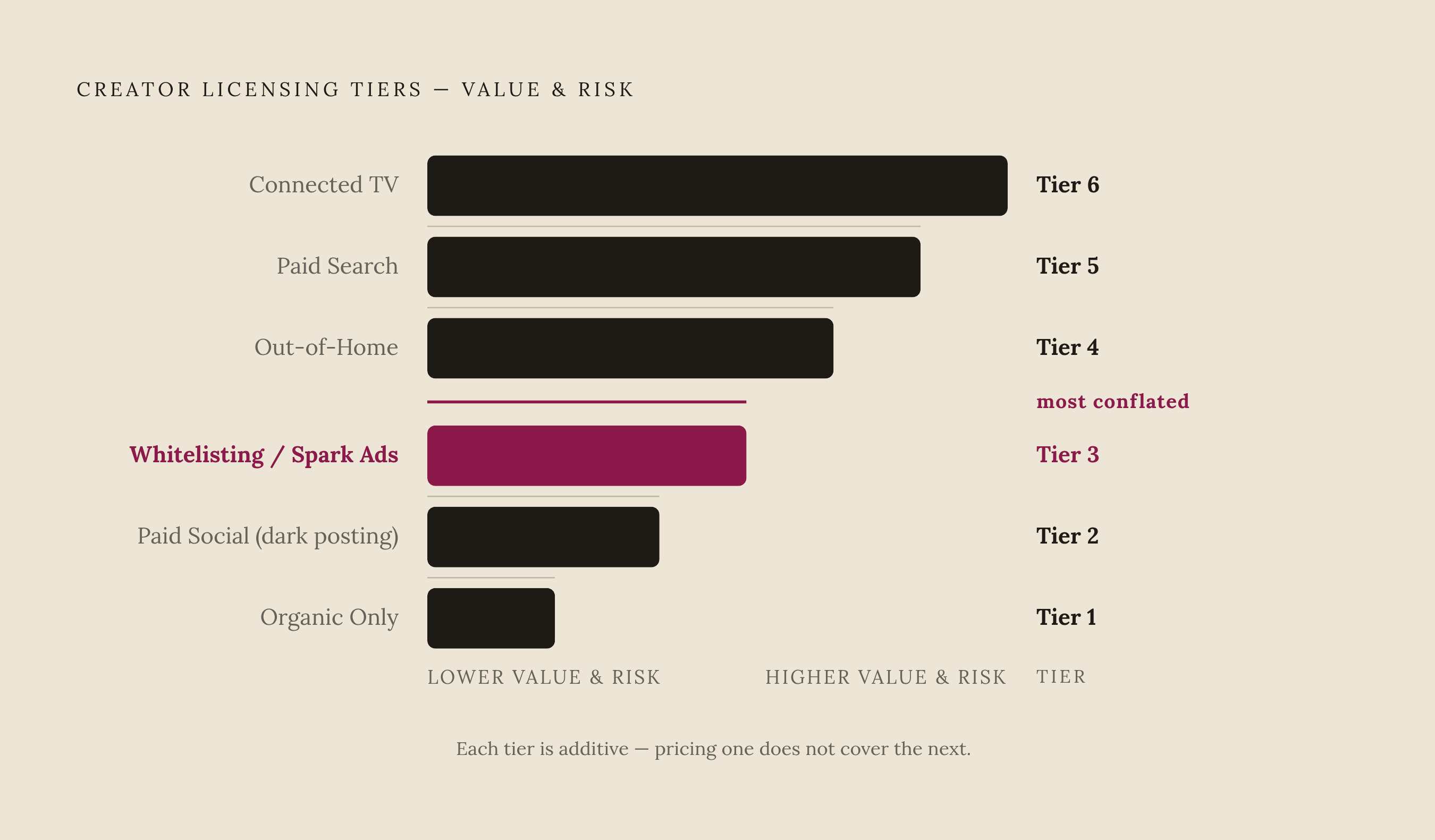
A full licensing program moves through tiers of rising value and rising risk: organic-only, paid social (dark posting), whitelisting or Spark Ads, out-of-home, paid search, connected TV. Each tier carries its own exposure, and none of them substitute for the others. Pricing one tier as if it covers the next is how brands end up back at the negotiating table.
How to price whitelisting and dark posting rights without breaking the CPA math
The premium for whitelisting isn't arbitrary, and it shouldn't get treated as negotiable padding. Brands running creator-whitelisted ads consistently outperform their own brand-run ads by 30 to 50% on cost-per-acquisition, and the trust advantage a creator handle carries in the feed is part of what drives the performance differential over brand-page ads. On the B2B side, the 2024 Edelman-LinkedIn B2B Thought Leadership Impact Study found 73% of decision-makers trust thought leadership more than traditional marketing, meaning a whitelisted ad enters the feed with a trust baseline a brand-page ad simply doesn't carry.
Rate guides give a rough map of where fees land. Per Launchpoint's 2026 creator rate guide, micro-influencers (10K to 100K followers) run roughly $150 to $500 a month for whitelisting access, while mid-tier creators (100K to 500K) run $500 to $2,000 a month. Usage rights extending past the standard 30 days typically add a 20 to 30% premium on top of the base content fee, and exclusivity that blocks competing brand work during the whitelisting window stacks another cost on top of that.
Dark post licensing runs on its own pricing track: a content license only, no account-access fee attached, because there's no handle relationship to price in.
This is where the math actually breaks, and it breaks in a specific, avoidable way. A creator charging a steep multiple of their normal organic rate for whitelisting access can eat the entire efficiency gain before the first impression even serves. Brands sign the rights clause and the fee separately, in sequence rather than at the same table, and the CPA advantage that justified the whitelisting spend in the first place quietly disappears somewhere between contract signature and campaign launch. Perpetual rights don't fix this. They just let a brand skip the work of checking whether the fee still earns its keep, and pay for skipping it later. Check performance monthly instead, and extend rights only on the assets that earn it.
The FTC disclosure obligations that whitelisted and dark post contracts routinely leave unaddressed
The FTC's Endorsement Guides require clear and conspicuous disclosure any time a material connection exists between a brand and an endorser. That rule doesn't soften because the unit in question is a dark post instead of an organic one, and it doesn't care that the audience never sees it on the creator's public grid.
Most agreements fall short in the same specific spot: they spell out disclosure requirements for what the creator posts organically, and say nothing about content the brand runs as a dark post under the creator's identity. That's a gap in the paper, not a compliance win by omission. Dark posting almost always sits on top of a whitelisting agreement, and those whitelisting agreements are usually written around usage rights and revenue splits, with no line naming who's actually responsible for putting the disclosure into the ad creative itself.
Platform tools don't close that gap on their own. Platform disclosure tools require deliberate setup, and a creative team can misconfigure or overlook them during upload without anyone noticing until later. Platforms also truncate captions inside ad units routinely, so a disclosure that reads fine at the bottom of a long organic caption can get clipped off entirely once that same copy runs as a paid unit. Dynamic creative optimization tools can reformat ad creative automatically, which creates a risk that disclosure language is altered or removed without any single person deciding to remove it. On TikTok Spark Ads and most other platforms, disclosure has to get defined contractually, since the platform label doesn't carry the weight Meta's Partnership Ads tooling partially does.
Then there's the paper trail. If a brand can't produce documentation showing which disclosed asset ran under which ad ID, on what date, it has nothing to hand the FTC or a state attorney general if either one comes asking. The contract needs to say, in writing, who keeps that record and how.
Exposure runs in both directions. The FTC has a track record of pursuing both the creator and the brand behind an undisclosed endorsement, and whitelisting arrangements often blur who technically "published" the ad. That blur doesn't help the brand: its media team configured the buy and launched it, which puts direct exposure on the brand regardless of whose name sits on the account. Regulatory scrutiny of influencer marketing has expanded beyond organic posts, and a compliance program built only around the public feed may not cover the full range of content regulators examine. A compliance program built only around the public feed is covering roughly half the ground regulators are actually checking. Layer in GDPR and state privacy law, and the exposure widens further: audience data collected while running ads from a creator's handle is data processing, and the data processing agreement needs to name that scope directly, especially wherever retargeting builds off whitelisted ad engagement.
How disclosure language and approval accountability belong in the contract, not left to the campaign
The contract has to name who embeds disclosure in every ad variant, not just the hero cut but every A/B test spun off it. It has to spell out the exact language and placement, something like "#ad" or "Paid partnership with [Brand]" visible before a viewer engages, not buried under three lines of caption. And it has to say what happens when a platform reformats creative in a way that strips or obscures that disclosure: who is responsible for catching it and correcting it.
A four-checkpoint approval pipeline keeps disclosure from quietly disappearing once volume picks up. Rights verification confirms the contract actually grants paid amplification for that platform and that creative type. Compliance review checks disclosure language, platform ad policy, and anything specific to a regulated category like finance, health, or alcohol. Brand and creative sign-off confirms tone, claims accuracy, and fit with whatever else is running in the campaign. Performance team activation comes last: the paid media team pulls the approved asset, tags the handle, and launches.
Not every asset needs the same scrutiny, and treating them all equally just slows the pipeline down for no reason. Low-risk assets, previously approved creator relationships in non-regulated categories, can move through an automated checklist without a lawyer in the loop, as long as the contract terms were already verified. Mid-risk assets, new creators or borderline categories, need a lighter legal touchpoint. High-risk assets, financial products, health claims, alcohol, anything with regulatory teeth, get full legal sign-off every time, no exceptions.
Accountability needs a name attached to it, not a department. Influencer and creator operations handles rights verification and routing. A single approval owner, often a Creator Program Lead or Category Operations Manager, signs off that every checkpoint actually cleared. Legal and compliance get consulted on flagged content and the high-risk tier, not on every asset that moves through the pipeline. Finance and paid media leadership stay informed through aggregate reporting rather than reviewing assets one by one. The contract itself should require the brand to keep records linking approved creative to disclosure confirmation, by date, across the full campaign window. That record is what makes the program defensible after the fact, not just well-intentioned at the start.
What breaks when agencies manage whitelisting and dark post rights across multiple brand clients
Dark posting sits across paid media, influencer marketing, and brand content at once, and most org charts still assume those are three separate lanes with three separate owners. That assumption holds fine at small volume. It collapses once an agency runs whitelisting and dark post rights across several brand clients at the same time.
Rights negotiated for one brand's campaign get assumed, wrongly, to cover a different brand's use of the same creator. Disclosure language approved for one brand's tone and category doesn't necessarily fit a second brand in a regulated category, even when the same agency team runs both accounts. And a creator vetted thoroughly for one brief often isn't formally on-boarded for the next, which leaves two bad options: re-vet from scratch every time, which is redundant and slow, or skip vetting on the assumption nothing's changed. The second option is the one agencies actually take under deadline pressure, and it's the wrong call: skipping vetting is a risk nobody should take on a creator relationship that now touches a second client's brand. The first option costs time. The second costs a lot more when it goes wrong.
As the creator economy expanded through 2025, agencies acquiring creator-focused shops are inheriting exactly this patchwork: overlapping creator contracts, inconsistent disclosure standards, and rights language that was never built to scale past a single brand relationship in the first place.