Morality Clauses in Influencer Contracts for Brand Safety
Brands need specific morality clauses or they lose in court.

Global influencer spending reached tens of billions of dollars in 2025, and a single creator scandal can wipe out a chunk of that value before a brand's legal team finishes drafting a statement. The tool meant to stop the bleeding is the morality clause, and most of them are written badly enough that they fail exactly when a brand needs them most. The fix is specificity, and most brands still get that backwards. It's specificity, and most brands still get that backwards.
What a morality clause says and what it gives each party
A morality clause gives a brand the right to walk away, and to make a creator take content down, if that creator does something the brand decides is damaging to its name. The traditional language, carried over from a century of use in entertainment and sports contracts, prohibits conduct "reasonably tending to bring the employer into public disrepute, contempt, scandal or ridicule," or anything that might "shock, insult or offend any class or group of people." Lawyers have used some version of that wording since long before anyone had a social media account.
For the brand, the clause does three jobs: it opens an exit, it forces content removal, and it gives grounds to hold back or claw back payment. None of that works unless the triggering conduct is actually defined somewhere in the agreement. For the creator, a well-built clause does something valuable too. It states exactly what's off-limits, and if the creator has negotiated well, it protects their pay when the brand invokes the clause instead of leaving them exposed to a one-sided call.
The detail that gets missed constantly is that outside of a signed contractual right, a brand has almost no power to make a creator delete a post from their own channel. That right has to exist in writing before the campaign goes live, not after a controversy breaks and everyone's scrambling for leverage. The morality clause also gets tangled up with three other provisions that need separating: the termination clause, the indemnity clause, and the content approval process. Each does distinct work. Treat them as interchangeable and gaps open up that nobody notices until a dispute lands in front of a judge.
Why courts notice the vagueness problem
Brands want room to move. Broad language like "morally reprehensible conduct" gives them that room, which is exactly why creators and their lawyers fight it. Vague wording hands the brand a trigger it can pull almost whenever it wants, and nobody at the negotiating table misses that.
The Lewis & Clark Law Review's piece on the subject, "Cancelled: Morality Clauses in an Influencer Era," notes that courts examine the actual language of the clause, the specific conduct in question, and whether the brand's actions lined up with what the contract says. Timing matters. Internal emails matter. Public statements matter. A brand that terminates a deal citing vague moral grounds, while its own internal messaging app records show the real motivation was a campaign that underperformed, has handed the creator's lawyers exactly what they need.
The flexibility that feels smart at the drafting table is the same flexibility that loses in court. Vague clauses don't protect brands, they expose them, because a judge reading "morally reprehensible" alongside a termination timed to a bad quarterly report will draw the obvious conclusion. Clarity up front does more for a brand's protection than discretion ever will. Tie termination rights to well-defined triggers, align them with the payment terms, and most of the uncertainty disappears before it has a chance to matter.
How to enumerate triggers so the clause does what it's meant to do
Specific beats vague, every time, and a clause built on one catch-all phrase is a clause built to lose. List out categories of conduct that count as a breach instead.
Criminal proceedings sit at the top of most lists: an arrest or a criminal charge, regardless of the eventual outcome, should give the brand an immediate right to terminate. Below that sit prohibited content behaviors, drug use, pornographic material, hate speech, defined precisely enough that both sides can point to the same standard and agree on whether it was crossed. Values misalignment is harder to draft but increasingly the category that matters most. It means spelling out scenarios like a creator publicly promoting a brand that's rolled back its DEI commitments or gotten caught in an environmental violation. Platform-specific conduct rounds it out: a post on a creator's personal account isn't the same thing as a post on the branded campaign channel, and the contract should name which platforms the clause actually covers.
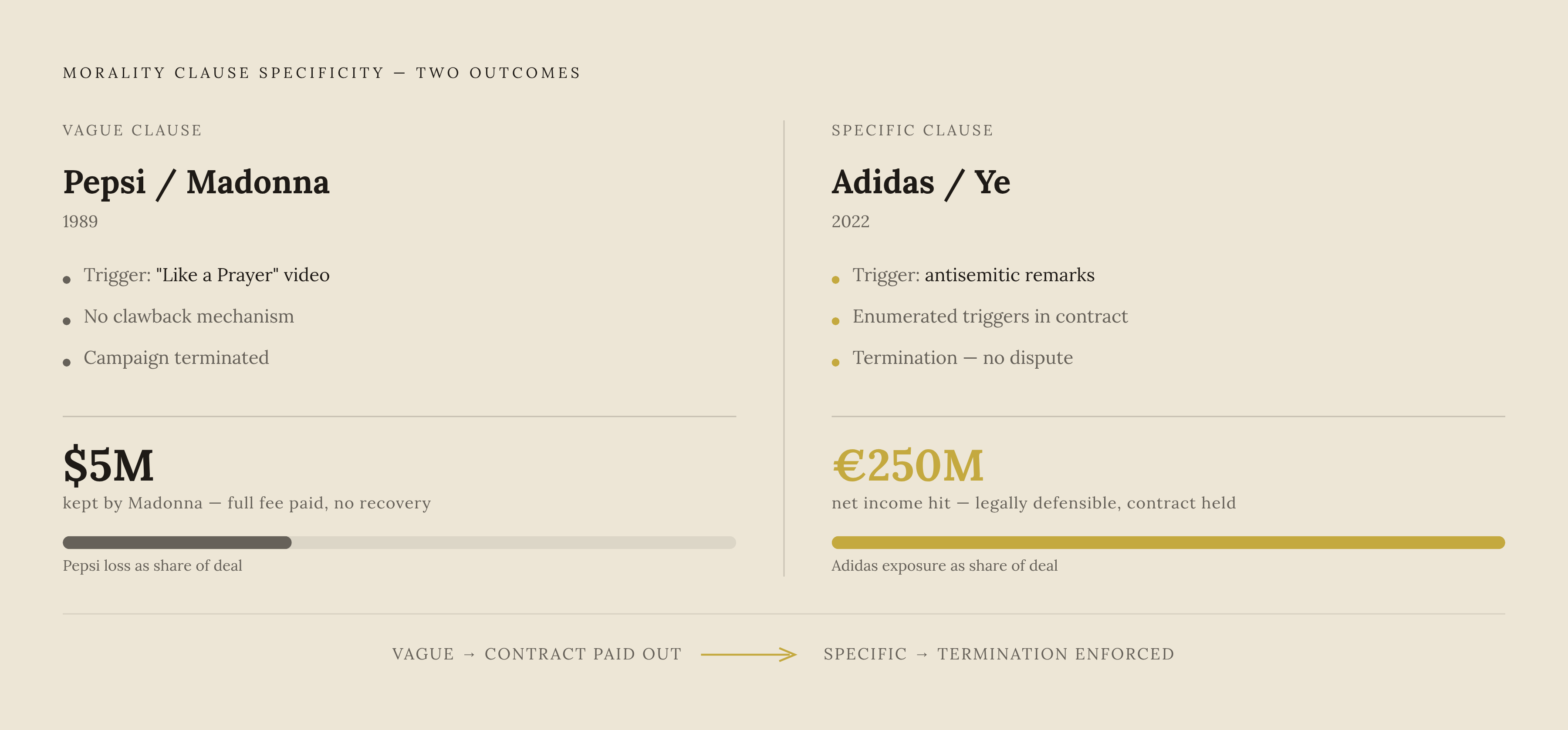
Adidas and Ye show what happens when this works as intended. Antisemitic remarks made across social media gave Adidas grounds to end the Yeezy partnership and stop all payments. Adidas estimated the short-term hit to 2022 net income at up to €250 million. That's the cost of the underlying business decision, not the contract itself, but the clarity of the termination right is what let Adidas act fast and defend the move publicly without getting bogged down in a fight over what the contract actually permitted.
Specificity cuts both ways, too. A creator who knows exactly what's prohibited can make informed choices about their own conduct, rather than operating under a clause so open-ended that almost anything could be read as a violation after the fact.
Notice, cure periods, and the staged exit process
Not every violation calls for an instant termination. A staged process, built around notice and a chance to fix things, holds up better in court and treats the creator more fairly.
The common structure: the brand sends written notice describing the alleged breach, then gives a cure window, commonly somewhere between 10 and 30 days, during which the creator can dispute the claim, take down the offending post, or issue a public correction. That window buys time for damage control, keeps the relationship alive if the issue is fixable, and builds a paper trail showing the brand followed its own process rather than acting on impulse.
Some triggers should skip the cure period entirely, and the contract needs to name which ones. A criminal arrest or hate speech posted to a public platform generally justifies immediate termination with no waiting period. Beyond the termination mechanics, the contract should also spell out what happens next: how fast sponsored posts come down from social feeds and brand pages, and whether both sides have agreed in advance on language for any public statement explaining the split.
What happens to compensation when the clause fires
Money is where morality clauses get tested in the real world. When David Dobrik lost 13 sponsors, some of the higher-tier creators involved still walked away with a percentage of their contracted fee, because they'd negotiated kill-fee protection ahead of time. That protection didn't happen by accident.
The Pepsi and Madonna case from 1989 shows how this plays out. Pepsi pulled its "Like a Prayer" campaign after religious groups condemned the music video, but Madonna kept the full $5 million fee, because the contract Pepsi signed gave it no mechanism to claw the money back. That's an old lesson, and it still applies: if the payment terms don't address termination directly, the brand's exit right is worth less than it looks.
Three structures appear most often in current drafting, and brands that skip straight to zero-payment termination are the ones that end up back at the negotiating table months later. A fixed kill fee gives the creator a set percentage of the total contract value, commonly in the 50 to 75% range, when the brand terminates on moral grounds. A performance-benchmark approach ties payment to metrics already delivered (impressions or engagement hit before the termination date), so the outcome isn't all-or-nothing. Zero-payment termination should exist only as a narrow option, reserved for cases where the creator's own conduct directly caused the harm, and it needs to be named explicitly as a zero-payment trigger rather than assumed. Precise payment language heads off ugly post-termination negotiations, and it leaves the door open for future collaboration once the dust settles. The contract should also state whether the brand can demand back fees already paid, under what conditions, and within what time frame.
Reverse and mutual morality clauses that creators increasingly demand
The clause doesn't have to run one direction. A reverse, or mutual, morality clause gives the creator the right to walk away if the brand stumbles, whether that's public backlash over a tone-deaf ad, a corporate scandal, discriminatory practices, or a regulatory violation.
For the creator, that means an exit, the ability to disassociate their content from the brand, and continued payment, full or partial, depending on what's negotiated. The logic behind reciprocity is simple: when both sides have something to lose reputationally, both sides tend to behave more carefully, and long-term partnerships hold up better as a result.
The drafting discipline doesn't change just because the direction flipped. "Brand reputational misstep" is exactly as vague and exactly as litigable as "morally reprehensible conduct" was on the creator's side, so the brand-side triggers need the same level of detail: named categories with specific definitions. Agencies handling multiple brand relationships should expect this demand to keep growing. Creators know what a mutual clause looks like now, and agencies that already understand the structure close deals faster and come across as the more sophisticated party at the table.
How the FTC regulatory layer changes what the clause needs to cover
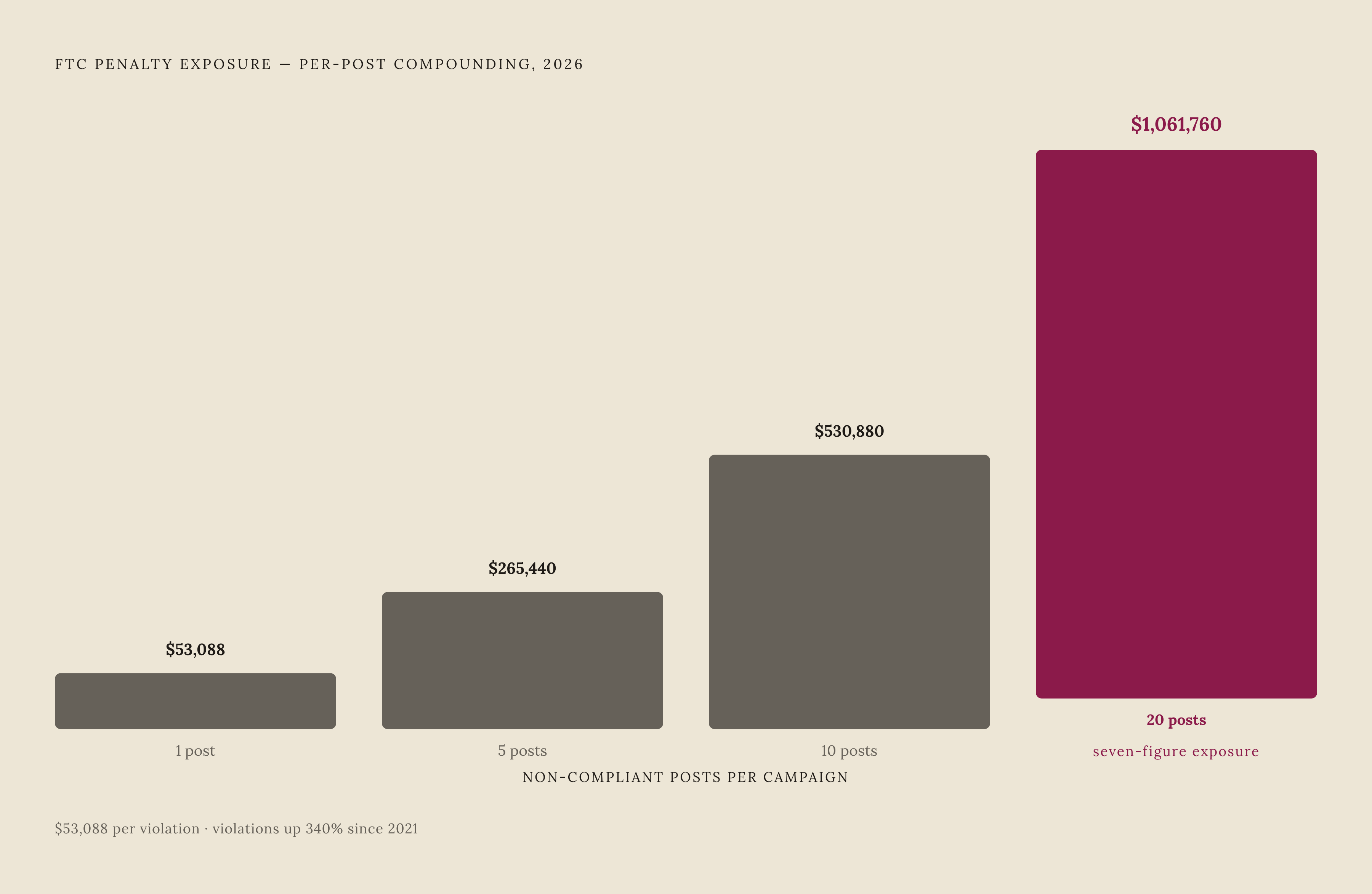
Regulation has caught up to influencer marketing, and morality clauses have to account for it now. Influencer marketing violations have surged 340% since 2021, and the FTC's maximum civil penalty is $53,088 per violation in 2026, with every non-compliant post counted separately. That math adds up fast across a multi-post campaign.
Brands get caught off guard because the FTC doesn't stop at the brand. It goes after the agency running the campaign and any intermediary that helped put the partnership together, and that exposure exists independent of what the brand actually knew. A creator's failure to disclose a paid post can trigger FTC liability for the agency and the brand at the same moment it triggers a breach of the morality clause, which means undisclosed paid promotion belongs in the contract as a named trigger, not an afterthought.
New York has added another layer with its Synthetic Performer Disclosure Law (S.8420-A/A.8887-B), signed December 11, 2025, and taking effect June 9, 2026. It requires conspicuous disclosure whenever an ad features a synthetic performer, which means any contract touching AI-generated or AI-assisted creator content now needs explicit language addressing it. The FTC's Operation AI Comply has already produced 12 enforcement actions since it launched, and AI-related compliance in advertising has drawn significant enforcement attention heading into 2026. Morality clauses covering AI-generated partnerships need to spell out disclosure obligations and what happens when a creator fails to meet them. The IAB's first AI Transparency and Disclosure Framework, released January 2026, recommends consumer-facing disclosures for AI use in advertising alongside C2PA machine-readable metadata standards, and brands working in this territory should reference compliance with those standards directly in the contract.
What agencies managing multiple brand partnerships need to do differently
An agency juggling dozens of live influencer deals can't treat every morality clause as a one-off legal exercise. That approach doesn't scale, and it slows everything down. Building a standardized set of trigger categories, a tiered response protocol for when something goes wrong, and cure-period communication templates that sit ready before they're needed works instead.
Pre-defined breach categories, paired with pre-agreed remedies, let agencies move faster on approvals, cut down the legal back-and-forth, and keep campaigns moving even when a controversy hits mid-flight. Integral Ad Science and YouGov found that 83% of U.S. digital media experts expect brand safety concerns to grow as digital video ad volume keeps expanding. Agencies that can show a systematic, repeatable approach to morality clause management have something real to point to in client retention conversations.
Portfolio management adds its own wrinkle. A youth sportswear brand and a financial services client don't share the same risk tolerance or the same values, so a clause built for one may be either too loose or too restrictive for the other. Agencies do better building a clause library organized around brand-specific triggers than forcing one template across every account. Monitoring matters just as much as drafting: a morality clause only works if someone at the agency actually catches the triggering event when it happens, rather than finding out from a client's angry phone call.
A newer wrinkle has emerged directly. As influencer content increasingly appears inside AI-generated answers and in GEO and AEO search results, a creator controversy doesn't just damage the social feed it started on. It can bleed into how a brand gets described in AI search results, a surface where brands have far less ability to step in and correct the record. Writer.com reports that 85% of brand mentions in AI search come from third-party pages, which means creator content is quietly part of a brand's AI-era reputation whether anyone planned for that or not. Agencies that can track how their clients show up in AI-generated conversations, and flag when a creator controversy starts affecting that presence, offer a layer of brand safety oversight that goes past what any contract alone can deliver. Agencies that build that monitoring capacityd exist to give agencies that kind of portfolio-wide visibility across AI surfaces.
A practical checklist for drafting a morality clause that will hold up
Pull the whole discussion together and the checklist looks like this. Enumerate triggers by name: criminal proceedings, prohibited content categories, hate speech, values-misalignment scenarios. Skip the catch-all language entirely. Decide up front which triggers justify immediate termination and which require notice plus a cure period, with 7 to 10 days the commonly cited window for the latter.
Set the financial terms before anything goes wrong: the kill fee percentage or formula, the conditions under which payment gets forfeited, and whether previously paid fees can be recouped, with a stated time limit on that recoupment. Build in content removal rights with a firm timeline and a list of exactly which platforms are covered, and lock that right into the contract before the first post goes live, not after a crisis starts.
Draft the reverse clause with the same care given to the brand-side language. Name FTC disclosure compliance as its own trigger category, covering both undisclosed paid partnerships and violations of whatever AI transparency rules apply. Address what happens after termination: who speaks publicly, what language both sides have already agreed to, and how the announcement gets coordinated. Add a dispute resolution mechanism built specifically for morality clause disputes, since arbitration keeps things faster, cheaper, and further from public view than litigation ever will. And review the clause with every new campaign, not just every new creator, since platform norms, regulatory demands, and a brand's own risk appetite shift more often than most legal teams update their templates.
A morality clause written on the assumption it'll never actually get used is a morality clause that fails the day it matters most. Draft it like the triggering event is a matter of when, not if, because at this point in the industry's growth, it usually is.
Sources
- Morality clauses best practices for brands and influencers - Ad Age
- Cancelled: Morality Clauses in an Influencer Era
- Safeguard Your Brand Campaigns with Morals & Force Majeure Clauses
- Morality Clauses in Influencer Agreements: When Can Brands Pull the Plug? | Munck Wilson Mandala
- lawjournalnewsletters.com
- Morals Clauses Can Protect Companies AND Influencers
- businessoffashion.com
- Enforceability of Morals Clauses in Talent Agreements