Product Seeding Campaign Logistics and Creator Selection
System thinking and creator fit determine whether seeding converts or ships into the void.

Product seeding is simple in concept: brands give creators free product, ask nothing in writing, and hope the creator posts because they actually like the thing. The gap between brands that make this work and brands that just ship boxes into the void comes down to whether creator selection and fulfillment get built as a repeatable system before the first package leaves the warehouse.
Why most product seeding programs fail despite high adoption
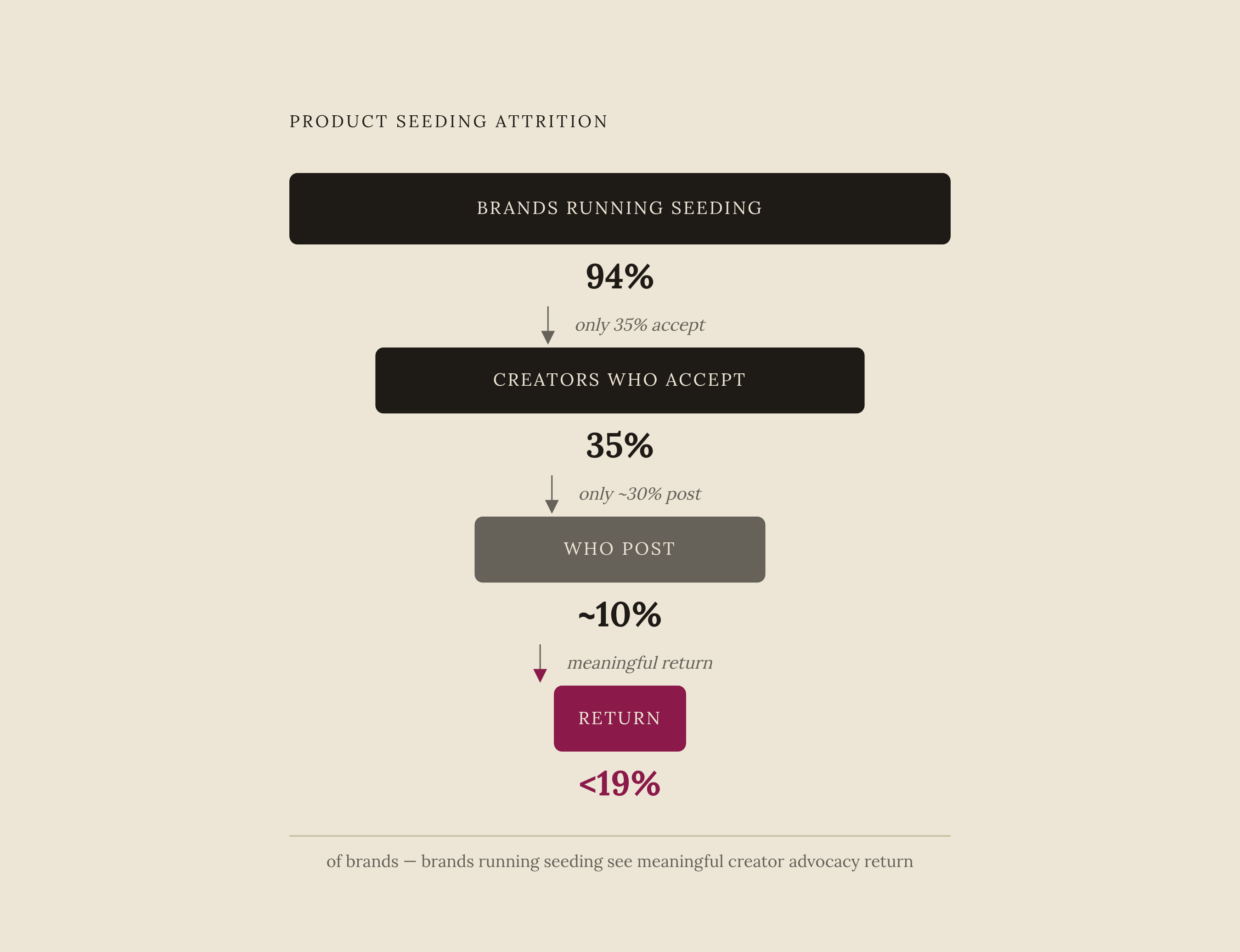
Seeding, as a mechanic, has no contract attached to it. A brand sends product, covers the cost of goods and shipping, and the creator posts (or doesn't) on their own terms, which is what makes the resulting content read as earned rather than paid. That's the appeal, and it's also the whole problem: nearly every brand runs this play, but a late 2025 industry analysis found that fewer than one in five, 19%, see any meaningful creator advocacy come back from it Nowadays Media, published 2026-04-14. Separate research puts a number on the waste directly: 65% of brands send product to creators who never post a word, which is less a creator problem than a symptom of a manual process that was never built to catch it influencergiftform.com.
The reason brands keep doing this anyway is that the prize on the other side is enormous. Consumers trust peer recommendations over any other form of advertising by a wide margin, 92% say so, and roughly half now vet a brand on social media before they'll buy from it ambassadorflow.com influencergiftform.com tomoson.com. Seeding is how a brand gets itself into that vetting environment in the first place, showing up in real accounts, real comment sections, real unboxing videos, rather than in an ad a shopper already knows to discount.
The 94%-to-19% gap is a measurement of how many brands are running seeding as a shipping function, pack it, label it, mail it, instead of as an actual system with selection criteria, follow-up, and tracking built in storika.ai. Everything that follows in this piece is about closing that gap: getting creator selection right first, then building the fulfillment operation that keeps the whole thing from collapsing once volume increases.
Operational discipline matters more as the channel's budgets grow.
The channel itself is large enough that "we'll figure it out as we go" stops being a viable strategy fairly quickly. One estimate puts influencer marketing at $24.1 billion in 2026, growing around 14% a year since 2020; another puts the figure at $32.55 billion, a discrepancy that likely comes down to how each source draws the boundary around what counts as "influencer marketing postaffiliatepro.com seedingops.com storika.ai."
Budgets are following. 76% of brands say they plan to increase influencer marketing spend in 2026, described as the highest share ever recorded, and 67% now run dedicated influencer budgets instead of borrowing from general marketing funds seedingops.com influencergiftform.com. Seeding specifically had a breakout year in 2025: it made up 31% of all campaigns on the Aspire platform, up from 20% the year before, which tells you this isn't confined to small gifting programs run out of a supply closet anymore aspire.io ainfluencer.com seedingops.com.
Frequency is rising with it. Yet 45% of brands are still running seeding out of spreadsheets, which is fine at low volume and increasingly unworkable as shipments multiply seedingops.com. Levanta's 2026 research describes this as a "chaos tax": what works cleanly at 20 shipments breaks at 100, wrong sizes go out, tracking links get left off inserts, deliveries run late, and nobody can say what the ROI actually was, because the team spent the quarter chasing status updates instead of analyzing results. Active seeding programs now average 120 shipments a quarter, a volume where manual tracking isn't just inefficient, it's structurally unsustainable seedingops.com. The average brand now runs 6–8 influencer campaigns per year, up from 3–4 in 2021; at that cadence, a manual process doesn't scale seedingops.com.
What the ROI data shows and requires
The baseline numbers on gifted collaborations are strong on their own. Mature programs, the ones that have been running long enough to reuse UGC and layer in affiliate revenue, typically run in the 3x to 8x ROI range GRIN, 2026.
Post rate functions as the diagnostic here. A healthy program sees 30% to 50% of recipients create and share content; anything under 20% is a signal, not bad luck, that points to a mismatch in creator selection, in product fit, or in follow-up ainfluencer.com seedingops.com tomoson.com. On a managed platform, ship-to-post rates can reach as high as 90%, the distance between a program running on hope and one running on a system.
Even in high-performing programs, only around 35% of contacted creators accept the offer, and roughly 30% of those go on to post seedingops.com ambassadorflow.com. Brands only ship product to the creators who say yes, so the entire cost-per-post equation gets decided upstream, before a single box goes out, by how well the initial targeting was done. The awareness spillover is real too: 92% of marketers report a direct link between seeding and brand awareness, and 76% say it drives sales seedingops.com ambassadorflow.com influencergiftform.com tomoson.com. But none of that ceiling is unconditional. Post rate, acceptance rate, and how much of the resulting content gets reused are all downstream of creator selection and logistics. Gifted collaborations average a 20%–40% post rate and return roughly $7.25 for every dollar invested, ahead of the broader influencer marketing average, Skeepers industry benchmarks show ainfluencer.com seedingops.com. Gifting a micro-creator costs roughly $30–$80 in product, and the economics only hold when the right creators receive it creatordb.app seedingops.com.
Creator selection is the single largest variable in seeding outcomes
Follower count gets treated as the deciding factor more often than any other input, and it's the least reliable one available. It measures reach. It says nothing about whether that reach will act on a recommendation. The ANA has found that 29% of influencer budgets go to waste, and most of that isn't fraud, it's poor tier selection and audience mismatch Nowadays Media, published 2026-04-14 influencers-time.com. The leak is happening at the selection stage, not somewhere further downstream Nowadays Media, published 2026-04-14 influencers-time.com.
A post is worth having when the creator's following actually overlaps with the brand's target buyer, in interest and in intent, not just in demographic label. A gift that lands with the right person does half the persuasive work before the creator even opens the box. Posting consistency and engagement rate matter too, since they indicate an audience that responds rather than one that merely scrolls past. Brand safety and the risk of friction belong in the same scoring pass: a seeded post from an account with an inauthentic following costs nothing in product budget and quite a lot in brand association.
It runs at real volume without turning into its own bottleneck, because a scoring system nobody actually uses is worse than no system. Engagement rate itself is calculated by averaging likes and comments against follower count across the last nine posts, and the comments are worth reading closely: they show buyer intent, they show whether the audience skews local or national, and creators who already review similar products in their niche tend to convert better than ones picking up a category cold. Levanta's operating system rates creators 1–5 across audience fit, content quality, consistency, brand safety, and friction risk, a practical scoring approach simple enough to apply at scale without becoming a bottleneck. A campaign volume target of 50–100 qualified creators for an initial campaign balances the probability of organic posts with budget constraints, tomoson.com reports. The typical micro-influencer engagement benchmark is 2%–5%, and anything below this threshold warrants closer scrutiny of audience authenticity tomoson.com.
Nano and micro-influencer tiers as the highest-return targets for seeding programs
The data on smaller creator tiers is consistent enough across sources that it's hard to argue with. That's not a marginal difference from larger tiers, it's a different category of audience relationship.
A brand chasing reach at the top of the follower pyramid is paying more for less reaction.
Payment isn't even the deciding factor for most of these creators. 83% say they'll post about a product for the gift alone, no fee attached, if they genuinely like it; a separate figure puts willingness at 86% when the brand fit is right skeepers.io ainfluencer.com. Different numbers, same conclusion: selection quality is the lever that matters here.
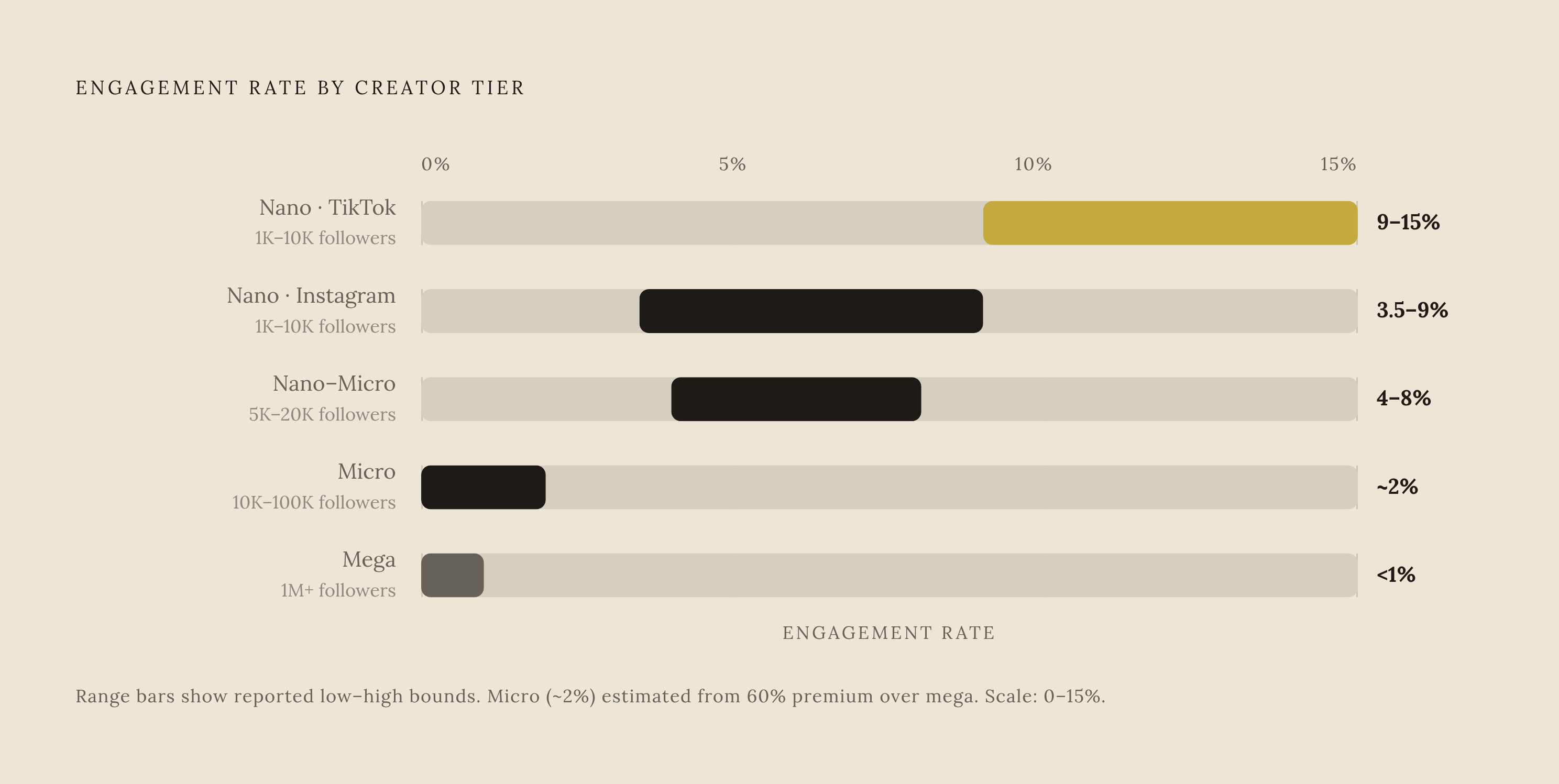
One of the most overlooked sources of nano-influencer candidates sits inside a brand's own customer list. These are people who bought the product with their own money and arrived pre-persuaded, so seeding simply formalizes an advocacy that was likely already underway informally. Shopify integrations, Upfluence's among them, can cross-reference a customer email list against social accounts as one way to surface this cohort. Even at gift-only scale, though, vetting still matters: a large following paired with low engagement or generic, copy-paste comment patterns is a disqualifier no matter how well the niche appears to fit. Nano-influencers (1K–10K followers) achieve 9%–15% engagement on TikTok and 3.5%–9% on Instagram, based on analysis of 15,000+ creator accounts across Q1 2026 by Nowadays Media, published 2026-04-14. Nano-influencers achieve the highest trust metrics of any tier, often surpassing 8% engagement rates, as their communities treat creator recommendations like advice from a friend, resulting in conversion rates 2–3x higher than macro campaigns, digitalapplied.com reports. Micro-influencers (10K–100K followers) deliver 60% higher engagement rates than those with over 1M followers, at roughly 1/10th the cost per post digitalapplied.com. Nano and micro creators in the 5K–20K range frequently operate in the 4%–8% engagement band, where bigger accounts typically sit under 1%, Skeepers reports storika.ai digitalapplied.com.
Setting campaign goals before any product ships
Seeding is not one objective wearing different outfits (the guide identifies three distinct seeding objectives, and what each requires). UGC generation campaigns are judged on content volume and quality instead, so the wave skews smaller and more selective, with creators chosen for their production craft rather than raw audience size. Trackable sales campaigns are judged on code-driven conversions, affiliate link clicks, and new customer counts, so the creator list should weight toward people who already move purchase behavior in that category.
HireInfluence frames this well: the goal chooses the list before the list ever chooses the outcome. Budget planning needs the same discipline. Seeding is "free" only until postage, packaging, and staff time enter the picture, so product cost and shipping (cross-border shipping especially) are the obvious lines, but custom packaging, inserts, any paid incentives layered on top of straight gifting, and tracking tools all belong on the same sheet.
Timeline matters just as much as budget. Outreach and creator confirmation need their own window, shipping and delivery need another, content creation time needs a third, and reporting needs a fourth. Compressing all of that into a vague "a few weeks" is where a lot of first campaigns quietly lose control of themselves. None of it works, either, without deciding upfront what "success" even measures: post rate, the share of creators who actually activate, attributable clicks and codes and conversions, and creator retention across future waves. Without those defined before shipping starts, there's no signal left to improve against afterward. For brand awareness, KPIs are reach and impressions, with the wave skewing broader, more creators, and a lower per-unit production expectation.
The eight-step operational loop that prevents fulfillment from becoming the bottleneck
Levanta's 2026 framework lays the process out as a loop, not a funnel: Recruit, Qualify, Ship, Confirm, Activate, Track, Learn, Repeat. Most brands instinctively try to scale the first step, more creators discovered, more names added to the list, because it feels like visible progress. But shipping, confirming, and tracking are the stages where programs actually come apart, and pouring more creators into a pipeline that can't fulfill or track them just compounds whatever is already broken downstream. All eight steps need to function as one connected system, or the ones that work well don't matter much.
Address collection is usually the first bottleneck, and it's a solvable one. A claim link, a branded page where the creator submits their own shipping address directly, cuts address collection time by roughly 95%, from days of back-and-forth email down to minutes seedingops.com. The same branded landing page can let creators pick their own size, color, or variant, which removes the confirmation messages and shipping errors that come from a brand guessing at preferences on someone else's behalf.
Outreach and onboarding messaging should be standardized too, setting expectations from the first message: no obligation to post, disclosure requirements spelled out, and what the brand actually hopes will come of the gift. Pressure dressed up as generosity tends to convert a promising prospect into a public critic instead.
Compliance rides along with every shipment, whether a brand thinks about it or not. Free product counts as a material connection under FTC endorsement rules, and disclosure guidance belongs printed right in the package insert. That protects the brand and the creator both, and it quietly signals to creators, many of whom have worked with brands that skipped this step entirely, that this one takes the relationship seriously.
Packaging, personalization, and reducing friction for the creator
The unboxing is frequently the content itself, which makes packaging a production decision as much as a logistics one. A personalized gift note lifts post rates by roughly 23% over generic packaging, and that's not a small margin for the cost of a note. Personalization, in practice, means a note that references the creator's actual work rather than a template swapped in by name, a product chosen for their specific situation instead of grabbed off a pallet, and packaging built around the idea that this is a first impression, not a fulfillment task.
Reducing friction for the creator matters just as much as the packaging itself. Clear prompts, simple talking points, and packaging designed with unboxing in mind all function as a production shortcut, especially for creators working with limited time and no crew. A short usage guide and an easy way to give feedback both raise the odds that what comes back is an honest review rather than silence. Call it the kit-as-brief principle: when the box itself carries the framing, message consistency improves without the brand ever having to mandate a script, and the creator still owns their own voice.
None of this scales through handwriting, though. At 120 shipments a quarter, personalization has to be systematized: merge-field note printing and pre-selected product bundles sorted by creator segment are the operational workarounds, since handwritten notes do not scale to 120 shipments per quarter without a process seedingops.com.
Tracking, attribution, and turning seeded content into reusable creative
Attribution has to start on day one, not after the first posts appear. Giving each creator a unique discount code or affiliate link tracks referral traffic, code usage, orders, and new customers, alongside the more familiar reach and engagement numbers, so a brand can rank creators by sales actually driven rather than by likes collected. That's a meaningfully different leaderboard, and it's usually the more honest one.
Untagged, organic mentions are what most brands lose track of without dedicated software in place: a creator posts, doesn't tag the brand, and the mention vanishes into the feed unseen. Keeping a record of who received product, following up with each of them individually, and actively capturing the posts that do surface (tagged or not) is what turns a seeding program from a one-time shipment into a growing library of usable creative, the exact kind of content that feeds the next wave of the same loop.
Sources
- Product Seeding Strategy For Creators: How ECommerce Brands Should Run Gifting At Scale Without Chaos
- Influencer Product Seeding: A Brand's Guide - HireInfluence.com
- Product Seeding: The 2026 Guide for Brands
- 8 Best Product Seeding Platforms for Brands
- Influencer Product Seeding: How to Build a Gifting Program That Actually Works | Storika
- Influencer Seeding (Creator Seeding): The Complete Guide for Ecommerce (2026)
- digitalapplied.com
- postaffiliatepro.com