Email Marketing Integration for Influencer Campaign Content
Repurposing creator content across email sequences amplifies campaign ROI without reshooting.

A single influencer campaign generates far more usable material than most brands ever put to work. Photos, video clips, quotes, and reviews pile up after one post goes live, and then they sit unused while the brand pays, separately, for a traditional product shoot to supply the same visual needs elsewhere. That's the waste at the center of this piece: creator content gets treated as a one-time social asset when it's really raw material for every owned channel a brand runs, including the inbox. Brands that are ahead of this shift already put creator content on product pages, inside paid ads, at checkout, and across email sequences rather than leaving it stranded on the single post where it first appeared. Email deserves particular attention here because it's a channel the brand fully owns, with no algorithm standing between the message and the subscriber, and because the content was already paid for once.
What "integration" means, and what it does not
Putting influencer content into email is a planning decision made before the first email goes out, not a copy-paste job done after the campaign wraps. Three distinct ways of using creator material exist, and each should be chosen deliberately. The first uses influencer photos, video clips, and quote pulls as the visual or text layer inside an email the brand itself still writes and sends. The second places influencer testimonials and reviews as proof points at specific moments in a sequence, where a subscriber needs reassurance before acting. The third hands an influencer the newsletter itself for one send, giving them editorial control so their own voice reaches subscribers directly. Each of these three modes calls for a different rights conversation, a different brief to the creator before anything gets shot, and a different spot in the email flow. None of that can happen if the brand waits until after the content exists to decide where it belongs. Creators need to know, at the point they're briefed, that the footage or stills they're producing will end up in an inbox: that means shooting in aspect ratios that render cleanly in an email client, keeping file sizes reasonable, and writing captions that can stand alone as quotable copy once they're lifted out of a social post's context.
Matching creator asset types to the right email touchpoints in a customer journey
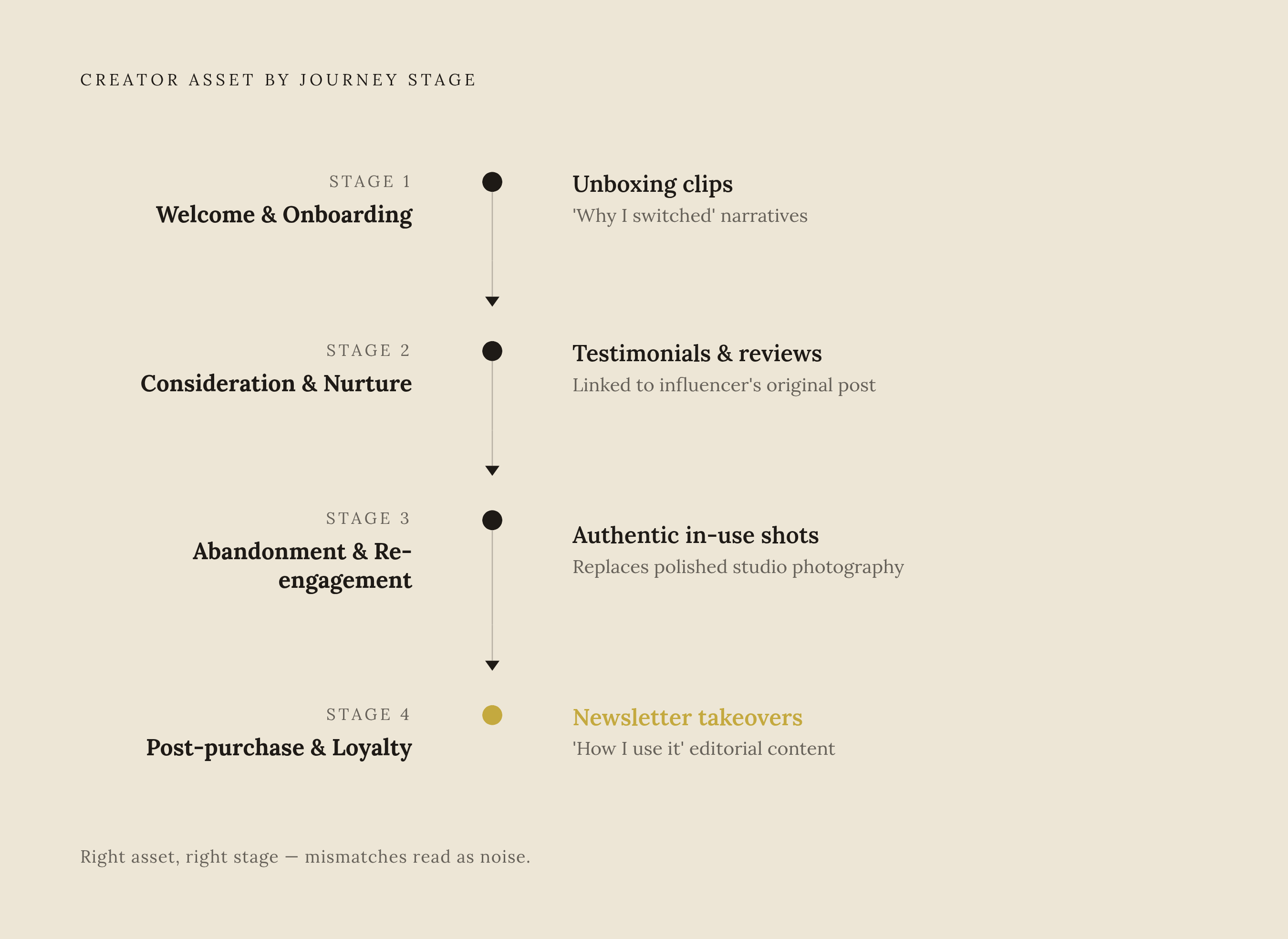
The return on influencer content in email depends on matching three things correctly: what kind of asset it is, how much trust the creator carries with a given subscriber, and where that subscriber sits in the journey from stranger to repeat customer. Get that alignment right and a single piece of creator content can do real work at more than one stage. Get it wrong and the same asset reads as noise.
Welcome and onboarding emails are the natural first stop for creator content, especially for a subscriber who joined the list by clicking through a specific influencer's referral link. That subscriber already trusts the creator who sent them there, so the welcome email should carry that creator's face or voice forward rather than switching to generic brand messaging the moment the click lands. Unboxing clips and "why I switched" narratives fit here because the subscriber is still forming a first impression of the brand and responds well to the same discovery energy that got them to click.
Consideration and nurture sequences are where testimonials and reviews earn their keep, since this is the stage where a subscriber is actively weighing whether to buy and needs outside validation to get past any doubt. Linking from the email back to the influencer's full review or original post keeps the subscriber engaged longer and gives the creator ongoing credit for the conversion they helped produce.
Abandonment and re-engagement emails benefit from a different kind of creator asset: an authentic shot of the product in actual use, in place of the polished studio photography the original cart email probably used. A subscriber who stalled out before completing a purchase often just needs a familiar, trusted face showing the product working in real life to get unstuck.
Post-purchase and loyalty sequences are where newsletter takeovers and longer-form influencer editorial content do the most good, because the subscriber is already a customer and doesn't need to be sold again. An influencer curating a "how I use it" email after purchase gives the new customer practical guidance on getting the most from what they bought, while quietly opening the door to related products they haven't tried yet.
Rights and permissions to lock in before the campaign launches
The matching described above only matters if the brand has the right to put the content in an email. Securing that right after the campaign is already live costs more time and more goodwill than building it into the original agreement, and it's a problem entirely avoidable with planning done upfront. Email use counts as a separate license from whatever rights cover the original social post, because the creator holds copyright over their work the moment they create it, and a standard agreement covering social usage doesn't automatically extend to email, paid amplification, or placement on a product page. Agility PR confirms that brands need permission from influencers specifically to use their content in email, a step that can be as simple as a confirmation email or as formal as a written agreement, but one that has to happen before the campaign goes out, not after. Brands building this into a campaign brief should name "email marketing use" as its own channel alongside social and paid use, so there's no ambiguity about scope later. They should also settle how long the license lasts, since an evergreen grant and a fixed window carry different risks: an influencer's endorsement reads as current when it's fresh and reads as stale if it's a year old and never refreshed, undermining the authenticity the content was supposed to deliver. Attribution terms need settling too, since some creators require their name or handle to appear visibly in the email, which affects how the template gets laid out from the start. Newsletter takeovers carry one more requirement: the brand needs sign-off rights on what the influencer writes before the send goes out, not a review after subscribers have already seen it. Once those rights are locked down, the next decision is who actually receives which piece of creator content, and that's a question of subscriber data, not legal paperwork.
Using creator audience data to segment email lists more precisely
Every influencer campaign throws off a layer of audience data that most brands collect and then barely use: which subscriber responded to which creator, on which platform, through which piece of content. That data is more useful for sharpening email segmentation than most current programs recognize. When a subscriber joins a list through a specific influencer's unique link or promo code, the brand knows precisely how that person first encountered the brand, through whose voice and whose aesthetic, and that fact should shape which version of an email they get later. Serving that subscriber content from the same creator who brought them in isn't personalization as a nicety, it protects the trust relationship that was already built on social before the subscriber ever opted into email. A handful of variables fall naturally out of this kind of campaign data, and segments should be built around which influencer actually drove the subscription, whether the subscriber clicked from a video or a static post, which product category the referring creator's niche suggests they care about, and whether the referring influencer was a micro-creator or a macro-creator, since the trust signal each carries is different. Platforms like Upfluence make some of this usable in practice, with a Klaviyo integration that lets a brand analyze its customer database to find existing customers who are already creators in their own right, a detail relevant when deciding whether a given tool fits an existing stack. Pricing for that kind of platform is generally available on request.
The tooling layer, connecting influencer platforms to email service providers
Having the data is one problem; getting it to move automatically into the system that sends the email is another, and it's a tooling gap more than a strategy gap. The platforms that close it well are the ones built with native connections into major email service providers, not the ones that leave a marketer exporting a CSV file by hand and uploading it somewhere else. Upfluence is one example of a platform built this way, offering end-to-end campaign management alongside that Klaviyo integration mentioned above, with pricing available on request. Choosing a tool here comes down to three practical questions rather than a ranking of which platform is objectively best, since different teams have different stacks and different needs. First, does the platform connect directly to the email service provider already in use, or does it require a manual export step that adds friction and room for error? Second, does it pass creator attribution down to the individual subscriber level, or does it only report aggregate campaign metrics that can't be tied back to a specific email send? Third, does it store approved creator assets, images and copy, in a place the email team can pull from directly, without routing every request back through whoever manages the influencer relationships? None of these questions has a universally right answer. They depend on how a given marketing team is already structured and what it's trying to measure.
Why attribution breaks down at the influencer-email intersection
Measuring whether creator content in an email actually drove a result is a genuinely hard problem. Traditional email platforms track opens and clicks cleanly within their own system. Influencer platforms track social engagement cleanly within theirs. Neither system natively understands what the other is reporting, so a subscriber who first saw a creator's post, then converted after clicking a link inside an email, gets credited entirely to email, and the influencer who actually started that journey disappears from the record. Privacy changes compound the problem: iOS tracking restrictions and ad blockers mean tracking pixels increasingly fail to fire even when an influencer did drive a direct click, so platform-reported attribution understates the creator's real contribution more and more over time.
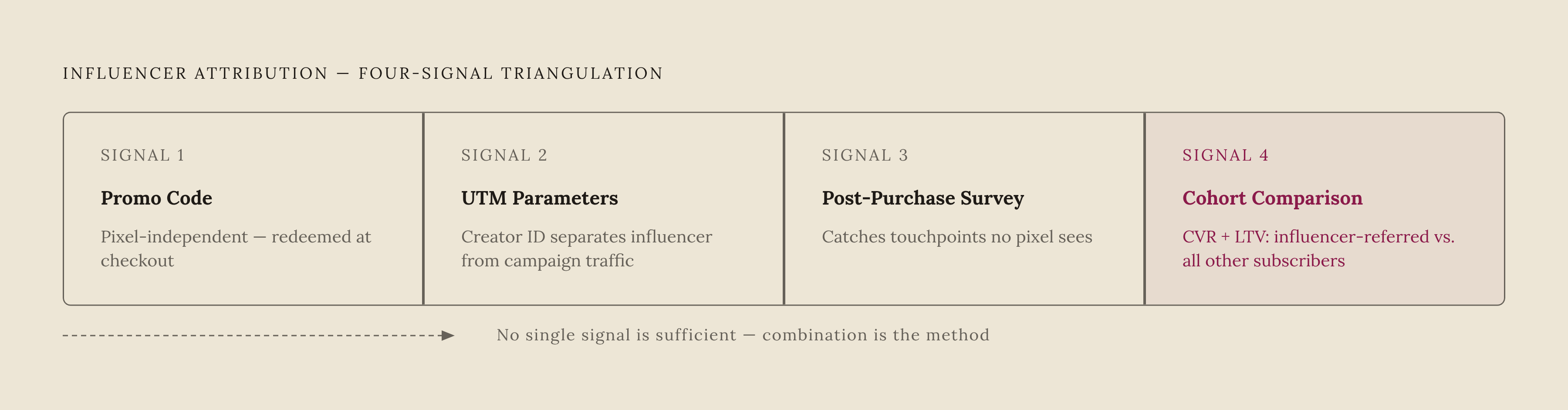
Measurement should triangulate across several signals rather than expecting one clean, trackable click to tell the whole story. A unique promo code assigned to each creator, carried into the email itself as the call to action, gives a clean offline signal through coupon redemption that works even when no pixel ever fires. Unique UTM parameters on email links, tagged with a creator ID, let the brand's own analytics separate traffic that came through an influencer-driven email from traffic that came through a standard campaign send. A simple post-purchase survey asking how the customer first heard about the brand adds a zero-party data layer that catches influencer touchpoints no pixel would ever see. Comparing conversion rates and lifetime value between subscribers acquired through influencer referral links and subscribers acquired through every other channel gives a final, cohort-level signal: wherever that comparison shows a gap, the creator relationship is what accounts for it. None of these four methods replaces the others. Used together, they give a brand a defensible, if imperfect, picture of what creator content inside email actually returns, which is a far more honest starting point than pretending a single click number tells the whole story.