Creator Brief Requirements for UGC Versus Sponsored Posts
Different formats demand different briefs: UGC and sponsored posts need separate guidance.

Global spend on influencer marketing hit $32.55 billion in 2025, and sponsored content alone accounted for $10.52 billion of U.S. ad budgets. Most teams still run that money through one document: a single "creator brief" template stretched to cover two formats that don't behave alike. That's the actual problem this piece is picking apart. UGC and sponsored posts carry different legal exposure, different creative logic, and different ways of failing, and treating them as interchangeable is how brands end up with content that's either legally unusable or creatively dead on arrival.
What separates UGC from sponsored posts at the format level
Start with what's actually being bought. A sponsored post is a placement: a creator posts to their own feed, in front of their own audience, and the brand pays for that creator's reach and the trust already sitting inside it. UGC buys something else entirely. It's content, usually video, sometimes photos or written reviews, made by a person specifically so the brand can run it elsewhere: paid ads, the website, email, organic social. The creator isn't lending an audience. They're lending a face, a voice, and whatever production skill gets a phone held steady for thirty seconds.
That distinction is why UGC exists as its own category instead of being a smaller, cheaper version of sponsored work. Nobody watching a UGC ad thinks it's spontaneous. Everyone involved knows it was shot for a Meta ad unit, edited, and approved by someone in a Slack channel. That's fine, because the format isn't selling spontaneity. It's selling the texture of something a friend would send, which is a different product than reach borrowed from an existing audience.
Here's the part most brief templates get backwards. Sponsored posts default to the creator's own feed only: any reuse beyond that is typically a separate negotiation, documented in the contract. UGC runs the opposite way. Usage rights get built into the deal on day one, because the entire reason the brand hired the creator was to walk away with an asset it can deploy somewhere else. And UGC creators don't need a following at all to be worth hiring. Some of the strongest UGC comes from people with a few hundred followers who happen to be good on camera. That's a casting call for a skill, not a rate card pegged to follower count.
The shared foundation both brief types need before the formats diverge
Before either brief gets written, two decisions need to be locked: what the campaign is trying to do, and who it's trying to reach. Skip that step and everything downstream wobbles, regardless of format.
A conversion campaign wants a fast hook, a clear problem-solution setup, and a CTA that tells someone exactly what to click. An awareness campaign wants something closer to a story: softer brand mentions, a CTA that invites a comment or a share instead of a purchase. Neither format gets to duck this decision, and a brief that hedges on it wastes everyone's time downstream.
From there, both UGC and sponsored briefs need the same basic skeleton: deliverables (what, where, how many), key brand messages and the ones to avoid, a timeline, payment terms, and a list of brand DOs and DON'Ts.
What changes is how much weight each of those pieces carries, and why it's there at all. That's where the conflation problem actually starts. A team builds one solid checklist, calls it "the brief," and assumes it works for both formats because the section headers look identical on paper. They aren't identical underneath. The shared skeleton is the floor, not the whole building, and mistaking one for the other is the single most avoidable error in this entire process.
How UGC briefs direct creative output without overriding creator authenticity
A UGC brief works best as scaffolding, not a script. Its job is removing ambiguity, not personality, and that distinction is worth sitting with because most briefs blur it without meaning to.
Vague briefs cost real money. A brief that leaves the moment-of-use unclear, or skips resolution specs, or forgets to mention aspect ratio, sends the creator off to shoot something that comes back wrong, and now there's a reshoot on the calendar. That's a production cost, not an abstraction.
The strongest UGC briefs hit five anchors: who the shopper is, what problem they're facing, the moment they'd actually reach for the product, some kind of proof it works, and a clear ask at the end. That maps onto Hook, Problem, Solution, CTA, which happens to be the exact shape that performs on TikTok and Reels.
The hook is where most of the persuasion lives, and it's also where over-scripting does the most damage. Give creators three to five hook directions to riff on rather than one line to recite verbatim. Add explicit permission language, phrases like "use your normal speaking voice" or "stumbles are fine" or "film wherever you'd normally be." That permission is what keeps footage from sounding like a hostage read.
So instead of handing over a script, hand over the three or four strongest product arguments, a suggested (not mandatory) hook, and the CTA. Let the creator build the sentence around it.
There's also a layer of technical detail UGC briefs need that sponsored briefs mostly skip: aspect ratio (9:16, 1:1, or 16:9), minimum resolution (1080p, or 1080x1920 vertical), audio requirements, safe zones for text overlays, whether the deliverable is raw footage or an edited cut, and lighting notes. Sponsored posts don't need this because the creator already knows how their own feed looks and behaves. UGC has no such luxury. The footage is headed somewhere the creator has never posted before, so the brief has to describe that destination in detail.
Reference content earns its place here too. A five-second clip of a past high-performer says more than a paragraph of adjectives ever could, and pairing it with a real performance number (a past campaign's click-through rate, say) gives the creator something to aim at besides "make it good."
And then the correction that undercuts a lot of the advice above: a brief can be too thorough. Stack on enough detail and it stops reading like guidance and starts reading like nerves. A ten-page document doesn't signal rigor, it signals that nobody on the brand side has actually decided what they want, and that uncertainty lands on the creator's desk fully intact.
What sponsored post briefs must specify that UGC briefs don't carry
Six things belong in a sponsored post brief, no exceptions: deliverables, key messages, disclosure requirements, usage rights, campaign goals with an approval process, and compensation. Skip any of these and the creator fills the gap with a guess, and the guess rarely matches what the brand had in mind.
Deliverables need more precision here than in a UGC brief, because a sponsored post covers a specific placement on a specific platform: a Reel, a carousel, a Story sequence, a standalone TikTok. Spell out whether Story coverage is bundled into the deal or billed separately. That single line is where a lot of post-campaign friction starts.
Key messages belong in the brief too, two or three points the brand wants communicated, and the word choice matters: points, not sentences. This is not a script. The creator's voice is the entire reason the brand is paying for the placement, and handing over a script cancels out the trust signal that justified the spend in the first place. Brands can suggest phrasing. They can't dictate tone, and under the FTC's updated endorsement guidelines, they shouldn't try.
Disclosure isn't a style choice. It's a compliance requirement that needs to show up in both the brief and the contract, spelled out exactly: #ad, a platform's paid partnership label, or both, in a specific placement on the post. The FTC's maximum civil penalty sat at $53,088 per endorsement violation in 2025, which is the number that turns disclosure from a nice-to-have into a line item legal actually reads.
Exclusivity has no UGC equivalent at all, and it deserves more attention than most briefs give it. A 30-day category lockout can cost a creator three or four other deals they'd otherwise take. A shorter window tied closely to the campaign flight usually covers what a brand actually needs, and asking for more than that without paying for it is where relationships sour. If a brand wants exclusivity, the payment has to reflect that cost: one integration rarely justifies six months of a creator turning down competitors. This clause needs to live in the brief from the start, not surface for the first time during contract talks, where it reads less like a term and more like an ambush.
Approval workflow deserves its own line as well. Consolidate feedback into as few rounds as possible, and keep the notes focused on compliance issues (disclosure, mandatory inclusions, brand safety) rather than personal opinions about word choice. The brands that move fastest here treat approval as a checklist, not a taste test.
How usage rights and ownership are handled differently across the two formats
Rights language runs in opposite directions depending on the format, and that's easy to miss when both brief types are sitting open in adjacent tabs.
In UGC, usage rights are the deliverable, not an add-on. The brief should name exactly where the content will run: paid ads, the website, email, organic social, maybe third-party placements. UGC contracts also need to nail down the smaller stuff that trips people up later: no logos or third-party brand marks in the footage unless cleared, no reposting by the creator unless explicitly allowed, and payment terms defined upfront and tied to clear approval milestones, so nobody's waiting on an edit cycle to get paid.
Sponsored posts start from the opposite default. The placement covers the creator's own feed and nothing past that, unless something else gets negotiated and written down. Any reuse, whitelisting the post as a paid ad, running it as a dark post, boosting it past organic reach, is a separate rights purchase, negotiated in advance and documented in the contract, not assumed after the fact.
Pricing follows the same logic. UGC creators often charge licensing fees scaled to duration and placement, since a video running for three months on Facebook carries different value than an organic post that vanishes from the feed in 48 hours.
Picture it as two ends of the same conversation, pointed in opposite directions. Sponsored briefs define what a creator can't do during and after a campaign, which is exclusivity. UGC briefs define what the brand can do with the footage and for how long, which is deployment scope. Skip that conversation at the brief stage and it doesn't disappear, it just resurfaces later as a renegotiation after the content already exists, which is a worse position for everyone at the table.
Where creative freedom is set differently in each brief type, and why it matters
UGC briefs are built loose on purpose, and tightening them is the most common way brands sabotage their own campaigns. Set the guardrails (claims a creator can and can't make, the technical specs) and then step back. Authenticity is the actual product being purchased here. Clamp down on delivery and the brief has quietly defeated the reason UGC was hired in the first place. Creative freedom isn't a courtesy extended out of niceness. It's a retention lever, and a quality lever, and treating it as optional polish gets both backwards.
Sponsored briefs tighten in a different place entirely. Compliance items, disclosure, mandatory inclusions, brand safety, stay locked and non-negotiable. But voice and delivery need room to move, because clamping down on those undoes the exact thing the brand paid for: a creator's existing relationship with an audience that already trusts them. Over-control a sponsored post and it starts sounding like a brand talking through a ventriloquist's dummy, lips moving a half-second off from the words. Audiences clock that faster than most brands expect.
Put the two side by side and the difference stops being subtle. A UGC brief says: here are five hook ideas, run with whichever fits, or blend a couple. A sponsored brief says: these two messages need to land somewhere in the post, everything else is the creator's call. Same document category, opposite instinct running underneath it.
Worth naming the asymmetry in what's actually at risk. A sponsored brief that goes wrong costs more, because it's touching a relationship built over months or years between a creator and their audience. A UGC brief that goes sideways costs a reshoot, which is annoying and expensive but recoverable inside a week. A sponsored post that goes sideways can cost a creator the exact credibility that made them worth hiring in the first place, and that doesn't come back with a re-edit.
Putting the two briefs side by side: what each document actually contains
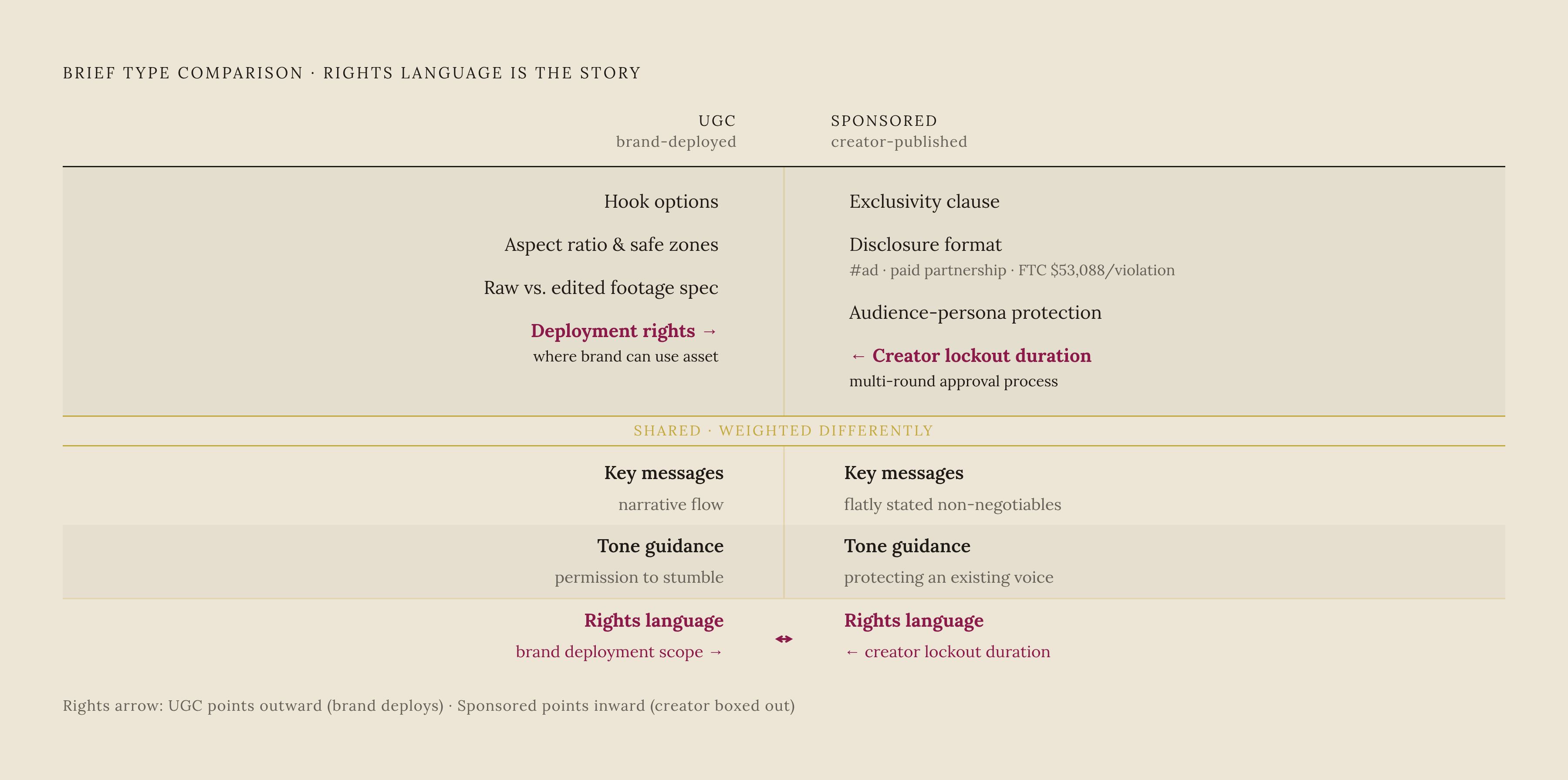
Line them up and the shape of each brief tells its own story. UGC briefs run heavy on technical production detail: hook options, aspect ratio, length, safe zones, resolution, whether the ask is raw footage or an edited cut, plus the deployment rights spelling out where the brand can use the finished asset. Sponsored briefs run heavy on the legal and relational side: disclosure language, exclusivity terms, the approval workflow, key message guardrails, and protections around a voice that already belongs to someone else.
Some elements show up in both but carry different weight depending on which side of the table they're serving. Key messages exist in each, but a UGC brief folds them into the narrative structure, living inside the Hook-Problem-Solution-CTA flow, while a sponsored brief states them flatly as non-negotiables next to a short list of things to avoid. Tone guidance appears in both too, but a UGC brief is handing out permission (stumbles are fine, use your normal voice), while a sponsored brief is protecting a voice that already exists instead of trying to build one from nothing. Rights language sits in both documents as well, just pointed in opposite directions: how far the brand can deploy the asset in UGC, versus how long the creator stays boxed out of other deals in sponsored work.
Then there's the stuff that belongs to exactly one format and nowhere else. Raw footage specs, safe zones, performance benchmarks used for creative calibration, and links to reference content live in UGC briefs alone. Exclusivity clauses, exact disclosure formatting, audience-persona protection language, and a defined multi-round approval process belong to sponsored briefs alone.
None of this is an argument for building two brief templates from scratch every time a campaign launches. It's an argument for knowing which lever belongs to which format before either document gets written, so a UGC brief doesn't end up starved of technical specs and a sponsored brief doesn't end up so scripted it strangles the exact trust the brand paid to borrow. Keep both templates on file, track approval rounds somewhere consistent, store rights documentation in one place, and the temptation to just reach for whatever brief happens to be open on the screen mostly goes away. At $32.55 billion in global spend, that's not a filing-cabinet problem. It's the difference between content that works and content that just got made.
Sources
- How to Brief UGC Creators for Better Results [2025]
- UGC Creator Brief Template Guide | InfluenceFlow
- UGC Brief Template: Step-By-Step Guide with Real Examples
- lp.insense.pro
- reshiftmedia.com
- UGC Creators vs Influencers: What’s the Difference? - Billo
- UGC Brief Template: The Playbook for High-Converting Content
- influee.co