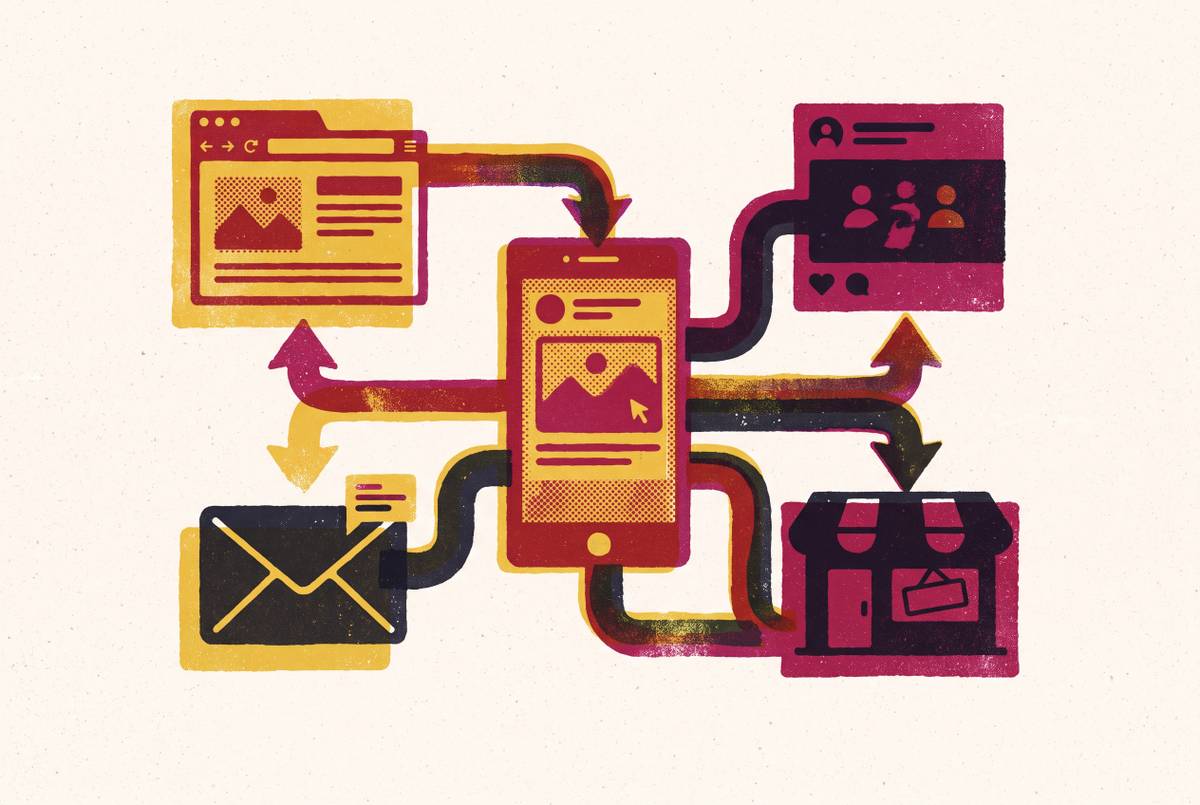
Content Distribution Calendar for Multi-Platform Creator Campaigns
Plan releases around one anchor asset instead of scheduling each platform separately.
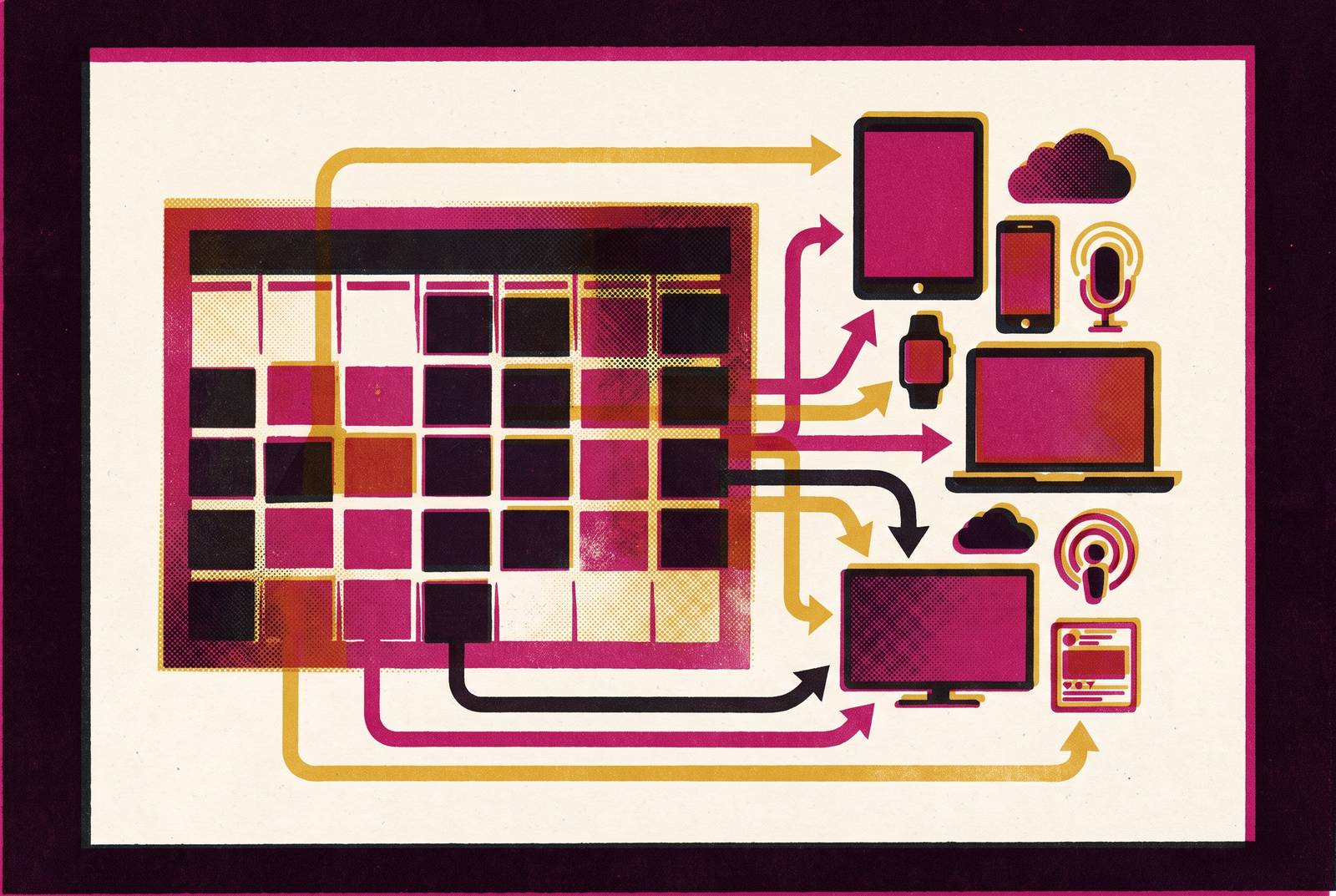
A creator finishes editing a long-form video at midnight, then spends time toggling between five different scheduler tabs, pasting a version of the same caption into each one, adjusting a hashtag here, trimming a sentence there because one platform caps character count and another doesn't. That routine, repeated weekly across a growing roster of platforms, is the actual mechanics behind what looks from the outside like a content strategy but isn't one. Creators now run an average of 3.4 platforms, and each of those platforms carries its own native format, its own algorithm logic, and its own audience expectation. A single piece of content pasted identically across all of them ends up platform-native on none of them.
The failure comes from architecture, not a shortage of content or effort. A channel-by-channel posting schedule treats each platform as its own independent queue, filled in isolation, scheduled on its own clock, judged by its own metrics. Nothing connects the separate platform posts beyond the fact that a human being happened to make all of them. The result, when a campaign actually needs those pieces to work together toward one release, is what practitioners call operational chaos: a teaser accidentally spoils the reveal it's supposed to build anticipation for, a short-form clip goes live two days before the long-form anchor it was cut from even exists publicly, and no single moment ever lands with the accumulated force a coordinated release would have produced.
Short-form distribution and synchronous launches now drive first-week discovery more than steady, spread-out posting does. A mistimed release doesn't just look sloppy on a shared calendar. A mistimed release lowers first-week view counts and flattens engagement curves, because platforms reward coordinated spikes of attention more than they reward a slow drip of disconnected uploads.
The instinct to fix this by posting more, on more platforms, more often, makes the underlying problem worse rather than better. Volume without sequencing doesn't dilute the chaos, it compounds it: more moving pieces scheduled independently means more opportunities for a teaser to contradict a reveal, for one platform's format to undercut another's momentum. The fix is a different mental model entirely, not a faster scheduler or a more detailed spreadsheet.
What a campaign spine is
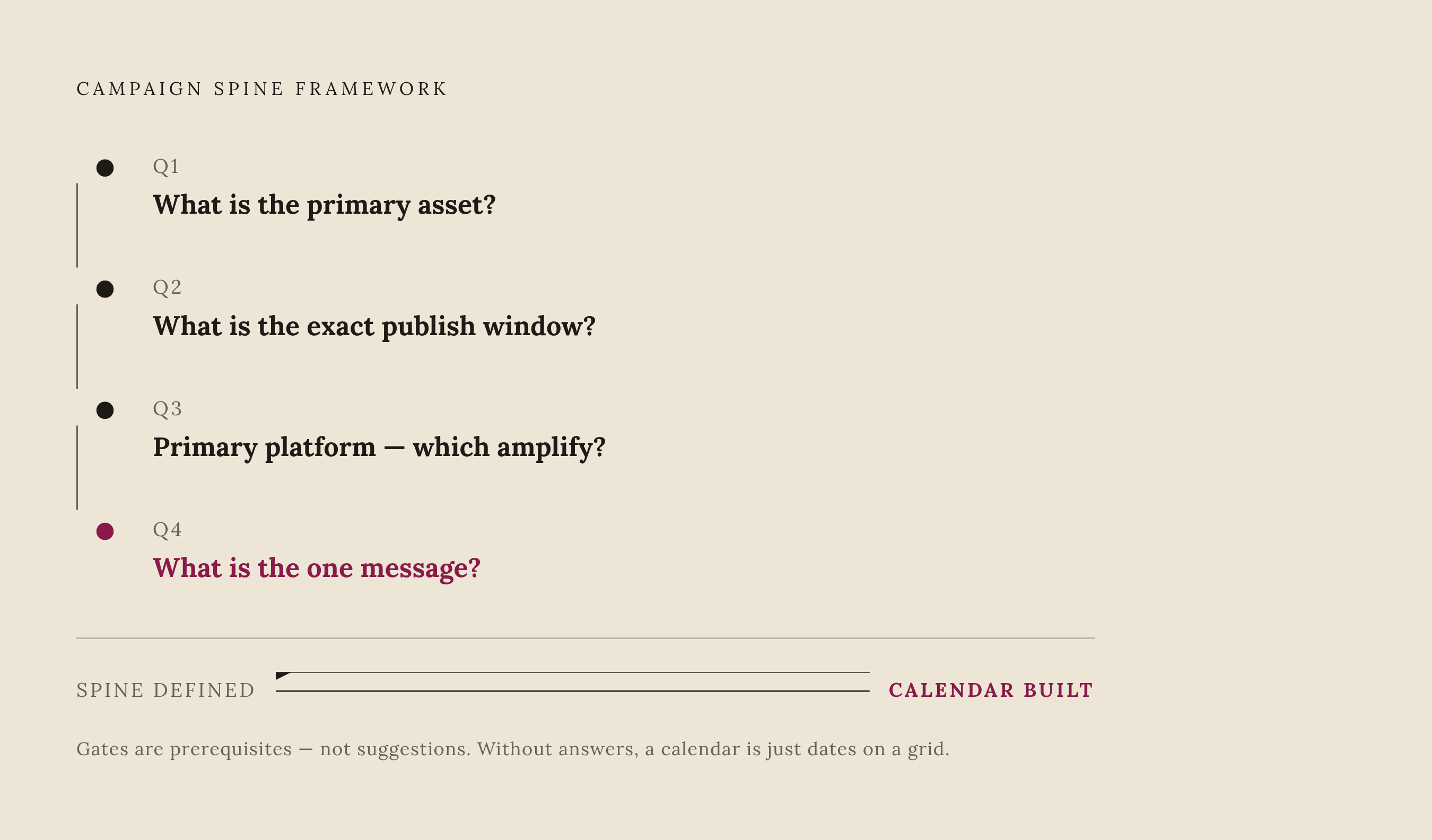
A campaign spine is the single anchor asset, and its exact release moment, around which every other platform-specific piece of content gets sequenced. It could be a long-form video, a podcast episode, a product launch post. Whatever form it takes, the spine is the thing everything else in the calendar exists to support. Without naming that anchor first, a calendar can still have dates filled in for every day of the month, but nothing connects those dates to one another beyond proximity on a grid.
The spine answers four questions before a single post gets scheduled. What's the primary asset anchoring the campaign? What's the exact publish window for it? Which platform is the primary home for that asset, and which platforms exist purely to amplify it after the fact? And what's the one message the entire campaign, across every format and every platform, needs to reinforce? A calendar built without clear answers to those four questions will still get filled in, just with whatever request happens to land that week rather than with content that serves a defined purpose. Influencer Marketing Hub's 2025 research found that 78% of successful content teams operate from a documented strategy, and content pillars force every post into a clear bucket with a clear job to do.
The spine also sets the planning horizon for everything beneath it. The most reliable calendars operate across four horizons at once: annual themes, quarterly pillars, monthly briefs, and weekly production. The campaign spine lives at the quarterly level.
Some creators push back on this framing, arguing that reactive, platform-native posting outperforms anything pre-planned because it reads as more authentic to an audience that can smell a scheduled campaign from a mile away. The pushback misunderstands what a spine actually restricts. Reactive posting and planned campaigns aren't in competition with each other. The spine governs when the anchor releases and what supports it directly; it leaves plenty of room for spontaneous, reactive content in the gaps between those planned moments. What it prevents isn't spontaneity. It prevents reactive posting that accidentally steps on a reveal the creator spent weeks building toward.
Sequencing teasers, platform formats, and publish windows
Sequencing means working backward from the anchor's publish window and placing every teaser, every format variant, and every amplification post in its correct position relative to that release, rather than scheduling each piece forward from whenever it happens to be ready.
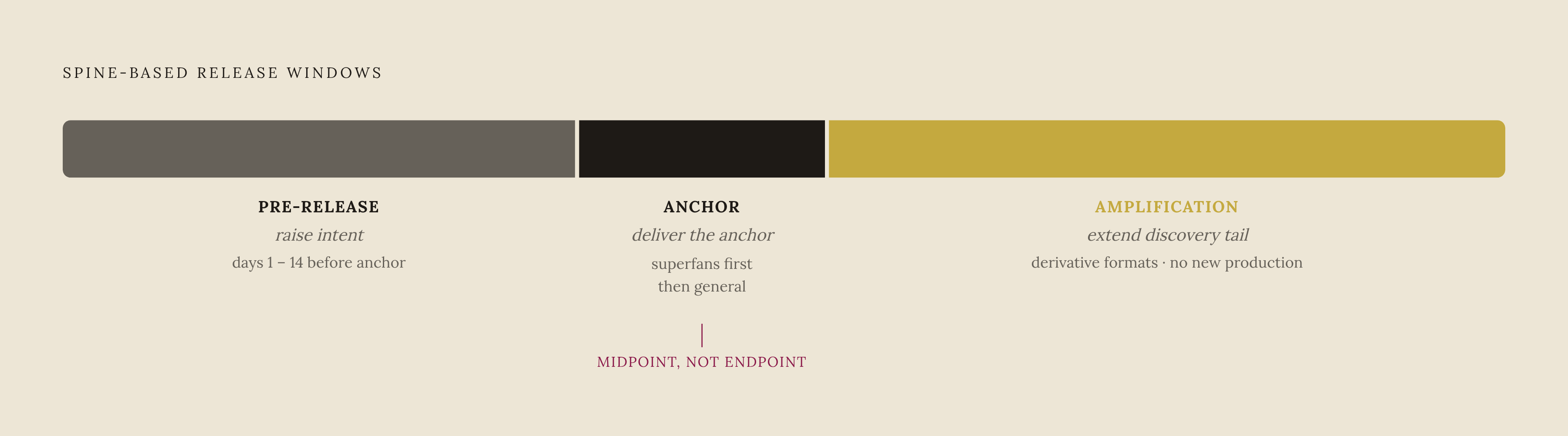
The pre-release window, typically running from several days out to as much as two weeks before the anchor goes live, is where teasers belong. The mistake most creators make here isn't posting too few teasers, it's distributing the same teaser identically across every platform instead of routing each format to the audience intent native to that platform. Mitski's early 2026 campaign is a useful case study in this discipline: rather than posting musical previews everywhere, the rollout used non-musical hooks, a phone number, a cryptic website, that generated press coverage and audience speculation precisely because they weren't the obvious format. Practitioners point to that campaign as evidence for a broader rule: cryptic landing pages work on superfans who'll dig for meaning, vertical edits work as social engagement bait for casual scrollers, and audiograms work on podcast audiences who are listening rather than watching. Each teaser format gets routed to the platform where that format is native.
That approach embeds a discipline: a teaser that gives away the anchor's core content in full, before the anchor itself is live, removes the audience's reason to engage with the actual release. The teaser's job is to raise intent. It is not to satisfy it.
Format adaptation matters just as much as timing does. Long-form video needs a home on whichever platform serves as the anchor's primary distribution surface. Short vertical clips function as a discovery surface elsewhere, pulling in audiences who'll never watch the long-form piece directly but might click through after seeing a fifteen-second cut of it. Audiograms and short audio excerpts serve podcast audiences specifically. Text-based derivative content, a thread, a newsletter excerpt, a LinkedIn post pulled from the anchor's core argument, serves platforms where audiences read rather than watch or listen. None of these formats is a lesser version of the anchor. Each is a distinct container built for how a specific platform's audience actually consumes content.
The publish window itself has also gotten more complicated. Through late 2025 and into 2026, platforms expanded ticketed premieres, native subscription tiers, and gated early-access features across video and audio formats alike. A single release moment can now be a tiered sequence: superfan early access first, a general release next, and an amplification window after that, where derivative content extends the discovery tail without requiring any new production. That amplification window matters just as much as the teaser window that preceded it. Once the anchor is live, deploying format variants across secondary platforms keeps the campaign's discovery surface active for days or weeks past the initial release, using assets that already exist rather than demanding fresh production on a tight clock.
Every row in the calendar itself needs to carry the same fields regardless of platform: publish date, time, platform, campaign tag, content pillar, copy, asset link, owner, status, and approval workflow. The campaign tag is the field doing the real work here. Without it tying each individual post back to the spine it belongs to, the calendar is just a list of scheduled posts. It stops functioning as a release system the moment that tag disappears.
Building the calendar as an operating system, not a posting sheet
A calendar becomes an operating system the moment it encodes more than what goes out and when. It needs to specify who owns each step, how approval moves from draft to published, and what production capacity the planned cadence actually assumes, given the people and time available to execute it.
Before a single post gets scheduled, a handful of constraints need to be documented up front: which platforms function as primary anchors versus secondary amplification surfaces, which content pillars each platform should emphasize (a small, focused set of pillars works better than a sprawling one, since too many pillars create overlap and slow every approval down), what actually requires review before publishing versus what can go out without it, and what counts as finished for copy, design, and scheduling before a piece enters the queue.
For brand-side teams coordinating a distributed network of creators, the calendar carries legal and operational weight beyond scheduling logistics. If a brand reviews content before it posts, that review time has to be built into the calendar as its own committed slot, with the median review duration added to every deadline rather than assumed to happen instantly. Creator coordination, product delivery, usage rights, approvals, and reporting all need named owners inside the calendar itself. Keeping that ownership in a separate tracker undermines the calendar's function as one coordinated system.
Cadence needs to be set by actual production capacity, not by whatever a competitor is putting out or whatever a platform's algorithm seems to reward at maximum frequency. A sustainable cadence outperforms an unsustainable one over time, yet a 2026 industry analysis found that 73% of marketers miss their intended posting cadence. The right optimization target is twelve months of consistency rather than a single month of high-volume output that collapses once the person running it burns out. That burnout risk isn't a soft, secondary concern tacked onto the operational argument. Most creators report burnout affecting their motivation, their physical health, and their mental health, and a calendar that assumes a cadence beyond what its owner can sustain will collapse under its own weight.
Governing the calendar also means governing what doesn't go into it. Running a format audit across the last publishing cycle, then cutting the formats that consistently underperform before adding new volume, reveals what's actually working. A calendar that only ever adds new content, never subtracting the formats that failed, never actually learns anything from one cycle to the next.
Creator partnerships need to be locked in four to eight weeks ahead of when they're needed. Last-minute recruitment almost never produces the coverage a campaign requires. When a coverage shortfall does appear anyway, the right response is concentrating the creators already committed onto the most important release days rather than spreading a thin roster evenly across a crowded calendar, diluting impact on the days that matter most.
How AI tools fit into the calendar without eroding authenticity
AI tools in 2026 handle structure, format conversion, and distribution timing capably. AI tools in 2026 handle structure, format, and distribution timing well, but they do not handle the creator-specific voice and experience that make platform-native content worth distributing in the first place.
Most tools marketed as AI content repurposing tools are actually either a cross-posting scheduler with an AI label attached or a generic text summarizer wrapped in a social media interface. Genuine AI repurposing means taking a long-form anchor asset and producing outputs that are actually native to each destination platform, not identical copy pasted across five different feeds with the formatting adjusted.
AI handles structure, length, and format conversion well. It does not handle authenticity, the specific example pulled from a creator's own experience, the off-script observation that only that particular creator would think to make. The spine's core message, the one thing the whole campaign needs to reinforce, has to be authored by the creator before any AI layer touches the material. Letting an AI tool draft the message architecture first, with a human editing around it afterward, risks losing the specific voice that made the anchor asset worth building a campaign around in the first place.
Agentic AI platforms have moved past passive scheduling into autonomous execution, with 81% of marketing technology leaders already piloting or actively using AI agents to run parts of a campaign across channels. That shift makes the calendar's message architecture more important, not less, because it now functions as the guardrail preventing an autonomous system from generating conflicting brand narratives across platforms it's managing without direct human review of every output. The more automation sits inside the system, the more weight the human-authored spine has to carry.
Real-time adjustment has become a standard feature of these tools: they monitor engagement and adjust posting time, audience targeting, creative elements, budget allocation, and posting frequency based on how content performs as it goes live. That capability earns its keep during the amplification window, where fine-tuning based on early performance data makes sense. Real-time adjustments should not override the sequencing logic already built into the pre-release window, because the order of teasers there matters more than optimizing any single post's individual reach.
Brand-side teams using AI tools to identify and coordinate creators face a distinct risk: AI-generated influencer profiles now make identity checks, audience verification, and content-quality review a standard part of creator due diligence. That vetting step belongs inside the calendar's creator-onboarding process from the start. Treating it as an afterthought, something handled outside the system after a creator's already been brought on, undermines the purpose of building an operating system.
Choosing the right tool for the calendar's actual complexity level
The right calendar tool is whichever one matches the actual complexity of the campaign system it's supporting, not whichever platform ships the most features. A solo creator running a spine-based campaign needs meaningfully different infrastructure than an enterprise team coordinating a distributed network of dozens of creators across multiple brands.
Three tiers cover most of the real-world cases. Solo creators and small teams need visual planning through calendar and board views, scheduling across their primary platforms, and a straightforward way to tag each post back to the campaign spine it belongs to. A dedicated tool earns its place over a spreadsheet even at this scale, since seeing the full strategy at a glance, keeping content pillars properly distributed, and collaborating with a small team in one shared space is difficult to pull off without dedicated infrastructure built for exactly that.
Mid-size creator teams and brand-side coordinators need more: approval workflows with full version history, role-based permissions so the right people review the right content, multi-platform scheduling that actually supports each platform's native format rather than forcing one format everywhere, and performance analytics that feed directly back into planning the next campaign cycle rather than sitting in a report nobody revisits.
Enterprise teams managing distributed creator networks need a different order of capability altogether: multi-brand management, governance controls tied directly to brand guidelines, creator workflow management at scale, and cross-channel performance metrics that roll up into a single view. Emplifi's Unified Campaign Calendar is built for this tier, using data drawn from 399 million posts tracked in the Emplifi 2025 Social Media Benchmarks Report, and the company holds recognition as a Forrester Wave Leader in Social Suites for Q4 2024.
For teams already organized inside Notion, a calendar template built to sit alongside existing planning docs offers a lighter-weight path to the same tagging and pillar discipline described above, without requiring a full platform migration.
None of these tools substitutes for the spine itself. The tool only ever executes the sequencing logic a creator or team has already worked out. Choosing infrastructure before that logic exists just means automating the chaos faster.
Sources
- Best content calendar tools for 2026: how to choose
- Content Calendar Template 2026: Strategy and Planning
- Creator-Friendly Multi-Channel Release Calendar
- What the Creator Economy is Starting to Look Like in 2026 - NAB Show
- Social media content calendar: free 2026 template
- Content Calendar Examples to Plan Content Like a Pro [+Free Template]