Briefing Nano and Micro Influencers Versus Macro Creators
Smaller creators need looser briefs; bigger ones need tighter control.

One brief cannot serve a nano creator posting from her car between shifts and a macro creator whose manager routes copy through legal before anyone shoots anything. The gap between those two realities is the entire argument here: briefing has to flex by tier, not just in tone, but in structure, creative latitude, approval process, and what "success" even means. Get the structure wrong and you either strip the authenticity out of a nano post before the camera turns on, or hand a macro production team a paragraph of vibes and wonder why nothing ships on time.
What each tier actually is and why the differences run deeper than follower count
Nano creators, generally those with a few thousand followers or fewer, function as trusted voices inside a tight community. Their content reads as conversational because it mostly is, and many of them aren't full-time creators at all. Micro creators, roughly tens of thousands of followers, occupy a different plane: niche authority paired with real reach, and increasingly run like small businesses, complete with media kits and rate cards. Macro creators, from hundreds of thousands up to a million followers, operate with agents, managers, and often a production crew standing behind every post.
The follower count is almost incidental. What actually separates these tiers is behavior. A nano creator might be filming a quick reaction in a parking lot. A macro creator has an editor reviewing footage, a manager negotiating usage rights, and a legal team checking disclosure language before anything goes live. Content production norms track the same split: nano content is spontaneous, micro content sits somewhere between organic and produced, and macro content is planned, shot on real equipment, and edited to something close to brand-adjacent polish.
Audience relationship shifts too, and this is the part briefs most often ignore. Nano followers treat a recommendation the way they'd treat advice from a friend. Macro followers, by contrast, consume more passively, closer to how they'd watch an ad. That distinction determines what a brief needs to protect (authenticity, at the small end) versus what it can safely prescribe (production specs, at the large end).
According to Linqia's 2026 State of Influencer Marketing, 92% of enterprise marketers plan to work with both macro and micro influencers in 2026. Most brand teams, in other words, will be briefing across tiers at the same time, which makes a single templated brief not just inefficient but actively risky. Compounding that, rates for top-tier creators have climbed 25 to 45% over the past two years, while nano rates have barely budged. That cost gap is exactly why multi-tier programs have become the norm rather than the exception, and why tier-specific briefing has stopped being a nice-to-have.
How engagement and conversion data should inform what a brief asks for
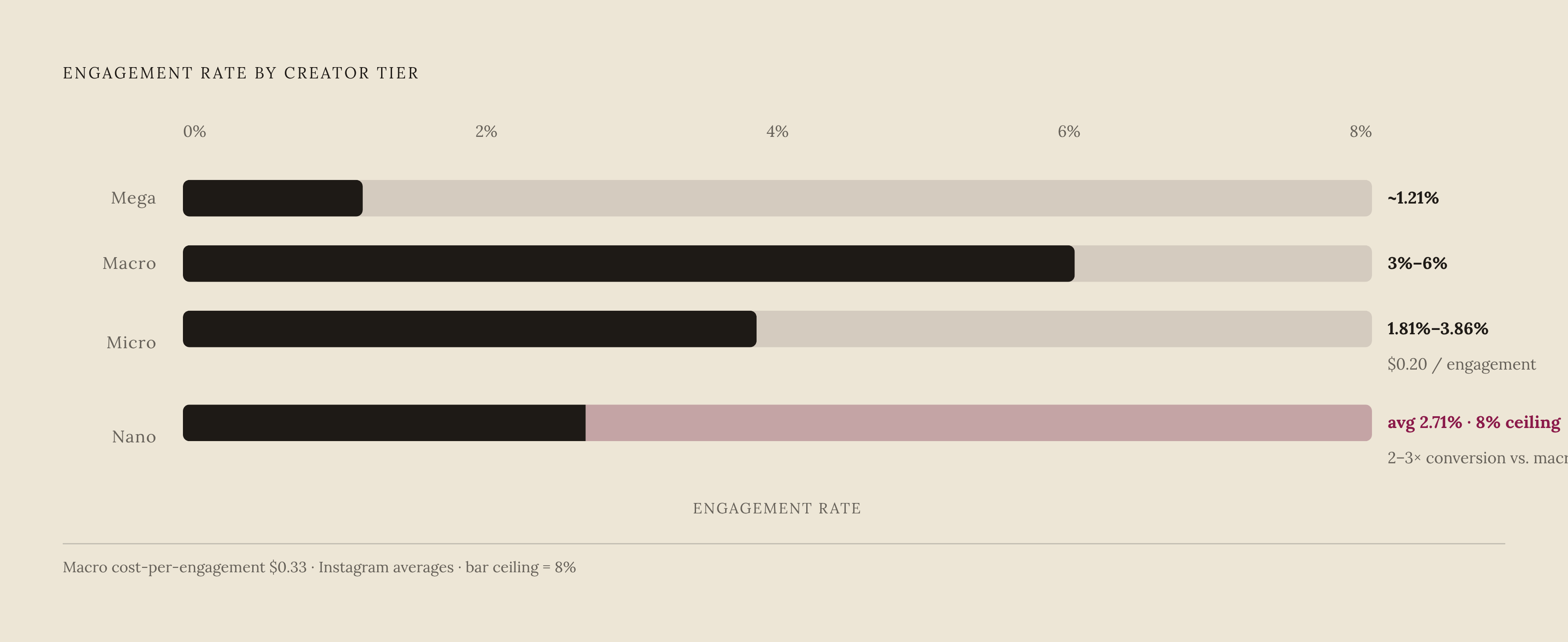
Engagement numbers make the case for differentiated briefing better than any theory could. Social Cat's research puts nano influencer engagement at an average of 2.71%. Micro influencers in the 10,000 to 50,000 range average around 1.81%, though a Paul M. Katz analysis found Instagram micro influencers reaching as high as 3.86%. Mega influencers, meanwhile, fall to roughly 1.21%. TANKE's figures paint an even wider spread for micro creators, 7% to 20% depending on niche and platform, against a macro range of 3% to 6%. Niche alignment, clearly, matters more than tier alone.
Nano creators convert hard inside tightly knit communities, often clearing 8% engagement, and their conversion rates can run two to three times higher than macro campaigns. A brief for that tier has one job: protect whatever is producing that number. Over-specify the content and the peer-trust dynamic that drives conversion disappears before the video even gets shot.
Macro briefs need the opposite instinct. A 3% to 6% engagement rate sounds unremarkable next to a nano creator's numbers, but on an audience of half a million, that's still enormous absolute visibility. The brief there has to specify production standards, usage rights, and approval stages, because that content needs to hold up at scale, not just feel authentic in the moment.
Cost data backs this up further. Micro influencers cost around $0.20 per engagement, compared to $0.33 for macro. Wasting a micro creator's authenticity with an over-prescribed brief isn't just a creative misstep, it's a straightforward efficiency loss. One case worth citing: a sustainable fashion brand ran an $8,000 budget across nano creators, generated 45,000 total engagements, drove 820 code-based purchases, and attributed $28,000 in revenue to the campaign. That result depended on creators getting creative freedom instead of a shot-by-shot script.
Briefing nano creators: what to include, what to leave out, and why less is more
The nano brief should look more like a product card than a campaign document. The brief should give just enough direction to ensure brand safety and authentic delivery; past a certain point, the content starts sounding scripted, and scripted is the one thing a nano audience smells instantly.
What belongs in it: the product essentials (what it is, what's distinct about it, what claims the brand can legally stand behind), a short list of mandatory disclosures (FTC or ASA compliance language needs to be spelled out in the brief itself, not left for the creator to guess at, and this holds at every tier without exception), a handful of hard no's (competitor mentions, pricing claims outside agreed terms, categories the brand can't touch), and a simple deliverable spec: platform, format, one deadline.
What doesn't belong: shot lists, scripted lines, required transitions or camera angles. These produce content that reads like an ad, which is precisely what nano audiences reject on sight. Multi-stage approval workflows are equally out of place here. Nano creators often post close to real time, and a five-day review cycle severs the content from the organic moment that made it work in the first place.
A short personal note goes a long way too, explaining why this specific creator got picked, what their community looks like, what made them the right fit. It signals the brand actually looked at their work rather than pulling a name off a spreadsheet. On compensation: nano campaigns tend to run on gifting or small flat fees, and where affiliate codes or links are involved, the brief should lay out the mechanics clearly enough that the creator can explain them naturally on camera, not read them off a card. And build in real lead time. Many nano creators have day jobs, so the brief should read like an invitation to collaborate, not a deadline handed down from above.
Briefing micro creators: enough structure to stay on-brand, enough room to stay authentic
This is the hardest brief to get right, because the failure runs in both directions. Too loose, and the brand's message drowns inside a creator who has genuine reach to lose. Too tight, and the niche authority that made the creator worth hiring evaporates on contact.
Micro creators run their content like a business now: media kits, rate cards, real audience analytics. They bring professional expectations to the table, so the brief needs to meet that standard without turning into a broadcast spec sheet.
Beyond the nano baseline, the micro brief should add a clearer campaign objective (not "promote this product" but the specific action the brand wants: a click, a code redemption, a comment), a messaging hierarchy separating the one point the creator must land from the secondary points that are optional, and format guidance loose enough to preserve voice (platform, rough length, whether the piece should feel tutorial-adjacent, review-adjacent, or lifestyle). One light review checkpoint, a content outline or a raw hook, fits at this tier. A full script approval does not.
Usage rights need to be spelled out too. Micro content increasingly gets pulled into paid amplification after the fact, and creators need to know that going in, since it affects both their rate and their willingness to participate. Personalization still matters here just as much as at nano: name the reason this creator specifically got the call. And tell them what's being measured, conversion codes, engagement rate, click-through, because at the micro tier attribution is trackable enough that the creator can actually shape content around the metric that matters.
Briefing macro creators: specification, approval stages, and the professional infrastructure behind the post
The macro brief runs longer, but not because the brand wants more control. It runs longer because the infrastructure on the other side demands it. A brief a manager can't parse and a legal team can't sign off on will stall before production even starts.
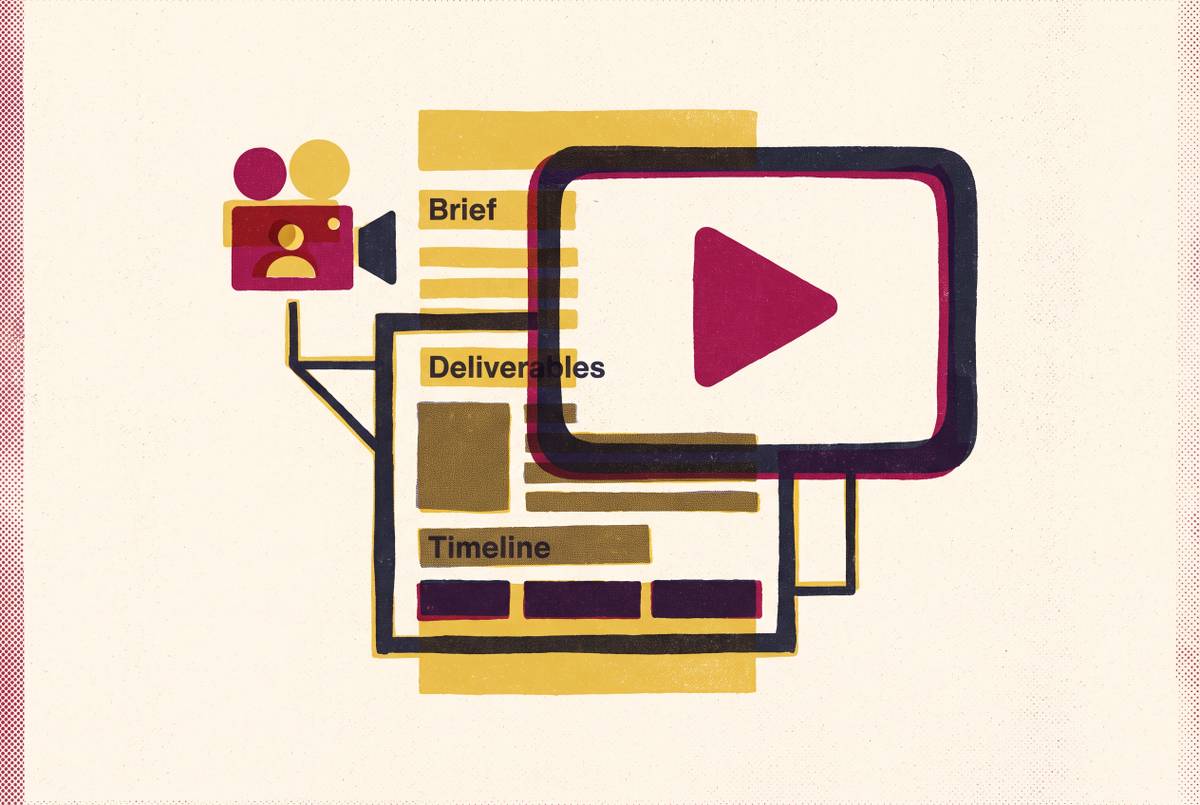
Structurally, this brief becomes something closer to a campaign spec document: objectives, deliverables, timelines, approval milestones, and legal terms, all living in one place. Creative direction needs more detail too, preferred visual treatment, brand tone, required disclosures, required product placements, because a production team executes against these, not a single creator improvising in front of a phone camera.
The approval workflow has to be explicit: how many rounds, who signs off, what the timeline looks like at each stage. If it's missing, the creator's team will ask for it anyway, so building it in up front saves a round trip. Usage rights, exclusivity clauses, and payment terms belong in or alongside the document as well. At this tier, those aren't afterthoughts, they're deal terms that shape whether the creator says yes at all.
Expect to be writing for a manager or agent rather than the creator directly, and the brief should read that way, precise enough for a professional intermediary rather than casual enough for someone reading it at home. Success metrics here should center on reach, impressions, awareness, and share of voice, not conversion codes, which feel out of place in polished macro content and which that audience is less inclined to act on directly.
Even at this scale, the brief still needs a real creative direction section, not a script, but a clear point of view. A generic brief that could apply to any brand in the category produces generic content, and generic content wastes the scale the brand just paid for. Given that macro and mega creator rates have climbed 25 to 45% over the past two years, precision here isn't optional. It's what keeps an expensive reshoot from happening at all.
Approval workflows and revision policies that fit each tier without slowing campaigns down
The approval process belongs inside the brief itself, not bolted on afterward once contracts are signed. Creators at every tier plan production differently depending on what review looks like, so they need to know before they start, not after a draft gets rejected.
At the nano tier, near-zero review is the goal. If a check is required at all, one pass on a draft or outline with a 24 to 48 hour turnaround is the ceiling. Anything longer breaks the spontaneous quality that makes the content credible in the first place.
Micro creators do well with a single checkpoint, usually a content outline or hook, followed by light notes. Multiple revision rounds at this tier read as distrust and wear down the partnership, and clear communication of expectations is something creators consistently say they value in a collaboration.
Macro workflows can and should carry multiple stages: an alignment call on the creative brief, a draft review, a final approval. The production investment on both sides justifies it, and management teams are already building this structure into their own project plans regardless of what the brand specifies.
One thing holds constant across every tier: the revision policy needs a stated number of permitted rounds and a definition of what counts as an out-of-scope change, protecting both sides from scope creep that delays a launch date. And disclosure compliance needs a final check at approval, no matter the tier, because putting the FTC or ASA language in the original brief doesn't guarantee it survives into the finished post. That verification step belongs on the checklist, every time.
Setting success metrics that match what each tier can actually deliver
Measuring the wrong thing at the wrong tier produces bad data and, worse, unfair judgments of creator performance. Holding a nano creator to a reach target, or a macro creator to conversion-code redemption, tells you nothing true about either one.
Nano metrics should center on conversion rate, code redemptions, and community response, comments, DMs, saves, since those are the outputs the format is actually built to generate. Reach is secondary at best. Micro metrics land in between: engagement rate, click-through to owned pages, affiliate attribution, and conversion codes, all trackable with something close to paid-social precision once UTM parameters and codes get built into the brief from the outset. Macro metrics belong at the top of the funnel: reach, impressions, share of voice, awareness lift. Even a modest engagement rate looks unremarkable until you remember the size of the audience behind it.
State the primary metric in the brief and say why it was chosen. A creator optimizing for saves produces a different piece of content than one optimizing for link clicks, and that context changes execution.
For agencies running multi-tier programs, the reporting has to stay granular. A single blended engagement rate averaged across nano and macro content hides the real performance at both ends of the spread. Tier-specific reporting is the only version that tells the client the truth. Platform analytics, affiliate tracking, and UTM parameters have gotten precise enough that nano and micro attribution can rival paid social, provided the tracking setup gets specified in the brief before the campaign starts, not reverse-engineered after it ends.
Running multi-tier campaigns as a system, not a series of one-off placements
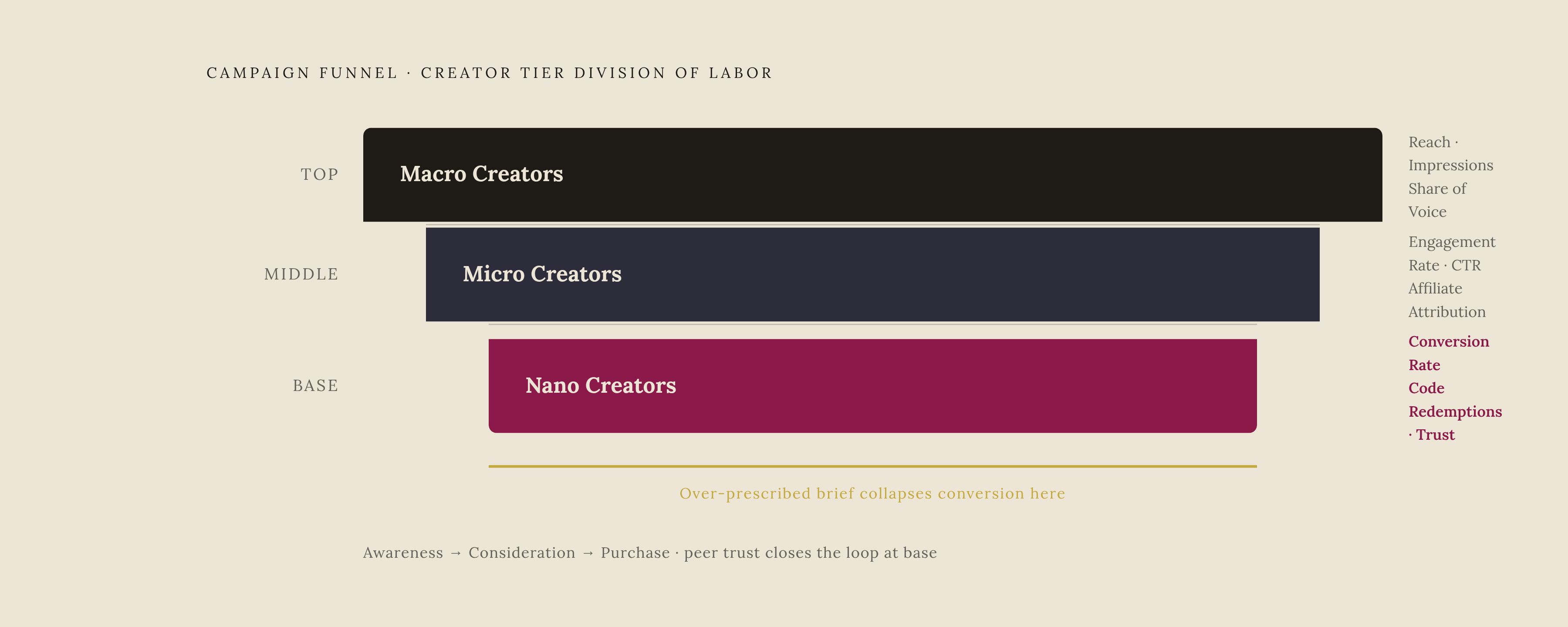
The 92% of enterprise marketers planning to work across macro and micro tiers in 2026, per Linqia, aren't running these as parallel, disconnected campaigns. They're assigning each tier a distinct job inside one funnel.
A workable division of labor looks something like this: macro creators anchor awareness and cultural reach, micro creators build niche credibility and move consideration forward, and nano creators supply the peer-level trust that closes the loop at the point of purchase. Each brief should reflect the role its tier plays in that sequence rather than treating every placement as an isolated transaction.
Content produced at the nano and micro level, run at volume, also compounds into something durable: a growing library of organic-feeling assets that a brand can draw on well past the original campaign window. That library only exists, though, if the briefs that generated it protected the qualities that made the content worth keeping in the first place. Standardize the brief across tiers and that library never gets built. Calibrate it, and the system starts working the way it was supposed to from the start.