Paid Amplification Strategy for Top-Performing Creator Content
Organic reach collapsed, forcing brands to amplify creator content with paid media.

Paid Amplification Strategy for Top-Performing Creator Content.
Why organic reach no longer justifies a creator budget
Organic reach for branded posts has fallen 60 to 70% since 2020, and a creator post that once landed in front of nearly a third of an audience now reaches somewhere around 5 to 8% without paid support Influencer marketing shifts toward paid amplification over creator de… influencers-time.com Which paid amplification strategy actually works in 2026? - Pulse Adv…. That is not a content quality problem. It is a distribution problem baked into how platforms now ration reach, and no amount of posting cadence or clever hooks fixes it. A brand can commission the best creator video of the year and still watch it die behind an algorithm that was never going to show it to more than a sliver of the intended audience.
The market has already adjusted to this reality faster than most budget conversations have caught up. Close to 8 in 10 marketers now put paid media behind creator content as a matter of course Creator Content Now Powers 44% of Paid Media Creative as the Traditio… Which paid amplification strategy actually works in 2026? - Pulse Adv…. The debate over amplifying is functionally over. What is left is harder and more interesting: deciding what to amplify, and when. Treating organic creator output and paid distribution as two separate line items, run by two separate teams on two separate timelines, leaves real revenue sitting on the table CreatorIQ 2025–2026 State of Creator Marketing Report. The rest of this piece is about closing that gap with a framework built on signal, not instinct.
The market context behind the shift to paid amplification of creator content
U.S. creator economy ad spend is projected to hit $43.9 billion in 2026, up from $37 billion in 2025, a jump of roughly 18% year over year and nearly four times the growth rate of media spend broadly Which paid amplification strategy actually works in 2026? - Pulse Adv…. Paid amplification of creator content specifically is expected to grow 48% year over year, reaching $13.2 billion, making it the fastest-growing piece of that spend. Roughly 23% of all social ad spend now runs through creator content instead of brand-made creative, and the mechanics behind that number are scaling just as fast as the dollars: spend on whitelisting and Spark Ads grew 64% year over year in 2025 bizkol.ai.
None of this is new money showing up out of nowhere. That is a reallocation, a bet that creator content earns a media dollar better than a studio-shot ad does. The brands moving first are compressing the advantage window for everyone else. That is why the decision framework in this piece matters now rather than in a year. 38% of large U.S. brands now allocate the majority of their influencer budgets to paid amplification rather than direct creator compensation alone.
Why creator content outperforms brand-produced creative in paid channels
The performance case is not soft. TikTok's own data, as reported by eMarketer, shows creator-led ads pulling about 70% higher click-through rates and 159% higher engagement than non-creator ads running at the same CPM. Ads built around user-generated content cut cost-per-click by 50% compared to ads without it, and multiple 2026 studies put creator content at 3–4x the efficiency of standard brand-created paid ads Creator Performance Marketing: A 2026 Playbook for Scalable ROI Influencer marketing shifts toward paid amplification over creator de…. Average influencer CPMs dropped 42% year over year to $2.68 in 2025, so the cost advantage is compounding right as the performance gap widens. Across tiers and platforms, influencer marketing returns $5.78 for every dollar spent influee.co.
The mechanism is not mysterious. Audiences do not flinch at a creator holding up a product the way they flinch at a polished studio ad, and that trust does conversion work no amount of paid targeting precision can manufacture on its own. But the deeper cause here is buried in the framework, not the headline stat: this advantage only holds for the right creator content, because the framework only credits amplification spend when the underlying post has already proven itself organically. A weak post amplified with a big budget still performs like a weak post, just at scale. Which post earned the spend has to come from data the platform hands you, not from a gut call on launch day.
The create → qualify → amplify loop: how signal-first programs are structured
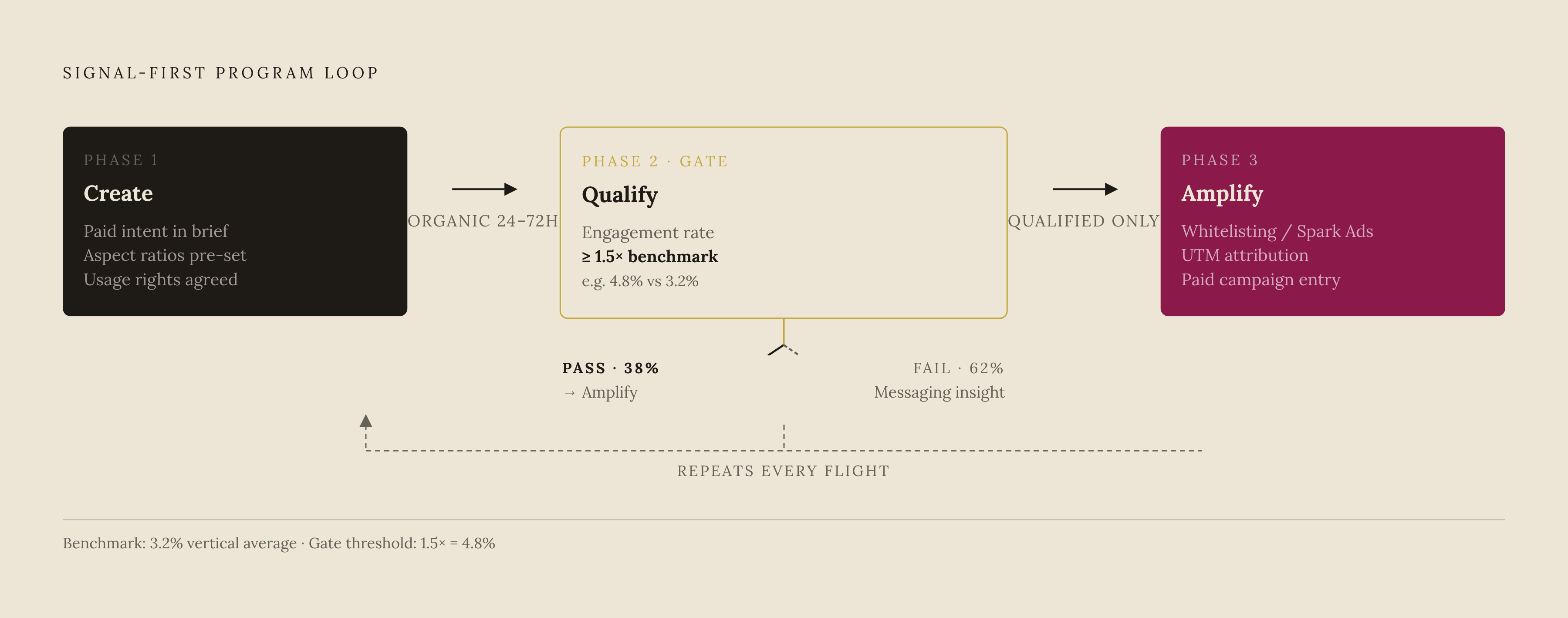
The brands getting this right in 2026 run a three-phase loop: create, qualify, amplify. It repeats every flight rather than running once as a linear campaign, and each phase exists to catch a specific failure mode.
Creation starts with paid intent built into the brief, not bolted on after a post takes off. That means specifying aspect ratios for paid placements, a pre-agreed performance threshold that triggers a boost, and messaging that survives a muted autoplay view on CTV or desktop, where on-screen text and captions have to carry the value proposition because sound is off by default. Most brand briefs still skip this. Usage rights belong in the same conversation: organic-only rights are the floor, whitelisting rights carry a premium, and full paid media rights (off-platform display, CTV) are their own line item.
Qualification is where the loop earns its name. Content runs natively for a window of 24 to 72 hours, and platform signals, saves, shares, watch-through rate, swipe-up clicks, act as the filter influencers-time.com. The trigger is specific: engagement rate exceeding the category benchmark by 1.5x or more within the first 24 hours is a signal worth acting on (if a vertical averages 3.2% on Instagram Reels and a post hits 4.8% in the first day, that qualifies) Brand Budget Framework: Paid Amplification vs More Creators. Posts that clear the bar move to paid; posts that don't get mined for messaging insight instead of getting boosted anyway. That distinction matters because 62% of amplification spend on creator content currently produces lower ROAS than equivalent brand-produced paid social, because the wrong posts are the ones getting boosted influencers-time.com. The qualification phase is the whole point of the framework; skip it, and the framework is just a slower way to waste money.
Amplification closes the loop with attribution built in from the start. Qualified content moves into paid campaigns through whitelisting or partnership ad units on Meta and TikTok, tagged with UTM parameters tied to a dedicated revenue attribution layer, so a dollar spent on a boosted post can be traced to a dollar of revenue rather than left to sit inside a vague engagement report.
Scoring which organic posts deserve amplification budget
A paid boost decision matrix turns the qualification phase into something a performance marketer can run without guessing. Creator evaluation under this model goes well past follower count: hook rate on recent posts, video completion percentage, whether comments read as genuine questions or emoji spam, and prior Spark Ad eligibility or boosting by another brand. Creators with that history already understand safe zones, CTA placement, and how revision requests work, which cuts friction once a post qualifies.
Score thresholds vary sharply by category, because what counts as a strong engagement rate in one vertical is unremarkable in another. A score that would flag a breakout post in fashion would read as mediocre in fintech, so a single company-wide threshold is close to useless.
None of this replaces judgment on brand safety or message accuracy. The score decides whether a post is a candidate for paid spend; a human still decides whether it's a candidate for the brand. Running the matrix seriously provides the direct answer to that 62% failure rate from the qualification phase: the wrong posts stop getting the budget because there's now a number attached to "wrong influencers-time.com." Supplements/wellness scores 72+. Financial products/fintech scores 75+. CPG/food scores 60+ Influencer marketing shifts toward paid amplification over creator de…. Fashion/apparel scores 58+. Beauty/personal care scores 65+.
No platform is a universal right answer here. The choice follows the objective, the format, and where the qualifying signal actually came from.
Meta Partnership Ads, renamed from Branded Content Ads, show 20 to 50% performance gains over conventional social ads, with cost-per-acquisition reductions documented up to 30%. Brands get full creative control, editing copy, swapping CTAs, running A/B tests and dark posts, which matters for direct-response work that needs fast iteration. Whitelisting fees add 25 to 30% on top of base content costs per 30-day usage window. Meta also announced at Cannes Lions on June 23, 2026, that it's merging Creator Marketplace and the Partnership Ads Hub into a single Creator Marketing Hub, due later in 2026, a workflow change that will reshape how brands manage this pipeline once it ships.
TikTok Spark Ads work differently bizkol.ai. Creator content boosted through Spark Ads pulled 159% higher engagement than non-creator content at matching CPMs across North America between February 2024 and January 2025, with completion rates running 30% ahead of standard in-feed ads. CPM sits meaningfully lower, at $9.16 against Facebook's $14.91, and the platform's relative undersaturation gives early movers something like a 12 to 18 month window before costs catch up. The tradeoff is limited creative control: no caption or visual edits, so the original content has to be strong enough to perform unaltered. Organic qualification must precede Spark Ad spend. Authorization codes also expire in 30 to 60 days, so renewal has to be managed proactively or a campaign lapses mid-flight without warning. TikTok now holds about 35% of global influencer spend in 2026, edging past Instagram's 33% for the first time bizkol.ai.
Brands running both platforms tend to split by funnel stage rather than treat them as competing choices: Meta for mid-funnel conversion, TikTok for top-funnel awareness. Ryan Detert, CEO of Influential, frames the paid share as roughly 30% for awareness objectives, rising to 70% for conversion, with the objective driving the platform weighting rather than the reverse. YouTube holds around 22% of creator spend, carried largely by long-form review content and Shorts, and its Brand Suitability controls make it a solid fit for longer creator content amplified against brand lift goals. X widened the category on July 15, 2026, with Mentions Boost, letting Premium Business accounts pay to extend unpaid posts that already mention them, a narrower mechanism than whitelisting or Spark Ads but a useful one for conversation-driven content. Facebook is best suited for mid-funnel conversion optimization, with mature targeting infrastructure and a higher baseline CPM at $14.91. The creator compensation model involves performance-based commissions of 5–15% of sales, aligning creator incentives with paid outcomes.
Structuring the amplification budget so the framework can function
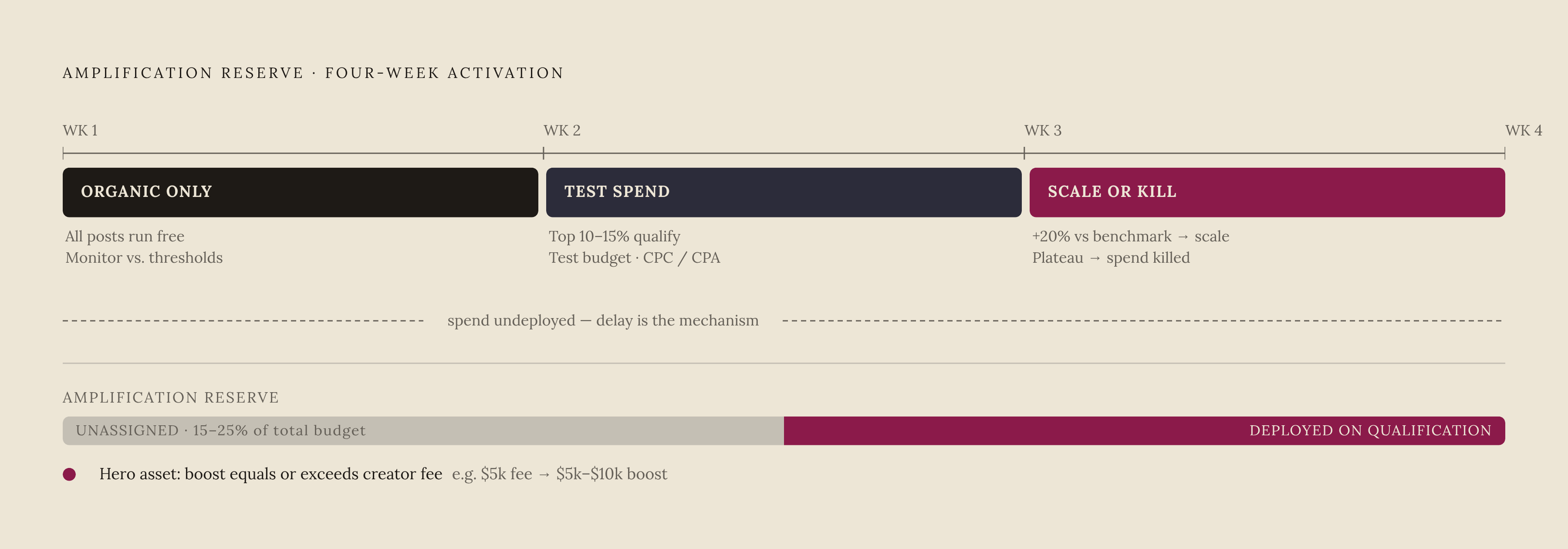
None of the phases above work without a budget built to feed them. The amplification reserve model calls for setting aside 15 to 25% of total creator budget as a dedicated, performance-contingent pool, not assigned to specific posts in advance, but held ready to deploy behind the top 10 to 15% of organic content that clears its threshold during a given flight. For hero assets, the creator-fee parity benchmark is a useful anchor: allocate amplification spend equal to or greater than the creator fee itself, so a creator costing $5,000 for a deliverable gets $5,000–$10,000 in paid boost for top-performing posts.
The activation timeline follows the qualification logic directly.
None of this holds if creator amplification lives as a sub-line inside a generic "social media" budget, funded only when campaign dollars happen to be left over. It has to be its own named line, rationed and governed on its own terms. In weeks 1–2, all creator content runs organically while being monitored against threshold triggers, with most content not qualifying. In weeks 2–3, amplification spend moves behind the top 10–15% of posts that hit thresholds, starting with a test budget per post and measuring CPC and CPA against brand ad benchmarks. In weeks 3–4, spend is scaled on posts that outperform brand benchmarks by 20% or more, while spend on boosted posts that plateau is killed. 57% of ad buyers identify influencer ads and partnerships as their top priority for 2026, up from 48% in 2025 according to the IAB, and budget structures are following that prioritization. Programs investing at scale report an average program investment reaching $6.6M, with more than eight in 10 respondents reporting at least 2x ROI per CreatorIQ's Creator-Powered Funnel Report, representing the scale at which the amplification reserve model operates at maturity Creator Content Now Powers 44% of Paid Media Creative as the Traditio….
The organizational and attribution problems that break amplification programs before they scale
The framework above sounds mechanical because it is supposed to be. The place it breaks is organizational. Influencer teams sit in one silo, paid social sits in another, and the approvals, usage rights, and creative hand-offs between them run on separate timelines that were never built to sync with a 24-to-72-hour qualification window influencers-time.com. A post can clear every threshold in the matrix and still miss its amplification window because legal is still reviewing a whitelisting clause that should have been settled at the brief stage. Attribution suffers the same fracture: without a shared revenue layer connecting the organic post, the paid campaign, and the actual sale, the two teams end up arguing over whose channel gets credit instead of agreeing on what worked CreatorIQ 2025–2026 State of Creator Marketing Report. The framework only functions where those two teams share a budget line, a timeline, and a single measurement system built to catch a signal within hours of it appearing, not weeks after the post has already gone flat CreatorIQ 2025–2026 State of Creator Marketing Report.
Sources
- Creator Performance Marketing: A 2026 Playbook for Scalable ROI
- Which paid amplification strategy actually works in 2026? - Pulse Advertising
- Brand Budget Framework: Paid Amplification vs More Creators
- Influencer marketing shifts toward paid amplification over creator deals - ECIKS.org
- Creator Content Now Powers 44% of Paid Media Creative as the Traditional Marketing Funnel Compresses, CreatorIQ Report Finds
- Creator Ads Vs Brand Ads: 2025 Data You Need
- UGC ads: how brands use creator content in paid media — Creator.co