Brand Voice Guidelines Inside a Creator Brief
Behavioral specs beat vague adjectives in telling creators how to sound.
Influencer marketing hit $32.55 billion in market value in 2025, up from $1.4 billion in 2014. That kind of growth built an entire industry faster than its paperwork could keep up, and most brands still treat the document meant to keep it coherent, the creator brief, like an afterthought. Here's the position this piece is going to argue: the adjective-based voice guide, the "friendly, bold, authentic" deck every brand seems to own a copy of, is the most overrated artifact in influencer marketing, and it should be retired rather than revised. It fails for a specific, traceable reason, and the rest of this piece unpacks exactly what that reason is.
Goldman Sachs puts the global creator population at roughly 67 million people in 2025, headed toward 107 million by 2030, and no brand marketing team, however large, personally onboards a pool that size. So the money has to travel through a document instead of a person. One brief does the work that used to belong to in-person training, tribal knowledge, and a marketing director looking over someone's shoulder mid-shoot. It's the only artifact that travels with every collaboration, and it's where brand voice either survives contact with a stranger's camera roll or dies quietly somewhere between the pitch and the post.
What brand voice actually means, and why adjectives alone don't transfer it
Voice and tone get used interchangeably by people who should know better, and the mix-up costs money. Voice is identity: the thing that stays constant no matter where the brand shows up. Tone is situational, the inflection layered on top of that identity depending on context. A brand can sound celebratory in a product launch email and measured in a customer service reply without becoming a different brand in either place, the same way a person can be gentle with a crying toddler and blunt with a contractor who missed a deadline while staying recognizably the same person the whole time.
Briefs blur this distinction constantly, and creators pay for the confusion. A creator who reads a tone instruction as a voice instruction either overcorrects, flattening every post into the same register regardless of platform, or ignores the direction entirely because it reads as noise instead of signal.
Here's where the real argument starts. Open a brand deck, any brand deck at all, and the odds favor landing on some combination of "friendly, professional, bold, authentic." Brand voice guideline analyses flag exactly this pattern. Those words feel sharp in a workshop, surrounded by whiteboard energy and a facilitator nodding along, but they constrain almost nothing once someone sits down to write an actual caption. Take the creator running three brand deals in a single week: all three briefs say "warm and authentic," yet none say what that means when the topic shifts from a skincare serum to a fintech app to a protein bar. The adjective stays fixed while the job changes completely, and the creator is left guessing which flavor of warmth applies where. The gap runs deeper than a training issue; it's a design flaw baked into the document itself.
A behavioral spec functions like a stage direction. It tells the creator how this voice actually behaves when conditions change, with a specificity that comes from describing an action rather than naming a trait, no matter how many synonyms get piled on top of the trait.
The six components that belong in the voice section of a creator brief
Influenceflow's brand voice guideline template breaks a workable voice section into six pieces, and each one earns its place by doing a job a bare adjective can't. Skip any one of them and the section slides back into decoration.
Start with voice personality: three to five traits, each with a functional definition attached, not a label floating alone. Then the why, tying the voice back to the brand's actual values so a creator understands intent instead of receiving an order stripped of context. Third, how the brand sounds in practice, broken out by context: social captions, long-form video, a crisis response, a one-on-one customer interaction, each handled differently. Fourth, vocabulary standards: the specific words the brand uses, the words it avoids, and what to say instead of the avoided ones. Fifth, the do's and don'ts, governing active versus passive construction, jargon, where the humor boundary sits.
Sixth, and most neglected: real examples, annotated, good and bad side by side, ideally pulled from content the brand actually published rather than something invented for the deck. That sixth element carries more weight than the other five combined, and a brief without annotated examples is missing its most functional piece, full stop. Written examples let a creator watch the voice operate inside real content, which is a faster route than reverse-engineering it from a paragraph of description.
The "what to avoid" list deserves particular attention here too. Two or three sharp negative examples, something like "corporate," "preachy," "aspirational-distant," often outperform an entire paragraph of positive description, because negatives eliminate the drift patterns that show up most often. Naming a failure mode directly beats dancing around it with more adjectives. Channel specificity matters as well: a brand's voice on TikTok and that same brand's voice in a LinkedIn post can flex in energy considerably while the underlying traits hold steady, and the brief should show both registers side by side instead of assuming a creator will intuit the gap.
Where over-briefing and under-briefing both break brand voice
Most underperforming campaigns trace back to the brief itself, and they tend to fail in one of two opposite directions. Both directions produce the same off-brand result, which is the tell that voice alignment is a narrower target than most teams assume.
Under-briefing looks like a single Slack message and a link to the product page. The creator improvises because there's nothing else to work from, the content drifts slowly away from brand voice over the course of production, and by the time anyone reviews the final cut, the brand sounds unrecognizable. Over-briefing swings the opposite way: a fully scripted document that hands the creator lines to read rather than a voice to inhabit. A scripted post undercuts audience trust even when every word in it checks out as technically true, because structurally, it reads like the ad it is. The content wears a creator's face, but the voice underneath belongs to a committee.
Over-briefing is the worse failure of the two, and it isn't close. Under-briefing is fixable with a better document, since it's a gap, and gaps get filled. Over-briefing signals a trust problem, and no amount of additional detail fixes a brief that never intended to let the creator sound like themselves in the first place. Adding more paper won't address a control instinct; admitting the instinct is there in the first place would, and most brands seem reluctant to do that.
Sprout Social's 2025 Influencer Marketing Report found 65% of creators would rather join strategy conversations early than receive a rigid brief handed down after every decision has already been made. That's a preference about architecture, not personality. Creators aren't asking to be coddled; they're asking to understand the shape of the thing before being told to color inside it.
The core and flex model offers a structural way through this. Core is non-negotiable: brand values, accurate product claims, legal guardrails, FTC disclosure requirements. Flex is the space where the creator's own voice operates inside the brand's, covering tone, humor, cultural references, format conventions. Some brands running longer partnerships lean on what's sometimes called a framework brief, or an "always-on" brief: tone rules and compliance guardrails set once, without scripting a single line of copy, built for relationships that span campaigns rather than a one-off post.
A brief that names, explicitly, what's fixed and what's flexible is a brief a creator can respect. Leave that line ambiguous, and creators respond one of two ways: they over-caution everything into blandness, or they disregard the brief altogether and wing it. Neither outcome is what the brand paid for, and neither is particularly hard to prevent.
How voice misalignment creates brand safety risk, and why the brief is the first line of defense
Brand safety and brand alignment get treated as synonyms, and conflating them is where a lot of these programs go wrong. A creator can clear every brand safety checkbox there is: no harmful content, no fraudulent claims, nothing that would trigger a platform flag, and still produce something that sounds like it came from an entirely different company. Safe and on-voice measure different things, even when they get graded on the same rubric.
Most reputational problems in creator campaigns start with misalignment, not creative recklessness. A creator producing off-brand content is, in the overwhelming majority of cases, working from a brief that never made the voice clear, or from no brief at all. The risk traces back to the brand never having said what "on-voice" meant in the first place, buried under a safety conversation that measures something else entirely.
Sprout Social's Q2 2024 Pulse Survey found 42% of consumers say they'll unfollow an influencer, and the brand behind the partnership, if a creator shares content that clashes with the audience's expectations. One post that breaks the expected pattern can dent trust that took considerably longer to build than it takes to lose, and that asymmetry alone should be reason enough to treat the voice section as more than a creative nicety.
Automation catches part of this, and only part. A disclosure omission or a missing logo is pattern-matchable, at least; tone, context, and fit still need a human eye, and the brief is the mechanism that hands that judgment to the creator before a camera ever turns on. The voice section deserves treatment as a risk document alongside its creative role. It belongs in the review and approval process the same way a legal disclosure check does, because functionally, it's doing comparable work: catching the same kind of mistake before it goes public instead of after.
Writing voice guidelines a creator can actually apply: the move from description to instruction
A simple test applies to any line in a voice section: can a creator make a concrete decision from this sentence without needing to ask a follow-up question? A sentence that fails needs rewriting, no exceptions, no partial credit.
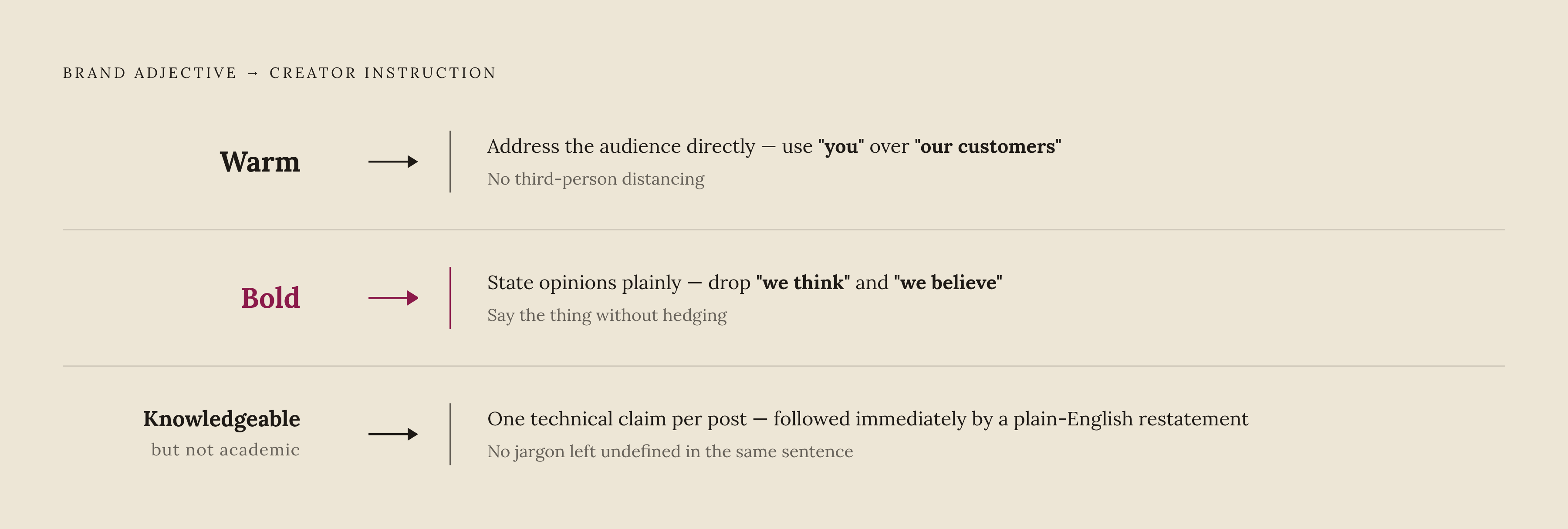
Take "warm." Alone, it's vague. Turned into instruction, it becomes something like: address the audience directly, use "you" more often than "our customers," skip the third-person distancing that creeps into corporate copy. Take "bold." Instruction: state opinions without hedging, drop "we think" and "we believe" from the vocabulary entirely, say the thing plainly. Take "knowledgeable but not academic," probably the hardest one to operationalize: one technical claim per post, followed immediately by a plain-English restatement of it, no jargon left undefined in the same sentence it appears in.
Vocabulary standards work best as a literal table inside the brief. Three columns: what the brand says, what it doesn't say, why. That third column matters more than it should, honestly, because a rule without a reason invites a creator to quietly ignore it the first time it feels inconvenient.
Annotated examples remain the single highest-leverage tool here. Pull two pieces of real published content, one that nails the voice and one that misses, mark up specifically what works and what doesn't line by line, and put both directly in the brief. Showing the pattern this way carries more weight than describing it from a distance, since watching an example performed teaches it faster than reading a description of it.
Tone variation deserves its own moment. The same brand voice should sound different responding to a story reply than it does narrating a product demo; the traits underneath hold steady, but the register shifts, and the brief should show that shift rather than leaving the creator to guess where the line sits.
Disclosure language is a voice question as much as a legal one. Creators who write their own disclosure language in their own cadence tend to perform better than creators pasting in a standard legal string lifted straight from a terms-of-service page, because audiences can tell the difference between a sentence someone meant and a sentence someone was told to paste. The brief should specify exactly what the disclosure needs to legally include, then explicitly leave the phrasing to the creator.
One thing a brief should never do: hand over a fully scripted line and add "feel free to make this your own!" on top of it. That framing contradicts itself inside a single sentence, and it tells the creator, more clearly than anything else in the document could, that the brand doesn't actually trust the person it just hired.
Embedding voice guidelines inside the brief's structure: placement, format, and handoff
A complete brief runs through several core elements, typically covering areas like brand overview, campaign goals, deliverables, key messages, what to avoid, disclosure, and usage rights. Voice belongs in the first of those, the brand overview, and gets reinforced again in the "what to avoid" section further down.
Placement carries real weight here. Voice guidelines buried in an appendix get skimmed at best, ignored at worst. Put that same section at the front, ahead of campaign goals, and it reframes everything that follows: the creator reads the deliverables list already knowing whose voice they're speaking in, rather than bolting that understanding on after the fact.
Format matters just as much as placement, and a static PDF is an increasingly awkward fit for how creators actually consume information day to day. Briefs that link out to audio samples, video references, or previously published content give the voice section texture a wall of text can't replicate, and the whole document should be scannable enough that a creator mid-production can find the voice section again in under thirty seconds, rather than losing five minutes to scrolling through a deck half-read three days ago.
Review and approval is where all of this either gets enforced or quietly forgotten. Best practice separates a dedicated voice check from the compliance and factual accuracy check, because tone and brand fit need a different set of eyes than a fact-checker's. For always-on partnerships, a standing voice reference shared once at onboarding cuts down on per-campaign re-briefing and keeps drift in check across a longer relationship, instead of re-litigating the same "warm and authentic" conversation every single time.
There's a production layer to this too, alongside the documentation one. Content platforms that pair editorial frameworks with AI-assisted drafting let marketing teams turn out consistent, on-brand briefs at a pace that doesn't depend on agency turnaround, keeping the voice standard owned in-house rather than outsourced to whoever's available that week.
The real measure of a voice section that's working shows up downstream: fewer revision rounds, less back-and-forth in approval, and creator content that sounds like the brand picked that person because the fit was genuine, with enough room in the brief for that person's own voice to come through anyway.